
Common Cuckoo vs Common Swift
Cuculus canorus versus Apus apus
Play a quiz with Common Cuckoo and Common Swift
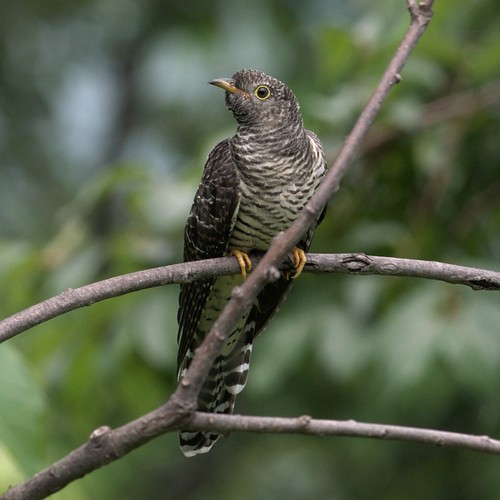 Common Cuckoo
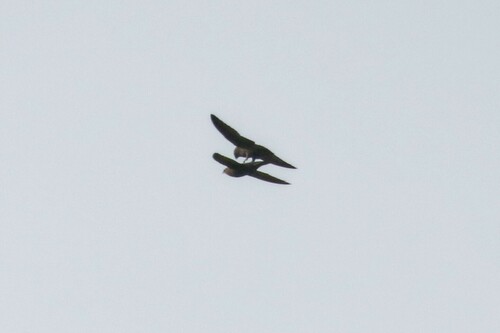 Common Swift
In short
The most reliable field mark for separating Common Cuckoo and Common Swift is their structure and flight style: cuckoos are slender, long-tailed birds with broad, rounded wings and a hawk-like jizz, while swifts are compact, sickle-winged, and almost always seen in fast, acrobatic flight. Juvenile cuckoos can be confused with swifts at a distance due to their dark plumage and white markings, but the cuckoo's white nape patch and barred underparts are distinctive. Swifts are uniformly dark with a small pale throat patch, never barred, and never perch openly like cuckoos. If you see a bird perched on a wire or branch, it is a cuckoo; swifts virtually never perch in the open. Voice, tail shape, and wing posture in flight are also key clues.
Identification tips
- Perched vs. flying: If the bird is perched in the open on a wire or branch, it is a Common Cuckoo. Swifts almost never perch visibly except at the nest.
- Flight style: Cuckoo flies with regular, deep wingbeats and a straight, hawk-like path; swift is fast, agile, and erratic, with rapid flickering wingbeats and gliding on crescent-shaped wings.
- Wing shape: Cuckoo's wings are broad and rounded; swift's wings are long, narrow, and swept back like a boomerang or sickle.
- Tail shape: Cuckoo has a long, straight or slightly rounded tail, often held raised when perched; swift has a short, deeply forked tail, usually closed in flight.
- Juvenile cuckoo marks: Look for a white nape patch, white feather fringes, and strong barring on underparts and upperwing coverts in juvenile cuckoos. Swifts never show these features at any age.
- Adult plumage: Adult cuckoos are slate-grey above with a sharply defined grey throat and barred underparts. Swifts are uniform blackish-brown with a small pale throat patch (not visible at distance), and never barred.
- Rufous morph confusion: Rufous morph cuckoos (mainly juveniles, rarely adult females) are reddish-brown with dark barring; swifts never show rufous or barred plumage.
- Size: Cuckoo is much larger and heavier, with a longer body and tail. Swifts are compact and light.
- Bill: Cuckoo has a slender, slightly downcurved bill; swift has a very short, broad bill, often hard to see in the field.
- Legs: Cuckoo has short but visible legs when perched; swift's legs are extremely short and rarely seen, as they do not perch openly.
- Group behavior: Swifts are usually in flocks, especially when calling or feeding; cuckoos are solitary.
- Voice: Cuckoo gives a two-note 'cuckoo' call or female bubbling; swift gives a high-pitched scream, often in groups.
- Habitat context: Cuckoo is often seen in open woodland, farmland, or reedbeds; swift is seen high over towns, lakes, and open countryside.
- Seasonal timing: Both are summer migrants, but swifts arrive slightly later in northern Europe and are present in large numbers over urban areas.
- Potential pitfalls: At a distance, a juvenile cuckoo in flight can look superficially like a swift due to dark plumage, but the cuckoo's size, barred underparts, and white nape patch are diagnostic. Swifts never show barring or white nape.
Size
Common Cuckoo is much larger and heavier than Common Swift. Cuckoo measures 32–34 cm in length with a wingspan of 55–60 cm and a body mass around 111.5 g [wikidata]. In contrast, Common Swift is 16–17 cm long with a wingspan of 38–40 cm and is much lighter (mass not specified, but always much less than cuckoo). The cuckoo's long tail and overall length are especially obvious when perched or seen well in flight, while the swift is compact with a short, deeply forked tail.
Plumage
Juvenile Common Cuckoos are variable but often show strongly barred chestnut-brown or plain grey upperparts, with distinctive white nape patch and white feather fringes. Their underparts are always barred and the upperwing coverts and primaries have whitish edges, with chestnut bars or spots on the secondaries and greater coverts. These features are present in first-autumn birds and may persist into spring. Adult cuckoos (male and grey female) are slate-grey above with a sharply demarcated grey throat and barred underparts; rufous morph females and juveniles are reddish-brown with dark barring. Swifts, by contrast, are entirely blackish-brown with a small white or pale grey throat patch (not visible at distance), and never show barring, white nape, or rufous tones. Swifts do not show any plumage variation by age that would mimic a cuckoo's barred or rufous pattern.
Behaviour
Cuckoos often perch openly on wires, posts, or branches, sometimes with drooped wings and raised tail, and are usually solitary. Their flight is direct, with regular wingbeats and a hawk-like appearance. Swifts are almost never seen perched in the open; they spend nearly all their time in the air, flying fast with rapid, flickering wingbeats and sweeping, crescent-shaped wings. Swifts are highly gregarious, often seen in screaming flocks, and their flight is much more agile and erratic than the cuckoo's.
Habitat
Both species are widespread summer migrants in Europe, but cuckoos are more often found in open woodland, farmland, and edges of reedbeds, especially where host species are present. They are usually seen perched or flying low over fields and woods. Swifts are urban and rural aerial specialists, most often seen high in the sky over towns, lakes, and open country, rarely landing except at nests. If you see a bird flying high overhead in a group, it is almost certainly a swift; a solitary bird perched or flying low is more likely a cuckoo.
Voice
The Common Cuckoo's song is the classic 'goo-ko' call, given from an open perch, usually in repeated groups with 1–1.5 second intervals. Females give a loud bubbling call. Swifts, on the other hand, never 'sing' but produce a loud, piercing scream, often in groups, with two pitch levels (higher in females). If you hear a 'cuckoo' call, it is diagnostic for the cuckoo; a screaming flock is always swift.