
Common Chaffinch vs Brambling
Fringilla coelebs versus Fringilla montifringilla
Play a quiz with Common Chaffinch and Brambling
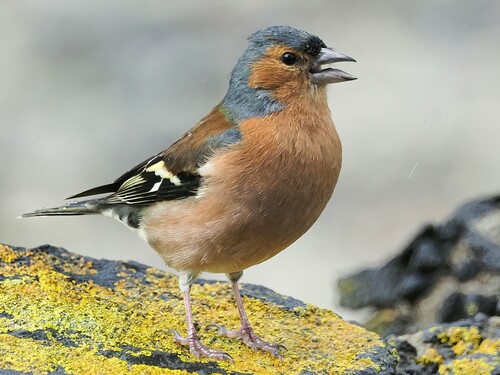 Common Chaffinch
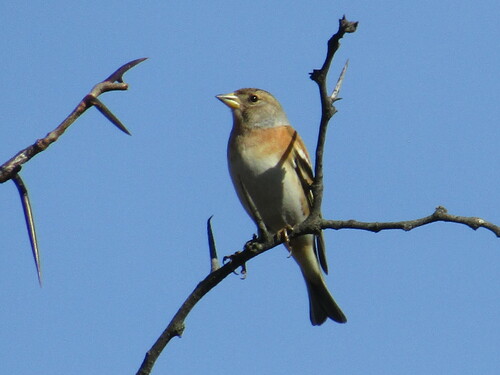 Brambling
In short
The most reliable field mark between Common Chaffinch and Brambling is the rump color: Brambling always shows a white rump in all plumages, while Chaffinch has a dull olive or grey-green rump. In flight, this difference is often obvious. For perched birds, note that Brambling has an orange breast sharply contrasting with a white belly and dark-spotted flanks, while Chaffinch’s underparts are more uniformly pinkish or buff. Chaffinch also shows white outer tail feathers, lacking in Brambling. Bill color can help: Brambling has a yellow bill outside of breeding males (which have a black bill), while Chaffinch’s bill is dull pinkish or bluish-grey depending on season. Both species are similar in size and shape, so focus on plumage and rump/tail pattern for a confident separation.
Identification tips
- Rump color in flight: Look for a white rump on Brambling (all ages/sexes) versus a dull olive or grey-green rump on Chaffinch. This is the most reliable mark in flight or when the bird flicks its tail.
- Tail pattern: Chaffinch always shows white outer tail feathers, visible when perched or flying. Brambling’s tail is uniformly dark, lacking white outer feathers.
- Breast and belly contrast: Brambling has a bright orange breast with a sharply defined white belly and dark-spotted flanks. Chaffinch’s underparts are more evenly pinkish or buff, with plain flanks.
- Bill color: Outside of breeding males, Brambling’s bill is yellow; in breeding males, it turns black. Chaffinch’s bill is dull pinkish in winter and bluish-grey in spring. Bill color can be useful at close range, but beware of seasonal changes.
- Scapular and upperpart color: Brambling shows orange scapulars, especially in males, while Chaffinch’s scapulars are grey or grey-brown.
- Head pattern in males: Breeding male Brambling has a black head and dark upperparts, while male Chaffinch has a blue-grey cap and nape, never black.
- Wing bars: Both species have two pale wing bars, but Chaffinch’s are often broader and more contrasting, especially in males. This is a supporting mark, not primary.
- Flank markings: Brambling has dark spots on the flanks; Chaffinch’s flanks are plain.
- Underpart color in females/juveniles: Female and juvenile Brambling can look like female Chaffinch, but the white rump and orange breast (even if dull) are clues. Chaffinch females/juveniles are more uniformly grey-brown above and pale below.
- Tail flicking: Both species may flick their tails, but use this to catch a glimpse of the rump and tail pattern.
- Flock composition: Large winter flocks are more likely to contain Brambling, especially outside the breeding season. Chaffinch is more often seen in smaller groups or pairs.
- Bill shape: Both have stout, conical bills typical of finches; shape is not a reliable separator.
- Voice: Not covered in the provided notes; do not rely on calls for separation here.
- Habitat and context: Both use similar habitats; presence in a large, mixed winter flock may hint at Brambling, but is not diagnostic.
- Seasonal context: Brambling is migratory and more likely in winter or migration periods; Chaffinch is resident in many areas, so out-of-season Bramblings are rare.
Size
Both species are nearly identical in size and structure, with an average body mass of 22g [wikidata]. Their overall proportions, including wingspan and body length, are very similar, so size is not a reliable field mark for separation.
Plumage
Juvenile and female Brambling can closely resemble female or young Chaffinch, but several key differences persist across ages:
- Rump color: Brambling of all ages and sexes has a white rump, while Chaffinch’s rump is dull olive-green or grey-green.
- Tail pattern: Chaffinch always shows white outer tail feathers (visible both perched and in flight), while Brambling lacks these, having a more uniformly dark tail.
- Breast and belly: Brambling has a bright orange breast with a sharp contrast to a white belly, and dark-spotted flanks. Chaffinch’s underparts are more evenly colored pinkish or buff, and the flanks are plain.
- Wing bars: Both species have two pale wing bars, but Chaffinch’s are often brighter and more contrasting, especially in males.
- Bill color: Brambling’s bill is yellow in most plumages, turning black in breeding males; Chaffinch’s bill is dull pinkish in winter, bluish-grey in spring.
- Male breeding plumage: Male Brambling is striking with a black head and orange scapulars; male Chaffinch has a blue-grey cap and rust-red underparts, lacking the black head and orange scapulars.
Behaviour
Both species are seed-eating finches with similar feeding and flight behavior. Brambling is noted for forming large migratory flocks, especially in winter, while Chaffinch is more often seen in pairs or small groups. In mixed flocks, Bramblings may be more restless and mobile, but this is not a strong field mark.
Habitat
Both species use similar habitats, including woodlands, parks, and gardens. Brambling is more migratory and may appear in large flocks during passage or winter, sometimes in open fields. Chaffinch is widespread and resident in much of its range, often more common in settled areas. Habitat alone is not diagnostic.