
Common Buzzard vs Long-legged Buzzard
Buteo buteo versus Buteo rufinus
Play a quiz with Common Buzzard and Long-legged Buzzard
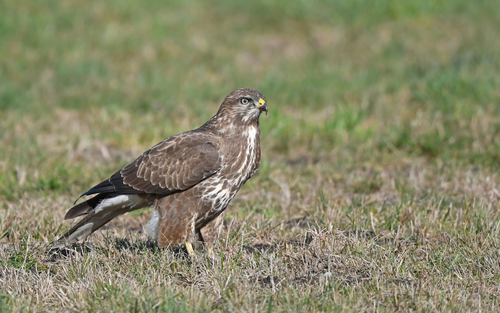 Common Buzzard
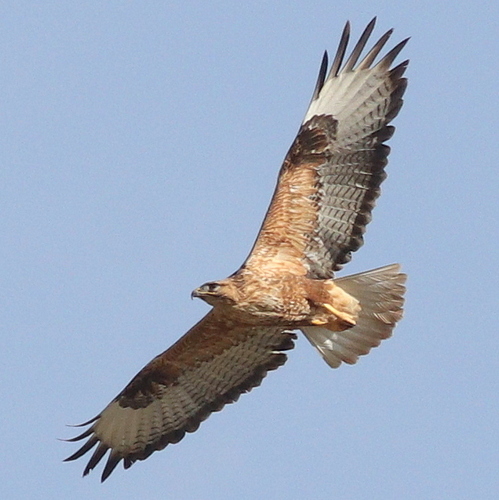 Long-legged Buzzard
In short
The most reliable field separation between Common Buzzard and Long-legged Buzzard is structural: Long-legged Buzzard is noticeably larger and longer-winged, with a longer tail and legs, and often shows a paler, more contrasting head and underparts—especially in pale morphs—compared to the more compact, variable Common Buzzard. Juvenile plumage can be confusing, but Long-legged Buzzard juveniles typically have paler heads and more streaked breasts, while Common Buzzard juveniles are more uniformly marked. In flight, Long-legged Buzzard appears bulkier and more eagle-like, with straighter wing edges and a longer, rounder tail, whereas Common Buzzard is shorter-tailed and more compact, with slightly upturned wings. Perched, Long-legged Buzzard often sits upright in open, prominent spots, while Common Buzzard is more versatile in posture and perch choice. Both are variable in plumage, so structure and flight silhouette are key.
Identification tips
- Juvenile head and breast: Juvenile Long-legged Buzzards show a pale, creamy or sandy head with a streaked breast, while juvenile Common Buzzards are more uniformly brown and lack a distinctly pale head. This is a key field mark in autumn and winter.
- Tail pattern in juveniles: Juvenile Long-legged Buzzard tails are pale with faint, irregular brown bars, darkening towards the tip, while Common Buzzard juveniles have more evenly marked, less contrasting tails.
- Adult pale morphs: Adult Long-legged Buzzard pale morphs have a plain pale head, sandy mantle, and rufous-orange tail with a contrasting darker belly and flanks. Common Buzzard pale morphs rarely show such a clean pale head/dark belly contrast.
- Dark morphs: Dark morph Long-legged Buzzards are all blackish-brown with a greyish tail and broad subterminal band, sometimes with faint bars. Dark Common Buzzards are more uniformly dark and lack the same tail pattern.
- Flight silhouette: Long-legged Buzzard is larger, with longer, broader wings that are straighter-edged and a longer, rounder tail. Common Buzzard is more compact, with shorter wings that are often slightly upturned and a shorter tail. This is most obvious in direct comparison or with experience.
- Perched posture: Long-legged Buzzard often perches very upright and openly on prominent rocks, crags, or pylons, sometimes standing or waddling on the ground. Common Buzzard is more versatile in posture and perch choice, less likely to stand on the ground for long.
- Leg length: Long-legged Buzzard has noticeably longer legs, which can be seen when perched or standing, giving it a more elongated look compared to the shorter-legged Common Buzzard.
- Bill size: Long-legged Buzzard has a relatively large bill on a smallish head, which can be a subtle but useful mark at close range.
- Eye color (age): Juvenile Long-legged Buzzards have pale grey to greyish-yellow eyes, turning light brown with age, while adults have very dark brown eyes. This is subtle and only useful at close range.
- Upperpart contrast: Long-legged Buzzard (especially pale morphs) shows a sandy-buff mantle and wing coverts with dark feather centers, creating a contrasting effect. Common Buzzard is more uniformly brown above.
- Flight jizz: Long-legged Buzzard appears bulkier and more eagle-like in flight, with a protruding head and heavy bill, while Common Buzzard is more compact and less protruding.
- Habitat context: In open, arid, or rocky areas, especially in southeastern Europe, North Africa, or Central Asia, Long-legged Buzzard is more likely. In woodland or mixed farmland, Common Buzzard is more likely, especially in western and northern Europe.
- Behavior on ground: Long-legged Buzzard is more likely to be seen walking or standing on the ground, often with a waddling gait. Common Buzzard does this less frequently.
- Plumage variability: Both species are highly variable, so do not rely solely on color; use structure and flight silhouette as primary cues.
- Direct comparison: If both species are present, Long-legged Buzzard will stand out as larger, longer-legged, and longer-tailed, with a paler head and more open, upright posture.
Size
Long-legged Buzzard is one of the largest Buteos, clearly bulkier and longer-winged than Common Buzzard. The only available mass figure is for Common Buzzard (878 g), but field guides and descriptions consistently note Long-legged Buzzard's greater size, longer legs, and longer tail. In direct comparison, Long-legged Buzzard appears more eagle-like and rangier, while Common Buzzard is more compact and medium-sized. This difference is most obvious when both species are seen together or with familiar raptors for scale.
Plumage
Juvenile Long-legged Buzzards (all morphs) have a paler, often creamy or sandy head with a more streaked breast and paler edging to upperparts, especially on the greater and median coverts. Their tails are pale with faint, irregular brown bars, darkening outward, and the overall impression is of a paler, more contrasting bird. Juvenile Common Buzzards are highly variable but tend to be more uniformly brown, with less contrast between head and body, and lack the distinctly pale head of Long-legged. Adults of both species are variable, but Long-legged Buzzard pale morphs show a plain pale head, sandy mantle, and rufous-orange tail, with a contrasting darker belly and flanks. Common Buzzard adults can be dark or pale but rarely show the same pale head/dark belly contrast. Dark morph Long-legged Buzzards are all blackish-brown with some whitish nape streaks and a greyish tail with a broad subterminal band, while dark Common Buzzards are more uniformly dark without the same tail pattern. In flight, Long-legged Buzzard shows straighter wing edges and a longer, rounder tail, while Common Buzzard's wings are shorter and more upturned, with a shorter tail. Both species are polymorphic, but Long-legged tends to be cleaner and more contrasting, especially in pale morphs.
Behaviour
Long-legged Buzzard is often sluggish and perches very openly and upright on prominent rocks, crags, or artificial structures, sometimes standing or waddling on the ground. Common Buzzard is more versatile, perching in a wider range of habitats and postures, and is less likely to be seen standing on the ground for extended periods. In flight, Long-legged Buzzard is bulkier and more eagle-like, with a steady, powerful flight, while Common Buzzard is more compact and can soar with slightly upturned wings, appearing less massive.
Habitat
Both species overlap in parts of southeastern Europe and western Asia, but Common Buzzard is widespread across most of Europe and into the Palearctic, while Long-legged Buzzard is more southern and eastern, ranging from southeastern Europe to North Africa, the Middle East, and Central Asia. Long-legged Buzzard prefers open, arid, or rocky habitats and is often seen in more open country, while Common Buzzard is more adaptable, found in woodlands, farmland, and mixed habitats.