
Collared Dove vs Common Cuckoo
Streptopelia decaocto versus Cuculus canorus
Play a quiz with Collared Dove and Common Cuckoo
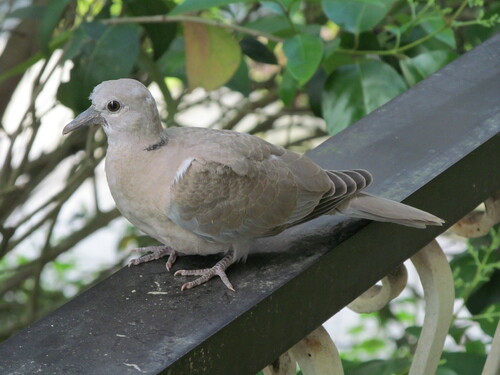 Collared Dove
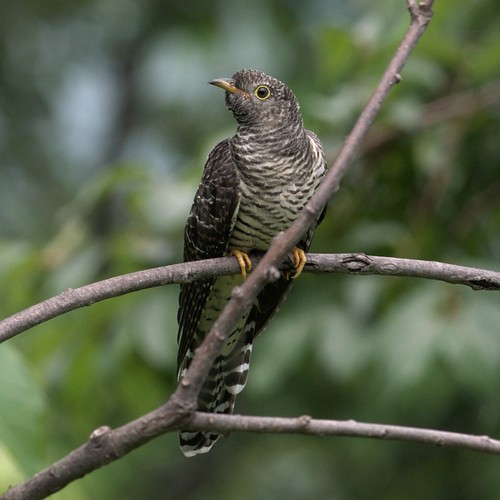 Common Cuckoo
In short
The most reliable field mark to separate Collared Dove from Common Cuckoo is the dove's distinctive black half-collar on the nape, which is never present on cuckoos of any age. Juvenile cuckoos, however, can be especially confusing in flight due to their barred underparts and variable brown or grey upperparts, but they always lack the dove's clean, pale look and collar. Structurally, Collared Doves are stockier with a shorter tail and a more uniform, soft coloration, while cuckoos are slimmer, longer-tailed, and often show a sharp contrast between their slate-grey upperparts and strongly barred underparts. In flight, cuckoos recall a small raptor with pointed wings and a long tail, whereas Collared Doves fly with fast, clipped wingbeats and a more direct, pigeon-like jizz.
Identification tips
- Black half-collar on nape (Collared Dove): Present in all but juvenile doves (where it is faint); never present on cuckoo of any age.
- Barred underparts (Cuckoo): All cuckoos, especially juveniles and females, show strong barring below; Collared Doves are uniformly pale below.
- White nape patch and white feather fringes (juvenile Cuckoo): Juvenile cuckoos show a white nape patch and white edges to wing feathers, absent in doves.
- Overall shape: Collared Dove is stocky, broad-bodied, with a short, square-tipped tail; cuckoo is slim, long-tailed, and falcon-like.
- Flight style: Collared Dove flies directly with fast, clipped wingbeats, rarely gliding except in display; cuckoo has a more buoyant, raptor-like flight with regular wingbeats and glides.
- Tail: Cuckoo's tail is long, graduated, and often shows white tips; dove's tail is shorter, broad, and square-tipped with white edges.
- Bill: Dove has a short, black bill; cuckoo's bill is longer, slightly downcurved, and yellow at the base.
- Eye and bare skin: Dove's iris is red (appears dark at distance), with a narrow reddish-brown rim and a small area of bare white or yellow skin; cuckoo's iris, orbital ring, and base of bill are yellow.
- Leg color: Dove has red legs; cuckoo's legs are yellow.
- Plumage texture: Dove is smooth, soft, and unbarred; cuckoo is sharper, with strong barring and sometimes rufous tones.
- Sex differences: Collared Dove sexes are identical; cuckoo females may be rufous or grey, with rufous morphs especially in juveniles.
- Habitat context: Doves are almost always near human habitation; cuckoos are in open country, woodland edge, or wetlands.
- Vocalization: Dove's cooing is rhythmic and repetitive; cuckoo's call is a clear, two-note 'cuck-oo' (male) or bubbling (female).
- Seasonality: Cuckoo is a summer migrant, absent in winter; Collared Dove is resident year-round.
- Display flight: Dove's display is a steep climb and glide with wings in an inverted 'V'; cuckoo does not display in this way.
Size
Collared Dove is significantly heavier (average 193 g vs 111.5 g for cuckoo) and appears bulkier in the field. Both species are similar in length (32–34 cm), but the cuckoo has a longer wingspan (55–60 cm vs 47–55 cm for the dove) and a proportionally longer tail, giving it a more elongated, slender look. The dove's body is more robust and rounded, while the cuckoo is noticeably slimmer and lighter-built.
Plumage
Juvenile Common Cuckoos are highly variable: some are chestnut-brown with strong barring above and below, others are plainer grey, but all show white feather fringes and a white nape patch, which can be a useful mark at close range. In flight, cuckoos (of all ages) show a sharp demarcation between the grey throat and barred underparts, and the tail is long and graduated with white tips. Adult Collared Doves are uniform grey-buff to pinkish-grey, with a clear black half-collar edged white on the nape (juveniles have a poorly developed collar). Their underwings are blue-grey, and the tail is broad with white tips on the outer feathers. The dove's plumage is soft and unbarred, lacking any strong contrast or barring. Cuckoo females can be rufous (especially juveniles), showing rufous upperparts with dark bars, but even then, the overall impression is of a slim, barred bird, unlike the smooth, pale dove.
Behaviour
Collared Doves are often seen perched on wires, rooftops, or in trees near human habitation, and their flight is direct and fast, with clipped wingbeats and little gliding except in display. Cuckoos perch more openly during the breeding season, often with drooped wings and a raised tail, and their flight is reminiscent of a small falcon or sparrowhawk, with regular wingbeats and a long, pointed tail. Cuckoos are usually solitary and secretive outside of singing males, while doves are more likely to be seen in pairs or small groups.
Habitat
Collared Doves are strongly associated with human environments: suburbs, villages, farms, and anywhere with trees and buildings for nesting. They are rarely found far from habitation. Common Cuckoos are much less tied to people, favoring open countryside, woodland edges, heathland, and wetlands—anywhere their host species breed. Seeing a dove in a remote, open landscape is unusual, while cuckoos are rarely seen in dense urban areas.
Voice
Collared Dove gives a familiar, rhythmic cooing, often rendered as 'coo-COO-coo', repeated persistently from a perch. Common Cuckoo males give the classic 'cuck-oo' call, usually from an open perch, with a clear two-note phrase repeated in bursts. Females have a loud bubbling call. The two species' voices are entirely different and diagnostic when heard.