

Motmot

Cockatiel vs Budgerigar

Nymphicus hollandicus versus Melopsittacus undulatus

Play a quiz with Cockatiel and Budgerigar
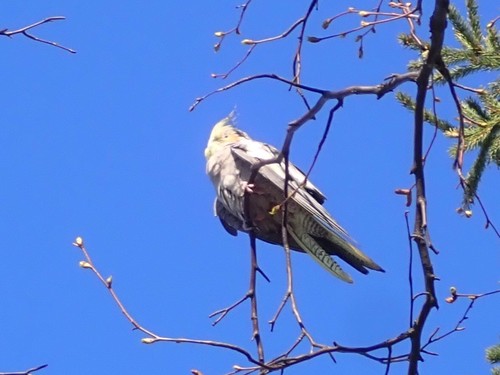
Cockatiel (Nymphicus hollandicus) Cockatiel
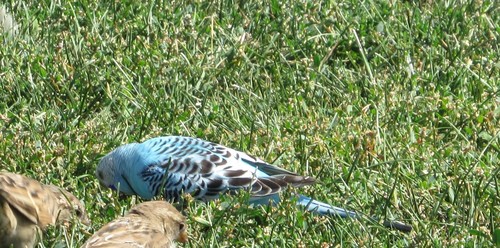
Budgerigar (Melopsittacus undulatus) Budgerigar

Media

Loading…

In short

The most reliable field mark between Cockatiel and Budgerigar is overall structure: Cockatiels are much larger, with a long, pointed tail and a prominent, expressive crest, while Budgerigars are smaller, lack a crest, and have a shorter tail. Juvenile Cockatiels show yellow barring and spots on the underside of the tail and wings, which are absent in Budgerigars; meanwhile, young Budgerigars have blackish stripes down the forehead to the cere, a feature lost in adults. Both species come in a wide variety of captive color mutations, but wild-type Cockatiels are grey with a yellow face and orange cheek patch, while wild Budgerigars are green and yellow with black scalloped markings and blue-violet cheek patches. In flight or at rest, the Cockatiel’s size and long tail are immediately apparent, whereas Budgerigars are noticeably smaller and more compact.

Identification tips

  1. Crest: Only Cockatiels have a prominent, expressive head crest; Budgerigars lack any true crest, though some captive mutations may show small tufts. The crest is visible at all ages and is a key field mark.
  2. Tail length and shape: Cockatiels have a long, pointed tail that extends well beyond the body, especially noticeable in flight or perched. Budgerigars have a shorter, more squared or slightly pointed tail.
  3. Size: Cockatiels are much larger and heavier (86g vs. 30–40g for Budgerigar). This is evident even at a distance or in mixed groups.
  4. Juvenile wing/tail pattern (Cockatiel): Juvenile Cockatiels (both sexes) show yellow barring on the underside of the tail and yellow spots on the ventral flight feathers. Adult males lose these after their first molt, but females and immatures retain them. Budgerigars never show this pattern.
  5. Juvenile head pattern (Budgerigar): Young Budgerigars have blackish stripes running from the crown down to the cere, lost by 3–4 months as the forehead and face become yellow. Cockatiels never show this striping.
  6. Cheek patch: Cockatiels have a large, round orange cheek patch (brighter in males, duller in females and immatures) on a yellow (male) or grey (female/immature) face. Budgerigars have small, blue-violet cheek patches and black throat spots, never orange.
  7. Body color (wild type): Wild Cockatiels are grey with yellow face (male) or grey face (female), orange cheek patch, and white flashes on the wings. Wild Budgerigars are green and yellow with black scalloped markings on the back and wings, blue-violet cheek patches, and a cobalt tail with yellow flashes.
  8. Color mutations: Both species are bred in many colors (e.g., lutino, pied, albino), but only Cockatiels have a true crest and orange cheek patch in most forms. Budgerigars may be blue, white, or pied but lack the Cockatiel’s facial pattern and crest.
  9. Sexual dimorphism: In Cockatiels, adult males have a bright yellow face and crest with a vivid orange cheek patch, while females and juveniles have a greyish face and less vibrant cheek. In Budgerigars, sex is best told by cere color: adult males have a blue cere, females have a brownish or white cere (breeding females brown), and immatures of both sexes have a pinkish cere.
  10. Head shape: Cockatiels have a more elongated head profile due to the crest; Budgerigars have a rounded head.
  11. Flight silhouette: Cockatiels in flight show a long, pointed tail and a larger, slower wingbeat; Budgerigars are compact, with rapid, fluttery flight and a shorter tail.
  12. Behavior: Budgerigars are more restless, often in large, noisy flocks; Cockatiels are calmer, often seen in pairs or small groups.
  13. Perching posture: Cockatiels often perch upright with the tail angled downward and crest raised or lowered; Budgerigars perch more horizontally, with the body parallel to the perch.
  14. Chewing behavior: Budgerigars, especially females, are more likely to be seen actively chewing on wood or other materials.
  15. Habitat context: In the wild, large flocks of small, green-and-yellow birds are likely Budgerigars; smaller groups or pairs of larger, grey birds with long tails and crests are Cockatiels.

Size

Cockatiel is substantially larger, with an average body mass of 86g [wikidata], compared to the much lighter Budgerigar (wild birds average 30–40g [wikipedia]). Cockatiels have a proportionally much longer, pointed tail and a larger, more robust body, while Budgerigars are small, slim, and have a shorter tail. The size difference is obvious even at a distance, especially in mixed aviaries or wild flocks. English (show) Budgerigars are larger than wild-type Budgerigars but still much smaller and more compact than Cockatiels.

Plumage

Juvenile Cockatiels (both sexes) show horizontal yellow stripes or bars on the underside of the tail and yellow spots on the ventral surface of the primary flight feathers; these marks are lost in adult males after their first molt, but retained by females and immature birds. Juvenile Budgerigars, in contrast, have blackish stripes running down the forehead to the cere, which disappear by 3–4 months of age as adults develop a clean yellow forehead and face. Wild-type Cockatiels are grey-bodied with a yellow face (male) or greyish face (female), and a bright orange cheek patch; wild Budgerigars are green and yellow with black scalloped mantle and wing markings, blue-violet cheek patches, and a cobalt tail with yellow flashes visible in flight. Both species are bred in a wide range of color mutations, including pied, lutino, albino, and crested forms, but only Cockatiels have a true head crest. Budgerigars may have small crests in some mutations, but these are not as prominent or expressive as the Cockatiel’s. The Cockatiel’s orange cheek patch is unique and diagnostic in wild-type and most captive forms.

Behaviour

Cockatiels are generally more sedate and may perch quietly for long periods, often raising and lowering their crest in response to stimuli. They are sociable and playful but less frenetic than Budgerigars. Budgerigars are highly active, social, and constantly moving, often seen in large flocks in the wild. Both species are inquisitive and interact with humans in captivity, but Budgerigars are more likely to be seen chewing on materials and perching as high as possible when alarmed. Cockatiels’ crest movements provide a visible cue to their mood, which Budgerigars lack.

Habitat

Both species are native to Australia and can be found in open habitats, but Cockatiels tend to prefer more open country and are often seen in small flocks or pairs, while Budgerigars form large, noisy flocks and are more likely to be seen in grasslands and lightly wooded areas. In captivity, both are common as pets worldwide, with Budgerigars being more frequently encountered in pet stores.

Voice

Both species are capable of mimicking sounds and whistles, but the notes do not provide specific field marks for separating their calls or songs. Cockatiels are generally quieter and have a whistled, melodic call, while Budgerigars are more incessantly chattery and can be quite noisy, especially in flocks. Both can learn to mimic human speech, but this is not a useful field mark.

Submit a better description

Use the same sections as the comparison. Your text is published immediately.

The most reliable field mark between Cockatiel and Budgerigar is overall structure: Cockatiels are much larger, with a long, pointed tail and a prominent, expressive crest, while Budgerigars are smaller, lack a crest, and have a shorter tail. Juvenile Cockatiels show yellow barring and spots on the underside of the tail and wings, which are absent in Budgerigars; meanwhile, young Budgerigars have blackish stripes down the forehead to the cere, a feature lost in adults. Both species come in a wide variety of captive color mutations, but wild-type Cockatiels are grey with a yellow face and orange cheek patch, while wild Budgerigars are green and yellow with black scalloped markings and blue-violet cheek patches. In flight or at rest, the Cockatiel’s size and long tail are immediately apparent, whereas Budgerigars are noticeably smaller and more compact.

  1. Crest: Only Cockatiels have a prominent, expressive head crest; Budgerigars lack any true crest, though some captive mutations may show small tufts. The crest is visible at all ages and is a key field mark.
  2. Tail length and shape: Cockatiels have a long, pointed tail that extends well beyond the body, especially noticeable in flight or perched. Budgerigars have a shorter, more squared or slightly pointed tail.
  3. Size: Cockatiels are much larger and heavier (86g vs. 30–40g for Budgerigar). This is evident even at a distance or in mixed groups.
  4. Juvenile wing/tail pattern (Cockatiel): Juvenile Cockatiels (both sexes) show yellow barring on the underside of the tail and yellow spots on the ventral flight feathers. Adult males lose these after their first molt, but females and immatures retain them. Budgerigars never show this pattern.
  5. Juvenile head pattern (Budgerigar): Young Budgerigars have blackish stripes running from the crown down to the cere, lost by 3–4 months as the forehead and face become yellow. Cockatiels never show this striping.
  6. Cheek patch: Cockatiels have a large, round orange cheek patch (brighter in males, duller in females and immatures) on a yellow (male) or grey (female/immature) face. Budgerigars have small, blue-violet cheek patches and black throat spots, never orange.
  7. Body color (wild type): Wild Cockatiels are grey with yellow face (male) or grey face (female), orange cheek patch, and white flashes on the wings. Wild Budgerigars are green and yellow with black scalloped markings on the back and wings, blue-violet cheek patches, and a cobalt tail with yellow flashes.
  8. Color mutations: Both species are bred in many colors (e.g., lutino, pied, albino), but only Cockatiels have a true crest and orange cheek patch in most forms. Budgerigars may be blue, white, or pied but lack the Cockatiel’s facial pattern and crest.
  9. Sexual dimorphism: In Cockatiels, adult males have a bright yellow face and crest with a vivid orange cheek patch, while females and juveniles have a greyish face and less vibrant cheek. In Budgerigars, sex is best told by cere color: adult males have a blue cere, females have a brownish or white cere (breeding females brown), and immatures of both sexes have a pinkish cere.
  10. Head shape: Cockatiels have a more elongated head profile due to the crest; Budgerigars have a rounded head.
  11. Flight silhouette: Cockatiels in flight show a long, pointed tail and a larger, slower wingbeat; Budgerigars are compact, with rapid, fluttery flight and a shorter tail.
  12. Behavior: Budgerigars are more restless, often in large, noisy flocks; Cockatiels are calmer, often seen in pairs or small groups.
  13. Perching posture: Cockatiels often perch upright with the tail angled downward and crest raised or lowered; Budgerigars perch more horizontally, with the body parallel to the perch.
  14. Chewing behavior: Budgerigars, especially females, are more likely to be seen actively chewing on wood or other materials.
  15. Habitat context: In the wild, large flocks of small, green-and-yellow birds are likely Budgerigars; smaller groups or pairs of larger, grey birds with long tails and crests are Cockatiels.

Cockatiel is substantially larger, with an average body mass of 86g [wikidata], compared to the much lighter Budgerigar (wild birds average 30–40g [wikipedia]). Cockatiels have a proportionally much longer, pointed tail and a larger, more robust body, while Budgerigars are small, slim, and have a shorter tail. The size difference is obvious even at a distance, especially in mixed aviaries or wild flocks. English (show) Budgerigars are larger than wild-type Budgerigars but still much smaller and more compact than Cockatiels.

Juvenile Cockatiels (both sexes) show horizontal yellow stripes or bars on the underside of the tail and yellow spots on the ventral surface of the primary flight feathers; these marks are lost in adult males after their first molt, but retained by females and immature birds. Juvenile Budgerigars, in contrast, have blackish stripes running down the forehead to the cere, which disappear by 3–4 months of age as adults develop a clean yellow forehead and face. Wild-type Cockatiels are grey-bodied with a yellow face (male) or greyish face (female), and a bright orange cheek patch; wild Budgerigars are green and yellow with black scalloped mantle and wing markings, blue-violet cheek patches, and a cobalt tail with yellow flashes visible in flight. Both species are bred in a wide range of color mutations, including pied, lutino, albino, and crested forms, but only Cockatiels have a true head crest. Budgerigars may have small crests in some mutations, but these are not as prominent or expressive as the Cockatiel’s. The Cockatiel’s orange cheek patch is unique and diagnostic in wild-type and most captive forms.

Cockatiels are generally more sedate and may perch quietly for long periods, often raising and lowering their crest in response to stimuli. They are sociable and playful but less frenetic than Budgerigars. Budgerigars are highly active, social, and constantly moving, often seen in large flocks in the wild. Both species are inquisitive and interact with humans in captivity, but Budgerigars are more likely to be seen chewing on materials and perching as high as possible when alarmed. Cockatiels’ crest movements provide a visible cue to their mood, which Budgerigars lack.

Both species are native to Australia and can be found in open habitats, but Cockatiels tend to prefer more open country and are often seen in small flocks or pairs, while Budgerigars form large, noisy flocks and are more likely to be seen in grasslands and lightly wooded areas. In captivity, both are common as pets worldwide, with Budgerigars being more frequently encountered in pet stores.

Both species are capable of mimicking sounds and whistles, but the notes do not provide specific field marks for separating their calls or songs. Cockatiels are generally quieter and have a whistled, melodic call, while Budgerigars are more incessantly chattery and can be quite noisy, especially in flocks. Both can learn to mimic human speech, but this is not a useful field mark.

Discard your changes?

You have unsaved edits. If you leave now, those changes will be lost.

Cockatiel · Budgerigar · My Tricky Birds