
Coal Tit vs Willow Tit
Periparus ater versus Poecile montanus
Play a quiz with Coal Tit and Willow Tit
 Coal Tit
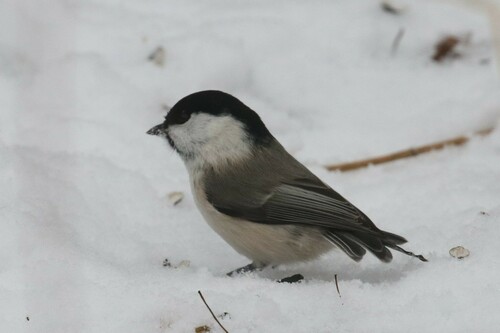 Willow Tit
In short
The most reliable field mark to separate Coal Tit from Willow Tit is the Coal Tit's bold white nape patch, which is always absent in Willow Tit. In addition, Coal Tit shows two clear white wingbars formed by the tips of the wing coverts, while Willow Tit has only a diffuse pale patch on the closed wing. Juvenile Coal Tits are duller but still show the nape spot, whereas Willow Tit juveniles resemble adults. Structurally, Coal Tit is daintier and more active, while Willow Tit is bulkier with a larger head. Voice and habitat can help, but plumage—especially the nape and wing pattern—remains the best field separation.
Identification tips
- White nape spot (all ages, all seasons): Coal Tit always shows a distinct white patch on the nape, even in juveniles (though tinged yellow in young birds). Willow Tit never shows a nape spot—this is the single most reliable mark.
- Wing pattern (all ages): Coal Tit has two crisp white wingbars formed by the tips of the wing coverts. Willow Tit lacks true wingbars, showing instead a diffuse pale patch on the closed wing from buff-edged secondaries.
- Cap color and gloss (adults): Coal Tit's crown and nape are glossy blue-black, contrasting with the white nape. Willow Tit's cap is dull, sooty black, extending onto the nape and mantle, never glossy.
- Face and cheek contrast: Both have white faces, but Coal Tit's white is brighter and more sharply defined, while Willow Tit's is off-white and can appear less crisp.
- Underparts and flanks: Coal Tit has whitish underparts with buff to rufous flanks. Willow Tit's underparts are more uniformly buff, with distinctly rufous flanks—this is subtle and best used in good light.
- Bill and head structure: Willow Tit has a proportionally larger head and a thin bill, giving a bull-necked look. Coal Tit appears daintier, with a smaller, finer bill.
- Size and jizz: Coal Tit is slightly smaller and more active, often flicking wings and tail. Willow Tit is bulkier, moves more slowly, and sits more upright.
- Habitat context: In dense coniferous woodland, especially upland, Coal Tit is much more likely. In damp, scrubby, or decaying deciduous woodland, especially with rotting stumps, Willow Tit is more probable.
- Behavior: Coal Tit is often in mixed-species flocks, especially with other tits. Willow Tit is more solitary or in pairs, especially outside the breeding season.
- Vocalizations: Coal Tit gives sharp, high-pitched 'see-see' calls and a rapid, high 'if-he' song. Willow Tit's calls are nasal 'zee, zee, zee' or 'ipsee, ipsee', less sharp and more drawn out. Use with caution, as calls are variable and can overlap.
- Juvenile plumage: Juvenile Coal Tits are duller but retain the nape spot and wingbars. Juvenile Willow Tits look like adults, lacking any nape spot and showing only the pale wing patch.
- Seasonal context: Both species are resident, but Willow Tit is much scarcer in some areas (e.g., UK) and declining. Coal Tit is widespread and common in suitable habitat.
- Pitfalls: Marsh Tit is very similar to Willow Tit—do not confuse the Willow Tit's single pale wing patch for Coal Tit's double wingbars. Always check for the nape spot and overall structure.
- Flight views: In flight, Coal Tit's white nape spot and wingbars can flash, while Willow Tit appears plainer above.
- When in doubt: If you see a tit with a white nape spot, it's a Coal Tit. If the nape is plain black and the bird is in damp, scrubby woodland, consider Willow Tit, but confirm with wing pattern and structure.
Size
Coal Tit is slightly smaller, measuring 10–11.5 cm in length, while Willow Tit is about 11.5 cm long with a wingspan of 17–20.5 cm and weighing around 11 g [wikipedia]. In the field, Coal Tit often appears more delicate and compact, whereas Willow Tit gives a bulkier impression with a proportionally larger head. The difference is subtle and not always reliable at a glance, especially without direct comparison.
Plumage
-
Juveniles: Juvenile Coal Tits lack the glossy black head of adults but retain a pale nape spot (though tinged yellow), and show two white wingbars. Juvenile Willow Tits look like adults, with a sooty black cap, no nape spot, and a single pale patch on the closed wing from buff-edged secondaries.
-
Adults: Adult Coal Tits have a glossy blue-black crown and nape with a large, bright white nape spot, off-white face, and two distinct white wingbars. Underparts are whitish with buff to rufous flanks. Willow Tit adults have a dull black cap extending onto the nape and mantle (never glossy, never with a white nape spot), white face, grey-brown back, and buff underparts with rufous flanks. The wing shows only a pale patch from buff-edged secondaries, not true wingbars.
-
In flight: Coal Tit's white nape spot and wingbars can be visible in flight, especially in good light. Willow Tit lacks these, appearing plainer and more uniform above.
Behaviour
Coal Tit is more active and agile, often flitting through conifers, hanging upside down, and joining mixed-species flocks. It frequently gives short, high-pitched contact calls. Willow Tit is less restless, moves more deliberately, and is often seen alone or in pairs, especially in winter. Willow Tit is also notable for excavating its own nest holes, a behavior not shared by Coal Tit.
Habitat
Coal Tit prefers coniferous and mixed forests, especially in upland or mountainous regions, but can also be found in gardens and parks with conifers. Willow Tit is more closely associated with damp, deciduous woodland, scrub, and areas with rotting stumps suitable for nest excavation. Overlap can occur, but Willow Tit avoids dense conifer plantations favored by Coal Tit.
Voice
Coal Tit gives incessant short 'dee' or 'see-see' calls and a fast, high-pitched 'if-he, if-he, if-he' song, higher and quicker than Great Tit. Willow Tit's commonest call is a nasal 'zee, zee, zee', sometimes a repeated double note 'ipsee, ipsee'. Willow Tit's calls are more nasal and less sharp than Coal Tit's, but both are variable and can be confusing without experience.