

Clapper Rail vs Virginia Rail
Rallus crepitans versus Rallus limicola
Play a quiz with Clapper Rail and Virginia Rail
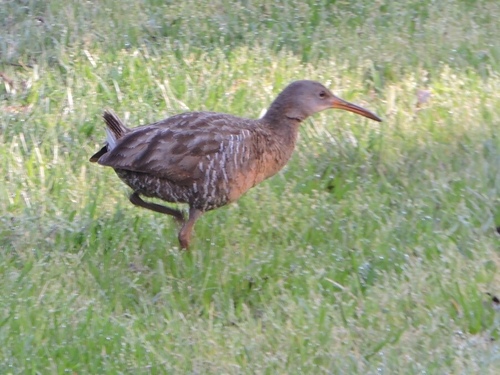 Clapper Rail
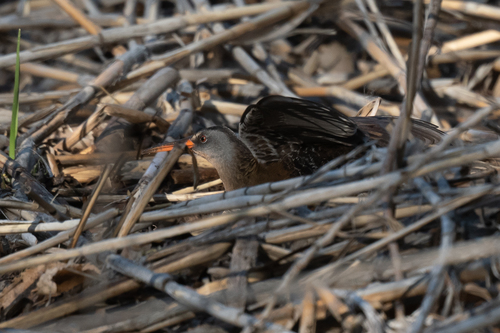 Virginia Rail
In short
The most reliable field mark between Clapper Rail and Virginia Rail is size: Clapper Rail is much larger and bulkier, with a chicken-like build, while Virginia Rail is notably smaller and slimmer. In the field, Clapper Rail shows a paler, grayish-brown plumage with a pale chestnut breast and a slightly downcurved, orange-based bill, whereas Virginia Rail is darker, with a more compact body, gray cheeks, a reddish bill, and orange-brown legs. Juvenile Virginia Rails are blackish-brown with rufous feather edges and a dark face, unlike any Clapper Rail. Both species are secretive and rarely fly, but Clapper Rail is more likely to be seen walking in open saltmarsh, while Virginia Rail prefers denser, fresher marsh vegetation. Use structure and bill color as your first clues, especially if size is hard to judge.
Identification tips
- Size is the most immediate clue: Clapper Rail is much larger and bulkier than Virginia Rail. If you see a rail that looks chicken-sized, it's almost certainly a Clapper Rail.
- Bill color and shape: Clapper Rail has a long, slightly downcurved bill with an orange-yellow base (brighter in males, duller in females). Virginia Rail's bill is long, slim, and reddish throughout, especially in adults.
- Facial pattern: Virginia Rail has gray cheeks, a whitish throat, and a light stripe over the eye, giving the face a more contrasting look. Clapper Rail's face is more uniform grayish-brown, lacking the strong cheek contrast.
- Leg color: Virginia Rail has orange-brown legs, which can be a useful field mark if seen well. Clapper Rail's leg color is less distinctive in the field.
- Breast and underparts: Clapper Rail shows a pale chestnut breast and paler belly, whereas Virginia Rail is darker below, with less contrast between breast and belly.
- Tail position: Virginia Rail often cocks its short tail upward, exposing white undertail coverts. Clapper Rail's tail is short but usually held level or drooped, not cocked.
- Juvenile plumage: Juvenile Virginia Rails are blackish-brown above with rufous feather edges and a dark face, unlike any Clapper Rail of any age. If you see a small, dark, fuzzy rail chick, it's Virginia Rail.
- Habitat context: Clapper Rail is almost always in saltmarsh (tidal, saline or brackish), while Virginia Rail prefers dense, fresh or slightly brackish marshes. Habitat alone can often separate them.
- Behavior: Virginia Rail is more likely to climb vegetation or swim/dives to escape, while Clapper Rail is more terrestrial and walks in open mud or shallow water.
- Flight: Both species rarely fly except when flushed; in flight, both show short, rounded wings and weak, fluttery flight, but Clapper Rail appears much larger and heavier.
- Sex differences: Both species have little sexual dimorphism in plumage, but Clapper Rail males have a brighter orange base to the bill.
- Confusion risk: In poor light or at a distance, size and bill color are your best bets. If you can't judge size, look for the facial pattern and leg color.
- Seasonal variation: No strong seasonal plumage differences are described for either species, so use structural and facial marks year-round.
- Vocalizations: Not covered in detail here, but both species are more often heard than seen; learning their calls can help in dense marshes.
- Contextual clues: If you see a rail in a tidal saltmarsh, default to Clapper Rail unless you have strong evidence for Virginia Rail; in dense, non-tidal marshes, expect Virginia Rail.
Size
Clapper Rail is substantially larger, with adults measuring 32–41 cm in length and weighing 199–400 g ([wikipedia]), compared to Virginia Rail's 20–27 cm length and average mass of 89 g ([wikidata]). In the field, Clapper Rail appears chicken-sized and robust, while Virginia Rail is noticeably smaller, slimmer, and more compressed laterally. Wing and tail are proportionally shorter in Virginia Rail, which also has a more delicate build. If both are seen together, the size difference is striking, but beware of lone birds in poor light, where context may be misleading.
Plumage
Juvenile Virginia Rails are distinctive: they are blackish-brown above with rufous feather edges, a brownish bill and legs, and dark brown to black underparts with a grayish-brown face. No Clapper Rail age matches this pattern. Adult Clapper Rails are grayish-brown overall with a pale chestnut breast, a pale belly, and a slightly downcurved bill that is orange-yellow at the base (duller in females). Virginia Rails (adults) are darker brown above and on the crown, with gray cheeks, a whitish throat, a reddish bill, and orange-brown legs. Both species have short tails, but Virginia Rail's is often cocked up, showing white undertail coverts. Clapper Rail's plumage is more uniform and paler, lacking the strong facial contrast of Virginia Rail. In flight, both show short, rounded wings, but no distinctive upperwing pattern is described for either species at any age.
Behaviour
Both species are secretive and prefer to walk or run through dense marsh vegetation rather than fly. Clapper Rail is more likely to be seen walking in open saltmarsh, sometimes probing with its bill in shallow water or mud. Virginia Rail is even more elusive, often heard rather than seen, and moves with a compressed body through dense, fresh or brackish marshes. Virginia Rail can climb vegetation and occasionally swims or dives to escape predators, while Clapper Rail is more terrestrial. Both rarely fly except when flushed or migrating.
Habitat
Clapper Rail is a saltmarsh specialist, found primarily along the Atlantic and Gulf coasts, in tidal marshes with saline or brackish water. Virginia Rail prefers freshwater or slightly brackish marshes with dense emergent vegetation (cattails, reeds, grasses) and is less tied to tidal habitats. While their ranges can overlap in coastal areas, Clapper Rail is almost always in saltmarsh, and Virginia Rail is more likely in inland or fresher marshes. If you see a rail in a tidal saltmarsh, Clapper Rail is much more likely; in a dense, non-tidal marsh, Virginia Rail is expected.