
Cetti's Warbler vs Common Whitethroat
Cettia cetti versus Curruca communis
Play a quiz with Cetti's Warbler and Common Whitethroat
 Cetti's Warbler
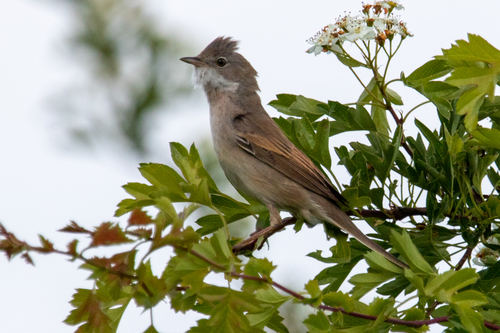 Common Whitethroat
In short
The most reliable way to separate Cetti's Warbler from Common Whitethroat is by structure and face pattern: Cetti's Warbler has a rounded head, short rounded wings, a long broad tail, and a narrow pale supercilium over a dark eye, while Common Whitethroat is slimmer with a more pointed wing, shorter tail, and lacks the strong supercilium. In plumage, Cetti's Warbler is a rich chestnut-brown above and pale grey-brown below, with sexes alike; Common Whitethroat males have a grey head and white throat, while females are browner and duller. Cetti's Warbler is nearly always found in dense, damp thickets and is usually heard before seen, whereas Common Whitethroat prefers more open scrub and sings from exposed perches. If you glimpse a skulking, round-bodied warbler with a loud explosive song near water, it's likely Cetti's; a more upright, open-perched bird with a scratchy song in dry scrub is likely Whitethroat.
Identification tips
- Head pattern: Cetti's Warbler has a rounded head with a narrow, pale supercilium over a dark eye, giving a strong facial contrast. Whitethroat lacks a strong supercilium; males have a grey head, females are plain brown.
- Tail shape and length: Cetti's Warbler has a long, broad tail (unique among warblers for having only ten tail feathers), often flicked or cocked. Whitethroat's tail is shorter, narrower, and not as prominently used in display.
- Wing shape: Cetti's Warbler has short, rounded wings, giving a compact, stubby appearance in flight and when perched. Whitethroat's wings are longer and more pointed, contributing to a more streamlined look.
- Plumage color: Cetti's is rich chestnut or dark reddish-brown above and pale grey-brown below, with little contrast between sexes. Whitethroat males have a grey head and white throat; females are browner and less contrasting, but both show a pale throat against a buff belly.
- Sexual dimorphism: Only Whitethroat shows strong male/female differences; Cetti's sexes are alike in the field.
- Juvenile confusion: Juvenile Cetti's look like adults (rich brown, pale below), while juvenile Whitethroat are paler, with a less distinct throat and no grey head.
- Perching behavior: Cetti's rarely perches in the open, usually staying deep in cover. Whitethroat often sings or forages from exposed perches.
- Habitat: Dense, wet thickets point to Cetti's; dry, open scrub or bramble patches suggest Whitethroat.
- Song: Cetti's song is a short, explosive burst from cover; Whitethroat's is a fast, scratchy, scolding series from an open perch.
- Flight style: Cetti's flies low and briefly between cover, often with a heavy, bouncing flight. Whitethroat makes longer, fluttering flights between bushes.
- Bill: Both have typical warbler bills, but Cetti's is slightly stubbier and less pointed than Whitethroat's.
- Eye color: Both species have dark eyes, but the contrast with Cetti's pale supercilium makes the eye stand out more.
- Tail flicking: Cetti's often flicks and fans its tail; Whitethroat does not show this behavior as prominently.
- Seasonal context: In early spring, Cetti's is resident and vocal; Whitethroat is a migrant, arriving later and departing earlier in autumn.
- Abundance: In suitable wet habitats, Cetti's can be common but is easily overlooked; Whitethroat is widespread in open country during the breeding season.
Size
Both species are similar in overall length (Cetti's Warbler 13–14 cm, Common Whitethroat similar), but Cetti's Warbler is slightly heavier on average (males up to 15 g) and appears bulkier, with a noticeably longer and broader tail. Whitethroat is slimmer, with a body mass around 14.5 g [wikidata], and has a proportionally shorter tail and more streamlined shape. In hand, male Cetti's Warbler has a significantly longer wing than female, but this is not easily judged in the field.
Plumage
Juvenile and adult Cetti's Warbler look very similar: both are rich chestnut or dark reddish-brown above and pale grey-brown below, with a narrow pale supercilium and a long, broad tail. Juveniles can be told by two dark spots on the tongue (not visible in the field). Cetti's has no wing pattern or pale panels, and its tail is unique among warblers for having only ten feathers. In contrast, Common Whitethroat shows clear sexual dimorphism: adult males have a grey head and white throat, with brown upperparts and chestnut fringes to the wing feathers; females lack the grey head and are overall browner and duller, with a less contrasting throat. Both sexes have a more uniform brown back and buff underparts, but the white throat is usually visible. In flight, Whitethroat's wings are longer and more pointed, and the tail is shorter and less broad than Cetti's. There are no distinctive juvenile wing patterns described for either species, so separation relies on overall color, head pattern, and structure.
Behaviour
Cetti's Warbler is extremely skulking, rarely leaving dense, damp vegetation, and is most often detected by its explosive song. It typically flicks its long tail and moves mouse-like through cover, rarely perching in the open. Common Whitethroat is much more conspicuous, often singing from exposed perches atop bushes or wires, and makes short, fluttering flights between shrubs. Its foraging is more active and visible, and it is less tied to dense cover.
Habitat
Cetti's Warbler is strongly associated with dense, shrubby vegetation near water—reedbeds, wet thickets, riversides, and marsh edges. It avoids dry or open habitats. Common Whitethroat prefers drier, more open scrub, hedgerows, bramble patches, and rough grassland, often away from water. If you find a warbler in thick, wet vegetation, Cetti's is much more likely; in dry, open scrub, expect Whitethroat.
Voice
Cetti's Warbler has a very loud, explosive song delivered in short bursts, often from deep cover, and is usually the first clue to its presence. The song is unique among European warblers and is not easily confused with Whitethroat. Common Whitethroat's song is fast, scratchy, and scolding, often given from an exposed perch; its calls are hoarse, nasal, and include a rough 'tschehr'. If you hear a sudden, powerful burst from a hidden bird, think Cetti's; a more continuous, scratchy song from an open perch points to Whitethroat.