

Caspian Tern vs Whiskered Tern
Hydroprogne caspia versus Chlidonias hybrida
Play a quiz with Caspian Tern and Whiskered Tern
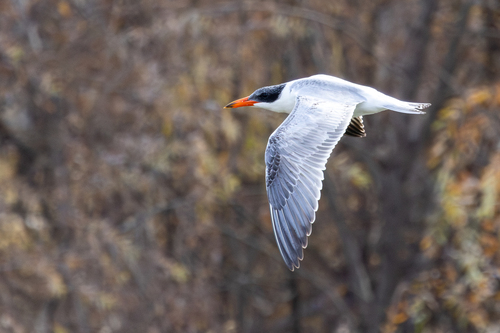 Caspian Tern
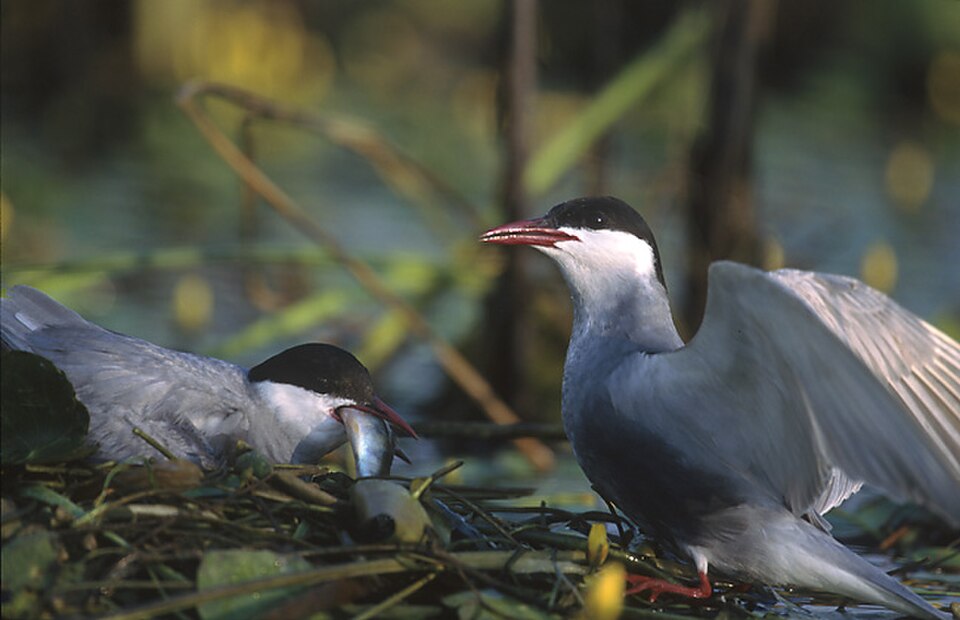 Whiskered Tern
In short
The most reliable field mark between Caspian Tern and Whiskered Tern is size: Caspian is vastly larger, with a thick red-orange bill and heavy jizz, while Whiskered is much smaller and more delicate. In flight, Caspian Tern shows pale underwings with black wingtips and a less forked tail, while Whiskered Tern is more buoyant, with a short, deeply forked tail and, in breeding plumage, dark grey underparts. Juvenile Whiskered Terns show a ginger-scalloped back, unlike the more uniform juvenile Caspian. Bill color and shape, cap pattern, and leg color also help, but beware seasonal changes and age-related variation. Always start with overall bulk and bill size, then check for the distinctive plumage and structural differences.
Identification tips
- Size is the first check: Caspian Tern is nearly eight times heavier than Whiskered Tern. If the bird looks gull-sized, it is Caspian; if it is swallow- or small-tern-sized, it is Whiskered. This works for all ages and seasons.
- Bill shape and color: Caspian has a massive, thick, long red-orange bill with a black tip (all ages). Whiskered’s bill is shorter, finer, and red (breeding adult), less robust, and never as thick. Juvenile Whiskered’s bill is also shorter and stubbier, especially in females.
- Tail shape: Caspian’s tail is only slightly forked and appears square-tipped in flight. Whiskered Tern’s tail is short but deeply forked, especially obvious in flight.
- Underwing pattern: Caspian shows pale underwings with contrasting black wingtips (primaries) in all plumages. Whiskered Tern’s underwing is more uniform, matching the body color—dark grey in breeding, paler in winter.
- Juvenile/first-winter upperparts: Juvenile Whiskered Tern has a ginger-scalloped back, with broad buff edges and bars on dark brown feathers, plus a mottled crown and C-shaped black ear-covert pattern. Caspian juveniles are more uniform, lacking this scaly appearance.
- Cap and face pattern: Caspian Tern always has a full black cap in summer, streaked with white in winter, but never forms a C-shaped pattern. Whiskered Tern shows a black cap in summer, but in winter and juvenile plumages, the black forms a C-shape around the ear-coverts, with a white forehead and nape.
- Leg color: Caspian has black legs (all ages). Whiskered Tern has red legs in breeding plumage, which may dull in winter but are never as dark as Caspian’s.
- Body color: Caspian is always white below, with pale grey upperparts. Whiskered Tern in breeding plumage is dark grey above and below, much duskier than Caspian. In winter, Whiskered becomes paler, but still greyer than Caspian.
- Flight style: Caspian is powerful, with slow, deep wingbeats and a heavy, direct flight. Whiskered is lighter, more buoyant, and agile, often fluttering or dipping.
- Habitat context: Caspian is found on open water, coasts, or large lakes; Whiskered prefers marshes and reedbeds, especially in breeding season.
- Vocalization: Caspian’s call is a loud, harsh croak; Whiskered’s is a sharp, brisk "krekk".
- Group behavior: Whiskered Tern is more likely to be in flocks or colonies, especially in marshes; Caspian is often solitary or in loose groups.
- Seasonal changes: In winter, both species lose some cap contrast, but Caspian always has a streaked black cap, while Whiskered develops a white forehead and retains the C-shaped black ear-covert mark.
- Bill tip: Caspian’s bill always shows a small black tip, even in adults; Whiskered’s bill is plain red in breeding, duller in winter, but never shows a black tip.
- When in doubt: If you cannot judge size, focus on bill thickness, tail fork depth, and cap/ear-covert pattern—these are reliable even at a distance or in poor light.
Size
Caspian Tern is the world's largest tern, weighing around 634 g, compared to just 84 g for Whiskered Tern [wikidata]. Caspian’s length (48–60 cm) and wingspan (127–145 cm) dwarf the Whiskered, which is a typical marsh tern in size. Even at a distance, Caspian appears much bulkier, with a massive head and bill, while Whiskered is slender and compact. If you see them together, the size gap is unmistakable—Caspian is closer to a small gull, Whiskered to a large swallow.
Plumage
Juvenile and first-winter birds are often confused. Juvenile Whiskered Tern has a distinctive ginger-scalloped back, with dark brown feathers broadly edged and barred with buff, plus a mottled crown and a C-shaped black ear-covert pattern. In contrast, juvenile Caspian Tern is more uniform, with variable pale creamy to grey-brown down, lacking the scaly or variegated pattern. Adult Caspian Tern in all seasons shows a white head with a black cap (streaked in winter), thick red-orange bill with a black tip, and pale underwings with dark wingtips; the tail is only slightly forked. Whiskered Tern adults in breeding plumage have a black cap, white cheeks, dark grey body and underparts, red legs and bill, and a short, deeply forked tail. In winter, Whiskered Tern’s forehead becomes white, the body paler grey, but the black ear-coverts and C-shaped head pattern remain. Caspian’s black cap is less variable seasonally, only streaked in winter, and never forms a C-shape. In flight, Caspian’s underwing is pale with black primaries, while Whiskered is more uniformly grey above and below in breeding, paler in winter.
Behaviour
Caspian Tern is powerful and direct in flight, often flying high and with deep, slow wingbeats, sometimes recalling a gull. It often hovers or glides before plunge-diving for fish. Whiskered Tern is more buoyant and agile, with lighter, more fluttery flight, often dipping to pick prey from the water or marsh surface. Caspian is more likely to be seen singly or in loose groups, while Whiskered Tern is more colonial and social, especially in breeding marshes.
Habitat
Caspian Tern prefers open water—large lakes, rivers, estuaries, and coasts, often nesting on bare sand or gravel islands. Whiskered Tern is a marsh specialist, breeding in colonies among emergent vegetation in inland marshes, often among gulls. Outside breeding, Whiskered may be found over lakes and wetlands, but rarely in the open coastal habitats favored by Caspian. If you see a tern over a reedbed or marsh, Whiskered is far more likely; over open water or a sandy spit, Caspian is the better bet.
Voice
Caspian Tern gives a loud, harsh, heron-like croak—much deeper and more resonant than Whiskered Tern’s calls. Whiskered Tern’s voice is a characteristic, sharp "krekk", higher-pitched and less guttural. If you hear a deep, croaking call, think Caspian; if the call is brisk and chattering, Whiskered is more likely.