

Carrion Crow vs Eurasian Blackbird
Corvus corone versus Turdus merula
Play a quiz with Carrion Crow and Eurasian Blackbird
 Carrion Crow
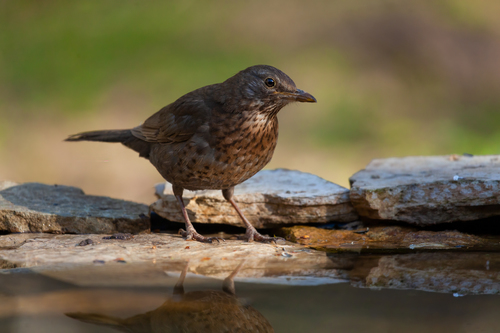 Eurasian Blackbird
In short
The most reliable field mark between Carrion Crow and Eurasian Blackbird is overall size and structure: Carrion Crow is much larger, bulkier, with a thick bill and all-black plumage, while Eurasian Blackbird is a medium-sized thrush with a slimmer build and a distinct yellow or orange-yellow bill in adult males. Juvenile and female blackbirds are brownish and never fully black, which can cause confusion with crows at a distance, but the crow's size and heavy bill are always diagnostic. In flight, Carrion Crow shows slow, deliberate wingbeats, while blackbird flight is quicker and more agile. Both species are common in European parks and gardens, but their behavior and vocalizations are quite different.
Identification tips
- Size: Carrion Crow is more than twice the length and several times the mass of Eurasian Blackbird; use this as your first check, especially when both species are present.
- Bill shape and color: Crow has a thick, all-black bill at all ages; adult male blackbird has a slender, bright yellow or orange-yellow bill, while females and juveniles have duller brownish bills.
- Plumage gloss: Carrion Crow is uniformly black with a green or purple sheen; blackbird males are glossy black but never as iridescent, and females/juveniles are brownish.
- Eye-ring: Adult male blackbird has a yellow eye-ring, absent in crows.
- Leg color: Crow’s legs are black; blackbird’s are blackish-brown but never as robust.
- Juvenile confusion: Juvenile crows are brownish-black and blue-eyed, but still bulkier and darker than any blackbird; juvenile blackbirds are brown with pale spots and a speckled breast.
- Flight style: Crow’s flight is slow and heavy with deep wingbeats; blackbird’s is fast, agile, and often low to the ground.
- Perched posture: Crows often perch upright on high vantage points; blackbirds are more horizontal, often on the ground or in low shrubs.
- Vocalization: Crow’s call is a deep, croaked 'kraa'; blackbird’s song is rich and musical, with a sharp 'tchook' alarm.
- Social behavior: Crows are mostly solitary or in pairs, blackbirds are territorial in breeding season but may flock in winter.
- Habitat use: Both occur in gardens and parks, but blackbirds are more often in dense cover or foraging on lawns; crows are more likely to be seen in open areas or perched high.
- Sex differences: Only male blackbird is fully black with yellow bill and eye-ring; female and juvenile blackbirds are brownish, never black.
- Seasonal changes: Blackbird’s bill color dulls in winter but remains yellowish; crow’s appearance does not change with season.
- Mistaken identity: At a distance, a female or juvenile blackbird may appear dark, but never matches the crow’s size or bulk; always check for bill color and structure.
- No wing pattern traps: Neither species shows distinctive wing panels or patterns in flight, so rely on size, structure, and bill for separation.
Size
Carrion Crow is substantially larger, measuring 48–52 cm in length with a wingspan of 84–100 cm and weighing 400–600 g [wikipedia][avonet]. Eurasian Blackbird is much smaller, at 23.5–29 cm long, with a proportionally long tail, and weighs only 80–125 g [wikipedia][avonet]. Even at a distance, the crow’s bulk, long wings, and thick bill stand out compared to the more delicate, thrush-like proportions of the blackbird.
Plumage
- Juvenile/First-year birds: Juvenile Carrion Crows are brownish-black with blue eyes, but still appear bulkier and darker than any Eurasian Blackbird. Juvenile blackbirds are brown with pale spots on the upperparts and a speckled breast, never fully black; first-year males have a brownish wing and dark bill, not the yellow-orange of adults [wikipedia].
- Adult males: Carrion Crow is entirely black with a greenish or purple gloss, including bill, legs, and feet. Adult male blackbird is glossy black but has a conspicuous yellow or orange-yellow bill and a yellow eye-ring; legs are blackish-brown [wikipedia].
- Adult females: Female blackbird is sooty-brown with a dull yellowish-brownish bill, brownish-white throat, and weak breast mottling, easily distinguished from the all-black crow. Female crows are identical to males in plumage.
- Flight/wing pattern: No distinctive upperwing panels or patterns noted for either species, but the blackbird's folded wing is brown in first-year males, contrasting with the black body plumage; crows are uniformly black at all ages except juveniles, which are brownish overall.
Behaviour
Carrion Crow is often solitary or in pairs, especially outside winter roosts, and is more likely to perch high and call loudly. It may become tame near humans but generally keeps a watchful distance. Its flight is slow and deliberate, with steady wingbeats. Eurasian Blackbird is a ground-feeding thrush, often seen running or hopping on lawns and in undergrowth. Males are territorial in breeding season, performing 'bow and run' threat displays; both sexes can be aggressive in defense of territory. Blackbirds are more likely to be seen in loose flocks during migration or winter, with a fast, agile flight interspersed with bursts of wingbeats and gliding.
Habitat
Both species are common in European parks, gardens, and urban areas. Carrion Crow is also found in forests and mountainous regions, and is more adaptable to a wide range of open and wooded habitats. Eurasian Blackbird is a classic garden and woodland thrush, often foraging on the ground in leaf litter or lawns. Habitat overlap is common, but blackbirds are more often seen in dense cover or low vegetation, while crows prefer higher perches and open ground.
Voice
Carrion Crow has a deep, guttural, croaked 'kraa', often given in series of three or four with pauses, and may bow its head and raise its shoulders while calling. Its voice is much deeper and rougher than the high-pitched 'kaaa' of the rook. Eurasian Blackbird is famous for its melodious, fluting song, especially at dawn and dusk; its alarm call is a sharp 'tchook' or 'chink'. The blackbird’s song is musical and varied, while the crow’s calls are harsh and unmelodic.