

Cardinal Woodpecker vs Golden-tailed Woodpecker
Dendropicos fuscescens versus Campethera abingoni
Play a quiz with Cardinal Woodpecker and Golden-tailed Woodpecker
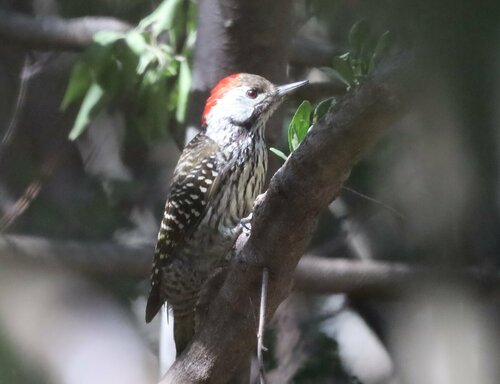 Cardinal Woodpecker
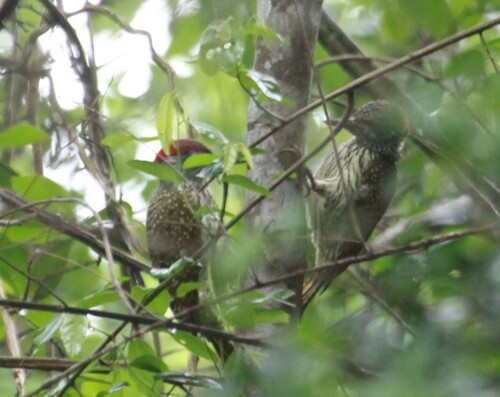 Golden-tailed Woodpecker
In short
The most reliable field mark between Cardinal and Golden-tailed Woodpeckers is size: Golden-tailed is much larger and heavier, with a noticeably longer body and bill. In all ages, Golden-tailed shows a greenish, barred upperpart and a golden-olive tail, while Cardinal is smaller, with duller olive upperparts, paler spotting, and a tawny rump. Both have streaked underparts, but Golden-tailed's streaking is generally heavier and more extensive, especially in some races. Head pattern is also key: male Cardinals have a red hind crown and nape, while male Golden-taileds have a red and brown forecrown, and females of both differ in crown and malar color. These differences are visible both perched and in flight, but size and overall color impression are most helpful at a distance.
Identification tips
- Size is the first check: Golden-tailed is much larger and heavier than Cardinal. If the bird appears small, compact, and delicate, Cardinal is more likely; if it looks long-bodied and robust, suspect Golden-tailed.
- Upperpart color and pattern: Golden-tailed has greenish, barred upperparts and a golden-olive tail. Cardinal is duller olive above, with paler dots and bands (not strong barring) and a tawny rump. Look for the overall greenish vs. brownish impression.
- Underpart streaking: Both species are streaked below, but Golden-tailed (especially some races) can have very dense streaking, sometimes almost solid black on throat and breast. Cardinal's streaking is heavy but less dense.
- Head pattern (sex and age): Male Cardinal has a red hind crown and nape; female has a dark hind crown and black nape. Male Golden-tailed has a red and brown forecrown; female has a black and white spotted forecrown. Juvenile Cardinals have a red hind crown and black nape (males), while juvenile Golden-taileds have mottled malar stripes and a brownish iris.
- Malar stripe: Cardinal shows a conspicuous black malar stripe separating the white throat and face. Golden-tailed's malar is red in males and mottled black and white in females/juveniles.
- Bill structure: Both have straight, pointed bills typical of woodpeckers, but Golden-tailed's is proportionally longer and stouter, matching its larger body size.
- Tail and rump: Cardinal has a tawny rump, while Golden-tailed's tail is golden-olive and not markedly different from its upperparts.
- Iris color: Golden-tailed usually has a dark red iris (variable), especially in adults; juvenile iris is brown to brownish-grey. Cardinal's iris color is not described as distinctive.
- Voice: Cardinal gives a high-pitched, repeated 'krrrek-krrrek-krrrek' and drums softly. Golden-tailed gives a single, strident call-note and is not noted for drumming. Listen for these differences if the bird is not seen well.
- Habitat context: Both can occur in overlapping habitats, but Cardinal is more likely in dense forest, thorn bush, or even reeds, while Golden-tailed is more associated with woodlands. Use habitat only as a supporting clue.
- Behavior: Cardinal often forages lower in trees, shrubs, and even on maize stalks or reeds, sometimes hanging from twigs. Golden-tailed's foraging is less described, but both are typical woodpeckers in movement.
- Flight and wing pattern: No distinctive upperwing or flight marks are described for either species, so rely on size and color impression in flight.
- Juvenile confusion: Juvenile Golden-taileds are heavily streaked and barred below, with mottled malar stripes and a brownish iris; juvenile Cardinals resemble adults but with a red hind crown and black nape in males. If the bird is particularly heavily streaked below and large, suspect Golden-tailed.
- Regional variation: Some Golden-tailed races are greener or more yellowish above, or have denser throat streaking. Cardinal is more uniformly dull olive above with paler markings.
- Pitfall: Both species can look similar in poor light or at a distance, especially females and juveniles. Always check multiple features—size, upperpart color, head pattern, and underpart streaking—for a confident ID.
Size
Cardinal Woodpecker is a very small woodpecker, measuring 14–15 cm in length. Golden-tailed Woodpecker is substantially larger, at 20–21 cm, and heavier (southern races ~70 g vs. Cardinal's much lighter build). The difference is obvious in the field when both are seen well: Golden-tailed looks bulkier and longer, with a proportionally longer bill. This size gap is a strong clue even in brief views.
Plumage
- Juvenile/immature birds: Both species show streaked underparts, but Golden-tailed juveniles are heavily streaked on the throat and breast and barred on the belly, with mottled malar stripes. Cardinal juveniles resemble adults but with a red hind crown and black nape in males, and generally less crisp head pattern.
- Adults: Golden-tailed has greenish, barred upperparts and a golden-olive tail, with streaked underparts. Cardinal is duller olive above, with paler dots and bands (not strong barring), a tawny rump, and white underparts heavily streaked black. The head pattern is distinctive: male Cardinal has a red hind crown and nape; male Golden-tailed has a red and brown forecrown. Female Cardinals have a dark hind crown and black nape, while female Golden-taileds have a black and white spotted forecrown and mottled black and white malar stripe. Both species have a black malar stripe, but the color and pattern differ by sex and species. The white throat and face with a conspicuous black malar stripe is more pronounced in Cardinal. Golden-tailed's iris is usually dark red, while Cardinal's is not described as distinctive.
Behaviour
Cardinal Woodpecker forages mainly in lower tree levels, shrubs, and even reeds, often in small family groups or mixed flocks. It pecks rapidly and probes dense vegetation, sometimes hanging from twigs. Golden-tailed's foraging behavior is not detailed here, but both are typical woodpeckers in movement and feeding. Cardinal is frequently seen and regularly drums softly; Golden-tailed is noted for a single, strident call-note rather than drumming.
Habitat
Both species overlap widely in sub-Saharan Africa and can occur in similar habitats, from dense forest to thorn bush (Cardinal) and arid/mesic woodlands (Golden-tailed). Cardinal is especially adaptable, found in a wider range of habitats, including dense forest, thorn bush, and even reeds. Golden-tailed is more associated with woodlands, and some races are tied to particular regions or habitat types, but habitat alone is not diagnostic where ranges overlap.
Voice
Cardinal Woodpecker gives a high-pitched, repeated 'krrrek-krrrek-krrrek' and drums softly. Golden-tailed Woodpecker is characterized by a single, strident call-note and is not noted for drumming. These differences can help in the field, especially if the bird is not seen well.
Cardinal Woodpecker · Golden-tailed Woodpecker · My Tricky Birds