

Canvasback vs Ladder-backed Woodpecker
Aythya valisineria versus Dryobates scalaris
Play a quiz with Canvasback and Ladder-backed Woodpecker
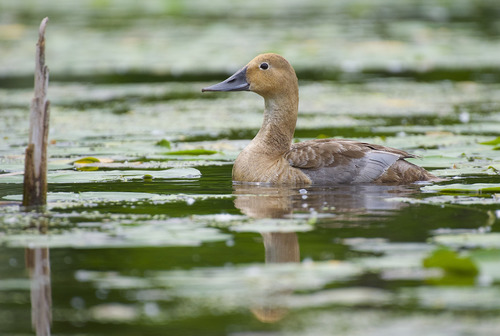 Canvasback
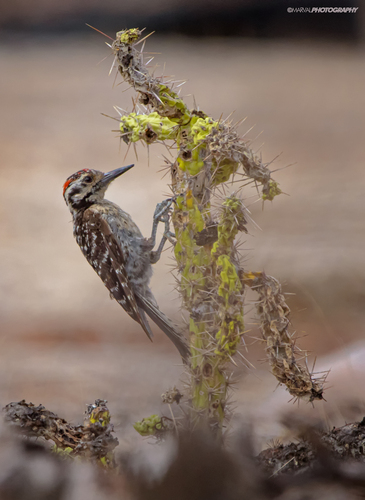 Ladder-backed Woodpecker
In short
Canvasback and Ladder-backed Woodpecker are extremely different in both structure and plumage, but quiz confusion may arise from distant, silhouetted, or poorly seen birds. The most reliable separation is overall shape: Canvasback is a large, heavy-bodied diving duck with a long, sloping head and neck, while Ladder-backed Woodpecker is a small, slim woodpecker with a straight, chisel-like bill and a stiff, pointed tail. In flight or at rest, Canvasback shows a smooth, pale body with a chestnut head (male) or brown head (female), whereas Ladder-backed Woodpecker is boldly patterned with black-and-white barring on the back and wings. Habitat is also a strong clue: Canvasback is found on open water, while Ladder-backed Woodpecker is restricted to dry brushy areas and thickets.
Identification tips
- Overall shape and structure: Canvasback is a large, heavy-bodied duck with a long, sloping neck and head; Ladder-backed Woodpecker is a small, slim woodpecker with a short neck, straight chisel bill, and stiff pointed tail. This is visible at any distance.
- Bill shape: Canvasback has a long, sloping, black bill that merges smoothly into the forehead; Ladder-backed Woodpecker has a short, straight, pointed bill typical of woodpeckers, never sloping.
- Head and neck: Male Canvasback shows a rich chestnut-red head and neck with a black breast; female is pale brown. Ladder-backed Woodpecker never shows this coloration, instead having a black-and-white barred crown (with red in males) and a pale, speckled face.
- Back and wings: Canvasback's back and wings are plain grayish or white (male) or brownish (female), never barred. Ladder-backed Woodpecker always shows black-and-white horizontal barring across the back and wings, creating a 'ladder' effect.
- Crown patch: Adult male Ladder-backed Woodpecker has a red crown patch (smaller in immatures, absent in females); Canvasback never shows any red on the crown.
- Underparts: Canvasback has clean white (male) or grayish (female) underparts; Ladder-backed Woodpecker has cream-colored underparts with black speckling, sometimes duskier in southern birds.
- Tail: Canvasback has a short, rounded tail; Ladder-backed Woodpecker has a stiff, pointed tail used for bracing against trunks.
- Flight style: Canvasback flies with steady, direct wingbeats over water; Ladder-backed Woodpecker has bounding, undulating flight typical of woodpeckers.
- Perching behavior: Canvasback is never seen perched vertically on trunks or cacti; Ladder-backed Woodpecker is rarely, if ever, seen on open water.
- Habitat: Canvasback is found on lakes, marshes, and open water; Ladder-backed Woodpecker is found in dry brush, thickets, and arid woodlands, often near cacti.
- Relative size: Canvasback is much larger than a mallard; Ladder-backed Woodpecker is smaller than a robin. Even distant silhouettes should show this size difference.
- Sex and age differences: Female and immature Canvasbacks are duller but still lack any barring or red crown; immature male Ladder-backed Woodpeckers show a reduced red crown patch but retain the ladder pattern.
- Contextual clues: If the bird is diving or swimming, it is a Canvasback; if it is pecking at wood or clinging to a trunk, it is a Ladder-backed Woodpecker.
- No overlap in key field marks: No Canvasback shows a ladder pattern, red crown, or woodpecker structure; no Ladder-backed Woodpecker shows a chestnut head, white body, or duck-like shape.
- Quiz pitfalls: Most confusion arises from distant, poorly seen birds or silhouettes. Focus on overall shape, habitat, and any hint of barring or crown color to separate them quickly.
Size
Canvasback dwarfs Ladder-backed Woodpecker in every dimension. Canvasback is 48–56 cm (19–22 in) long and weighs over 1,100 g on average, making it the largest North American diving duck [wikipedia]. In contrast, Ladder-backed Woodpecker is only 16.5–19 cm (6.5–7.5 in) long and weighs about 30 g [wikidata], less than 3% of a Canvasback's mass. Even at a distance or in flight, the duck's bulk and long neck are unmistakable compared to the small, compact woodpecker.
Plumage
No age or wing pattern overlap exists between these species. Canvasback of all ages and sexes lacks any barring or ladder pattern; instead, males show a striking chestnut head, black breast, and white body, while females are brownish with a pale face and grayish flanks [wikipedia]. In flight, Canvasbacks show pale upperwings and a long, white body. Ladder-backed Woodpecker, regardless of age or sex, is patterned with black-and-white horizontal bars across the back and wings, giving a ladder-like appearance. Males have a red crown patch (smaller in immatures, absent in females), and both sexes have a pale, speckled underside. No Canvasback ever shows a red crown or ladder pattern, and no Ladder-backed Woodpecker ever has a chestnut head, white body, or black breast.
Behaviour
Canvasback is a diving duck, often seen swimming low in the water, diving for food, or flying with strong, direct wingbeats over open water. It rarely perches. Ladder-backed Woodpecker is almost always seen clinging vertically to tree trunks, branches, or cacti, using its stiff tail for support, and foraging by pecking at wood or bark. Its flight is undulating and bounding, typical of woodpeckers, and it may briefly perch on exposed branches but never swims or dives.
Habitat
Habitat alone often separates these species. Canvasback is strictly aquatic, found on lakes, marshes, and open water, especially during migration and winter. It nests in marshes with emergent vegetation. Ladder-backed Woodpecker is terrestrial, inhabiting dry brushy areas, thickets, and arid woodlands, often far from large bodies of water. It nests in cavities in trees or cacti. Seeing a bird on open water immediately rules out Ladder-backed Woodpecker, while a bird foraging on a tree or cactus trunk is never a Canvasback.