

Canary Islands Chiffchaff vs Common Chiffchaff
Phylloscopus canariensis versus Phylloscopus collybita
Play a quiz with Canary Islands Chiffchaff and Common Chiffchaff
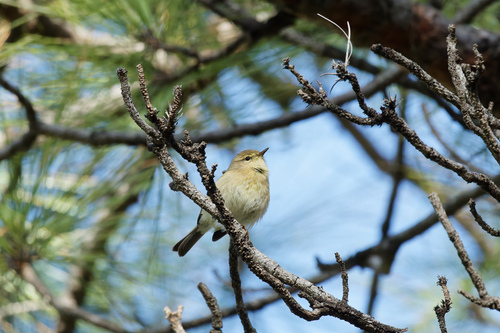 Canary Islands Chiffchaff
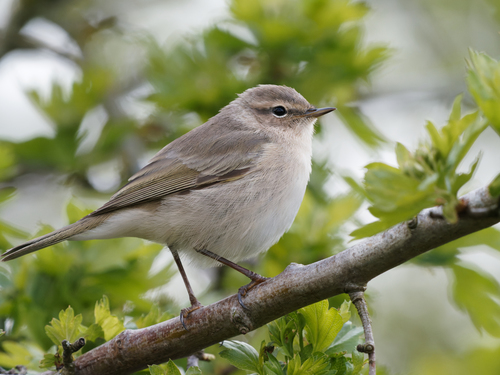 Common Chiffchaff
In short
The most reliable field mark between Canary Islands Chiffchaff and Common Chiffchaff is the combination of structure and plumage: Canary Islands Chiffchaff has a longer bill, shorter wings, and a longer tail, with darker brown upperparts and brownish-buff underparts, especially on the flanks and breast. Common Chiffchaff is generally greener above and off-white below, with a shorter bill and tail, and longer wings. Juvenile and adult plumages can be subtly different, but these structural and color differences are consistent. Voice and behavior offer additional clues, but are best used in combination with plumage and shape, especially outside the breeding season.
Identification tips
- Location is key: If you are not on the Canary Islands, you are almost certainly seeing Common Chiffchaff. Canary Islands Chiffchaff is endemic to the Canaries and not found elsewhere.
- Bill length: Canary Islands Chiffchaff has a noticeably longer bill than Common Chiffchaff. Look for this especially in profile views.
- Wing and tail proportions: Canary Islands Chiffchaff has shorter wings and a longer tail, giving it a more elongated look, while Common Chiffchaff is dumpier with longer wings and a shorter tail. This is visible both perched and in flight.
- Upperpart coloration: Canary Islands Chiffchaff is darker brown above, lacking the greenish tones of Common Chiffchaff, which is dull greenish-brown above (brighter and greener after moult).
- Underpart coloration: Canary Islands Chiffchaff has a strong brownish-buff wash on the flanks and breast, while Common Chiffchaff is off-white below, sometimes with a faint yellowish tinge on the flanks in fresh plumage.
- Juvenile plumage: Juvenile Common Chiffchaffs are browner above and yellow-white below, but after their first moult, they become greener above and paler below. Canary Islands Chiffchaff juveniles are not described in detail but are expected to be darker and browner, like adults.
- Supercilium: Common Chiffchaff has a short, whitish supercilium, which may be less distinct in Canary Islands Chiffchaff.
- Leg color: Both species have dark legs, so this is not useful for separation.
- Tail movement: Both species flick or wag their tails, but Common Chiffchaff often dips and then wags sidewards, a behavior less emphasized in Canary Islands Chiffchaff, which tends to flick more frenetically.
- Song: Common Chiffchaff has a simple, repetitive 'chiff-chaff' song, while Canary Islands Chiffchaff's song is harsher, shorter, more varied, and faster. Use song only if you are confident and in range.
- Call: Calls are similar but Canary Islands Chiffchaff's is slightly harsher. This is a subtle difference and not always reliable.
- Seasonal context: During the breeding season, both are territorial and solitary or in pairs. In autumn and winter, Canary Islands Chiffchaff forms small flocks, as does Common Chiffchaff during migration and winter.
- Habitat: Canary Islands Chiffchaff is found in laurisilva or coastal scrub on the Canaries; Common Chiffchaff is in a wide range of woodlands and scrub across Europe and Asia.
- Moult timing: Canary Islands Chiffchaff completes its post-breeding moult by late July; Common Chiffchaff has a prolonged complete moult before migration. This may affect plumage brightness but is not a primary field mark.
- Pitfalls: Non-singing birds can be very difficult to separate on plumage alone, especially if seen briefly or in poor light. Focus on structure and overall color tone, and always consider location.
Size
Both species are small leaf warblers, but Common Chiffchaff is slightly larger overall. Adult Common Chiffchaffs measure 10–12 cm in length and weigh 6–8 grams, while Canary Islands Chiffchaff is described as smaller with shorter wings and a longer tail, but precise measurements are not provided in the notes. In hand, the difference is subtle, but in the field, the longer tail and bill of Canary Islands Chiffchaff can make it look more elongated compared to the dumpier Common Chiffchaff.
Plumage
No distinctive age-specific upperwing pattern is described for either species, so separation relies on overall coloration and structure. Adult Canary Islands Chiffchaff shows darker brown upperparts and a strong brownish-buff wash on the underparts, especially flanks and breast, while Common Chiffchaff adults are dull greenish-brown above and off-white below, with only a hint of yellow on the flanks in fresh plumage. Juvenile Common Chiffchaffs are browner above and have yellow-white underparts, but after their first moult, they become brighter and greener above with a paler supercilium. Canary Islands Chiffchaff maintains its darker, browner tones throughout the year. Both species have dark legs and a fine dark bill, but Canary Islands Chiffchaff's bill is longer. The supercilium is short and whitish in Common Chiffchaff; no distinctive supercilium is noted for Canary Islands Chiffchaff.
Behaviour
Both species are active, often flicking their wings and tails. Canary Islands Chiffchaff is especially noted for quick, frenzied movements and frequent tail wagging or flicking. Common Chiffchaff also wags its tail, but with a characteristic dip then sidewards wag, which is distinctive among Phylloscopus warblers. Both species forage actively among foliage from ground level to canopy, sometimes hovering or flycatching. During the breeding season, Canary Islands Chiffchaff is territorial and solitary or in pairs, while in autumn and winter it forms small flocks. Common Chiffchaff is also solitary or in pairs during breeding, but forms loose flocks in migration and winter.
Habitat
Canary Islands Chiffchaff is endemic to the Canary Islands and is not found elsewhere, typically inhabiting coastal scrub and laurisilva forests, nesting near the ground or higher up depending on habitat. Common Chiffchaff is widespread across northern and temperate Europe and the Palearctic, breeding in open woodlands and wintering in southern and western Europe, southern Asia, and North Africa. The two species do not overlap in range, so any chiffchaff seen outside the Canary Islands is almost certainly Common Chiffchaff.
Voice
Canary Islands Chiffchaff has a harsher, shorter, and more varied song than Common Chiffchaff, lacking the metronomic 'chiff-chaff' rhythm. Its song is faster and more variable, with a rich, deep 'chip-cheep-cheep-chip-chip-cheep' described for the western subspecies. The call is similar to Common Chiffchaff but slightly harsher. Common Chiffchaff's song is a simple, repetitive 'chiff-chaff' that is easy to recognize and is one of the first signs of spring in its range. Calls are a simple 'hweet.' Mixed singers can occur in hybrid zones, but this is not relevant in the Canary Islands.
Canary Islands Chiffchaff · Common Chiffchaff · My Tricky Birds