

Canada Goose vs Canada Jay
Branta canadensis versus Perisoreus canadensis
Play a quiz with Canada Goose and Canada Jay
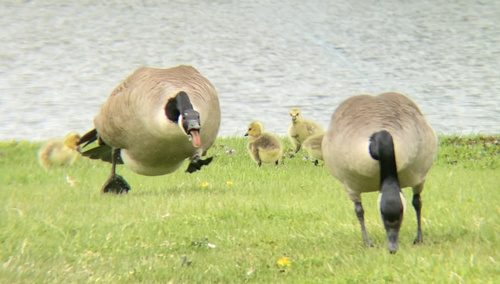 Canada Goose
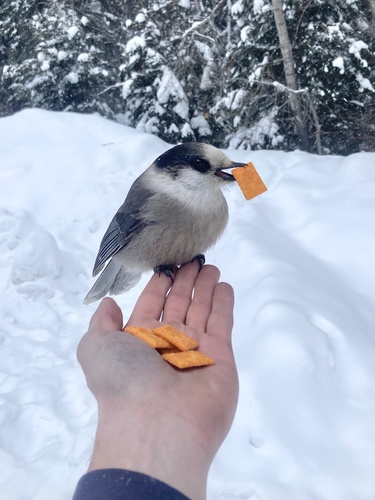 Canada Jay
In short
The Canada Goose and Canada Jay are extremely different in size, shape, and behavior, but their names and overlapping ranges can cause confusion, especially for beginners. The most reliable field mark is size: Canada Goose is a massive waterfowl, while Canada Jay is a medium-sized songbird. In flight or perched, Canada Goose shows a long black neck with a white chinstrap, brown body, and large, heavy build; Canada Jay is compact, with a fluffy, pale grey body, a short black bill, and a white face with a dark nape. Juvenile Canada Jays are all dark grey, while Canada Goose juveniles resemble adults. These species never overlap in structure or typical habitat use, and their calls are entirely different.
Identification tips
- Size is the most immediate clue: Canada Goose is a giant bird, much larger than any jay. If you see a bird larger than a crow, especially near water, Canada Jay is ruled out.
- Neck length: Canada Goose has a very long, slender black neck; Canada Jay has a short neck, typical of a songbird.
- Bill shape: Canada Goose has a broad, flat bill for grazing; Canada Jay has a short, pointed bill for picking at food.
- Plumage contrast: Adult Canada Goose has a black head and neck with a white chinstrap and brown body. Canada Jay adults are pale grey below, medium grey above, with a white face and dark nape.
- Juvenile plumage: Young Canada Jays are all dark grey before their first molt (July–August), never showing a white face or chinstrap. Juvenile Canada Geese look like duller adults, never all-dark.
- Wing and tail shape in flight: Canada Goose has long, broad wings and a short, blunt tail; Canada Jay has rounded wings and a long, loosely held tail.
- Behavior: Canada Goose is usually seen in flocks on water or grazing; Canada Jay is solitary or in small family groups, moving through trees.
- Habitat: Canada Goose is found in open areas near water; Canada Jay is restricted to forests, especially conifers.
- Vocalizations: Canada Goose honks or hrinks loudly; Canada Jay gives soft whistles, clicks, and mimicked calls.
- Perched posture: Canada Goose stands upright, often on the ground; Canada Jay perches on branches, often fluffed up.
- Flight style: Canada Goose flies with steady, strong wingbeats, often in V-formation; Canada Jay flies with short, buoyant hops and glides between trees.
- Leg color: Canada Goose has black legs, but so does Canada Jay; this is not helpful for separation.
- Sexual dimorphism: Both species are similar between sexes; size difference is subtle and not useful in the field.
- Seasonal confusion: Canada Goose is present year-round in many areas, but Canada Jay is resident in boreal forests; range overlap is limited to northern forests.
- Common pitfalls: The only likely confusion is by name or for beginners unfamiliar with either species; in the field, their structure, size, and habitat are unmistakably different.
Size
Canada Goose is among the largest wild geese, averaging over 3500 g in mass and reaching up to 110 cm in length, with a wingspan up to 185 cm [wikidata][wikipedia]. In contrast, Canada Jay is a medium-sized songbird, weighing only about 65–70 g and measuring 25–33 cm in length with a wingspan around 45 cm [wikipedia]. In the field, Canada Goose dwarfs the Canada Jay, being more than four times as long and over fifty times heavier. There is no overlap in size; even the smallest Canada Goose is vastly larger than the largest Canada Jay.
Plumage
Juvenile Canada Jays are distinctive, being uniformly dark grey all over before their first molt (July–August), after which they acquire the adult's pale grey underparts, medium grey back, and white face with a dark nape and hood [wikipedia]. Adult Canada Jays always have a short black bill, white face, and fluffy, soft-looking plumage. Canada Goose, regardless of age, shows a black head and long neck with a white chinstrap, brown body, and white under the chin. Juvenile Canada Geese look similar to adults but may be slightly duller and lack sharp contrast; however, they never show the all-dark look of young Canada Jays. In flight, Canada Goose's large, broad wings and long neck are unmistakable, while Canada Jay is compact with rounded wings and a long, loosely held tail. There is no age or seasonal overlap in wing pattern or body plumage between these species.
Behaviour
Canada Goose is almost always seen on or near water, grazing in flocks, swimming, or flying in V-formations. Its movements are heavy and deliberate, both on land and in flight. Canada Jay is arboreal, often seen flitting between trees, hovering briefly, or perching on branches. It is inquisitive and often approaches humans, sometimes taking food. Canada Jay's flight is buoyant and direct, with frequent glides and short hops, never the strong, steady wingbeats or long glides of a goose. The two species never flock together and behave very differently in all contexts.
Habitat
Canada Goose prefers open water bodies—lakes, ponds, rivers, and adjacent grassy fields—often in urban parks or agricultural land [wikipedia]. It is rarely found deep in forests. Canada Jay is a bird of boreal and subalpine forests, especially coniferous woods, and is seldom seen far from trees [wikipedia]. While both can occur in northern North America, their preferred habitats do not overlap: Canada Goose is tied to open water and open ground, Canada Jay to dense woodland.
Voice
Canada Goose gives loud, resonant honks (males) or higher-pitched hrinks (females), often in flight or when alarmed. Their calls are deep, far-carrying, and unmistakably goose-like. Canada Jay, by contrast, produces a variety of soft whistles, clicks, and chuckles, sometimes mimicking other birds or mammals. Its calls are much quieter, more varied, and never honking. There is no overlap in vocalizations.