
Cackling Goose vs Canada Goose
Branta hutchinsii versus Branta canadensis
Play a quiz with Cackling Goose and Canada Goose
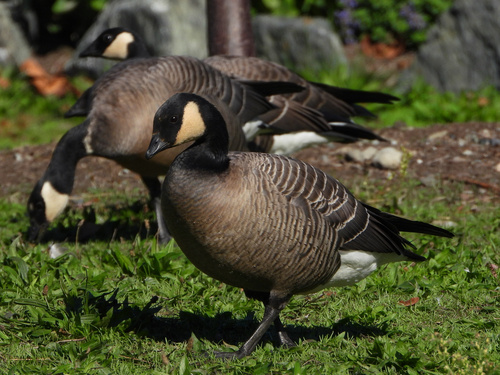 Cackling Goose
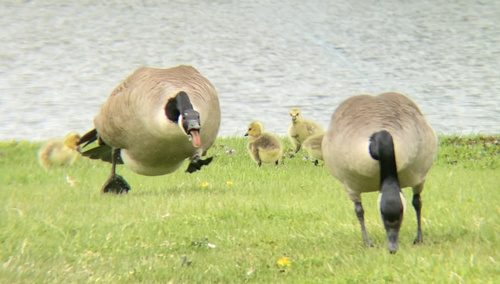 Canada Goose
In short
The most reliable field mark to separate Cackling Goose from Canada Goose is overall size and proportions: Cackling Goose is distinctly smaller, with a noticeably shorter neck and smaller bill, especially obvious in direct comparison. Both species share the classic black head and neck with a white chinstrap, so structure and size are key. Some small Canada Goose subspecies can overlap with large Cackling Geese, making separation tricky, but Cackling Goose typically appears compact and stubby-necked. No age-specific upperwing or flight pattern marks are noted to separate them, so focus on body shape and bill size, especially in mixed flocks.
Identification tips
- Size is the best field mark: Cackling Goose is much smaller than Canada Goose, often strikingly so in mixed flocks. Use direct comparison whenever possible.
- Neck length: Cackling Goose has a noticeably short, stubby neck, while Canada Goose's neck is long and graceful. This is especially obvious in flight or when alert.
- Bill size and shape: Cackling Goose has a short, stubby bill; Canada Goose's bill is longer and more proportional to its head. This can be seen well in profile views.
- Body shape: Cackling Goose appears compact and round-bodied, with a short tail and squat posture. Canada Goose is long-bodied and stands taller.
- In flight: Cackling Goose looks compact and short-necked, with quick, rapid wingbeats. Canada Goose appears heavy, with a long neck stretched out and slower, deeper wingbeats.
- Plumage similarities: Both have black head/neck and white chinstrap; do not rely on this for separation. Body color is variable and overlaps.
- Subspecies confusion: Some small Canada Geese (parvipes) can overlap with large Cackling Geese (hutchinsii), making separation difficult. In these cases, structure (neck, bill) is more reliable than size alone.
- Leucistic variants: Rare Canada Geese may show unusual white or spotted necks; these are not Cackling Geese.
- Sex and age: Males and females are nearly identical in both species; no reliable sex-based field marks. No distinctive juvenile/immature wing or body pattern differences are documented.
- Voice: Listen for higher-pitched, yelping calls from Cackling Goose versus the deeper honk of Canada Goose. Useful when birds are not visible or in mixed flocks.
- Flock structure: Cackling Geese often form tight, compact groups within larger flocks; Canada Geese are more loosely spaced.
- Context: In North America, both species can occur together, especially in migration and winter. In Eurasia, Canada Goose is common due to introductions; Cackling Goose is rare and usually among Canada flocks.
- Habitat: Not a reliable separator, as both use similar wetlands and fields.
- When in doubt: Focus on the combination of small size, short neck, and stubby bill for Cackling Goose, especially in direct comparison with Canada Goose.
- Pitfalls: Beware of overlap between small Canada and large Cackling subspecies; use multiple marks and, if possible, direct side-by-side comparison.
Size
Cackling Goose is much smaller than Canada Goose, with adult Cackling Geese (depending on subspecies) weighing roughly 1.4–2.4 kg, while Canada Goose averages about 3.6 kg (female) to 3.9 kg (male) [wikidata]. The smallest Cackling Goose (minima) is only slightly larger than a Mallard, while even the smallest Canada Goose (parvipes) is bulkier. Canada Goose is also longer (75–110 cm) and has a much greater wingspan (127–185 cm) compared to Cackling Goose (63–65 cm length, 108–111 cm wingspan). In the field, Cackling Goose looks compact, with a short neck and small bill, while Canada Goose is long-necked and hefty.
Plumage
Both species have a black head and neck with a white chinstrap, brownish body, and pale underparts, making plumage alone unreliable for separation in most cases. No distinctive juvenile or immature wing or flight pattern differences are documented between them. Subtle differences exist: Cackling Goose may show slightly paler or grayer body tones in some subspecies, but this is variable and not always reliable. Canada Goose sometimes shows leucistic variants (pepper-spotted necks, white foreheads), but these are rare. Barnacle Goose, sometimes confused with both, has a black breast and gray body, but is not relevant here. Female plumage is nearly identical to males in both species.
Behaviour
Both species behave similarly, often seen grazing in flocks or swimming. However, Cackling Geese often appear more active and alert, with a tendency to move in tighter, more compact groups. In flight, Cackling Geese look stubby and short-necked, while Canada Geese show a long, graceful neck and heavy body. When mixed, Cackling Geese may stick together within a larger Canada Goose flock.
Habitat
Both species are found in North America, often sharing the same lakes, ponds, and grassy fields, especially during migration and winter. Canada Goose is also widespread in Eurasia due to introductions. Cackling Goose is more likely in western and northern regions, but both can overlap extensively. Habitat alone is not diagnostic.
Voice
Both species have similar honking calls, but Cackling Goose gives a higher-pitched, more yelping or squeaky call compared to the deeper, resonant honk of Canada Goose. Female calls are higher and shorter in both species, but the difference is subtle and best appreciated with experience or in direct comparison.