
Buff-browed Foliage-gleaner vs Buff-fronted Foliage-gleaner
Syndactyla rufosuperciliata versus Dendroma rufa
Play a quiz with Buff-browed Foliage-gleaner and Buff-fronted Foliage-gleaner
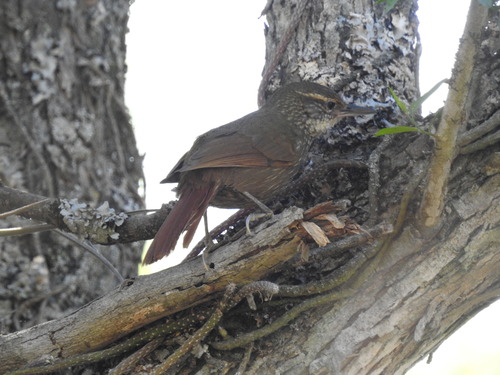 Buff-browed Foliage-gleaner
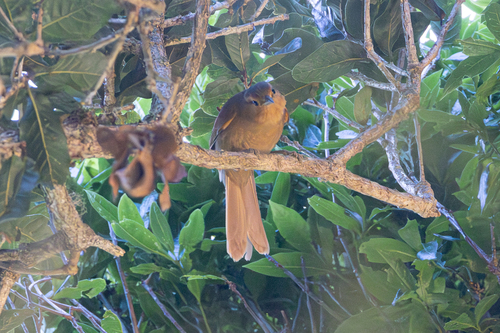 Buff-fronted Foliage-gleaner
In short
The most reliable field mark to separate Buff-browed and Buff-fronted Foliage-gleaners is the color and shape of the supercilium and forehead: Buff-browed shows a long, pale buffy supercilium that extends well past the eye, while Buff-fronted has a wide, glowing ochraceous forehead ('front') that merges into a broad supercilium but is brightest above the bill. In the field, Buff-fronted is slightly larger and bulkier with a more contrasting, glowing ochraceous face and underparts, whereas Buff-browed is plainer olive-brown overall with a less vivid face. Juveniles of both are similar to adults but with subtle differences in underpart patterning. Bill shape and tail color also help in close views. Flight and perched jizz are similar, but careful attention to facial pattern and underpart color will usually clinch the ID.
Identification tips
- Supercilium and Forehead (All Ages): Buff-browed has a long, pale buffy supercilium that extends well behind the eye, giving a 'browed' look. Buff-fronted shows a wide, glowing ochraceous forehead that merges into a broad supercilium, brightest above the bill ('fronted' appearance). This is the single most useful field mark.
- Face Pattern: Buff-fronted's face is more contrasting, with ochraceous ear coverts and malars, and a dark brownish gray line behind the eye. Buff-browed's face is plainer, with brownish tones and small buff markings.
- Crown and Nape: Buff-browed has a dull olive-brown crown with vague whitish streaks at the rear; Buff-fronted's crown is dull brownish gray with nearly invisible paler streaks, often appearing more uniform.
- Back and Rump: Buff-browed is plain olive-brown above; Buff-fronted transitions from dull brownish gray upper back to ochraceous brown lower back and rump, sometimes appearing more colorful from behind.
- Tail Color: Buff-browed's tail is dull rufous, blending with the back; Buff-fronted's tail is dull rufous-brown with pointed feather tips, and may appear brighter and more contrasting with the back, especially in flight.
- Wing Color: Buff-fronted has mostly bright rufous wings with darker primary coverts, giving a more colorful impression in flight or when wings are spread. Buff-browed's wings are rich olivaceous brown, less contrasting with the back.
- Underparts (Adults): Buff-browed shows buffy whitish breast with olive-brown scalloping and blurry streaks on the belly, which fade toward the vent. Buff-fronted has a glowing ochraceous throat and breast, fading to duller ochraceous on the belly and flanks, with little or no streaking.
- Underparts (Juveniles): Buff-browed juveniles have spotted underparts, while Buff-fronted juveniles have darker, more rufescent underparts and a narrower ochraceous forehead band.
- Bill Shape: Buff-browed has a thick, slightly upcurved bill; Buff-fronted's bill is less obviously upcurved and may appear more typical for a foliage-gleaner. This is subtle and best seen at close range.
- Leg Color: Both species have olive to brownish gray legs and feet; not reliably separable in the field.
- Size: Buff-fronted is slightly larger and heavier, but this is rarely obvious unless both are seen side by side.
- Sexes: Both species are sexually monomorphic; plumage differences are not sex-related.
- Flight and Jizz: Both species have similar flight style and foraging behavior; do not rely on jizz for separation.
- Habitat: Both occur in overlapping habitats; context is not a reliable separator.
- Pitfalls: Beware of lighting conditions that can dull or exaggerate facial colors. Immature birds can be especially tricky; focus on the width and color of the supercilium/forehead and underpart patterning for best results.
Size
Buff-fronted Foliage-gleaner is marginally larger and heavier, measuring 18–19 cm in length and weighing 25–36 g, compared to Buff-browed's 17–18 cm and 22–33 g ([wikidata], [wikipedia]). In the hand or at close range, Buff-fronted may appear bulkier and more robust, but in the field this difference is subtle and rarely diagnostic on its own.
Plumage
-
Juveniles: Both species' juveniles resemble adults, but Buff-browed juveniles have spotted (not streaked) underparts, while Buff-fronted juveniles have a narrower ochraceous forehead band and darker, more rufescent underparts. These differences are subtle and best seen at close range.
-
Adults: Buff-browed has a long, pale buffy supercilium extending to the nape, a dull olive-brown crown with vague whitish streaks, plain olive-brown back, and a dull rufous tail. Underparts are buffy whitish with olive-brown scalloping on the breast and blurry streaks on the belly, fading toward the rear. Buff-fronted shows a wide, glowing ochraceous forehead and supercilium, a dull brownish gray crown, ochraceous ear coverts and malars, and a more contrasting, bright rufous wing and tail. Its throat and breast are a rich ochraceous, fading to duller ochraceous on the belly and flanks. The facial pattern is bolder and more colorful in Buff-fronted, while Buff-browed is plainer and more olive overall.
Behaviour
Both species forage actively in foliage, often in pairs or mixed flocks, moving methodically through mid- to upper-level branches. Their foraging behavior and posture are very similar, making behavioral differences unreliable for separation.
Habitat
Both species overlap widely in range and habitat, occurring in humid and semi-humid forests, forest edges, and secondary growth across much of South America. Habitat preference is not a reliable separator in most areas, as both can be found in similar environments from lowlands to foothills.
Buff-browed Foliage-gleaner · Buff-fronted Foliage-gleaner · My Tricky Birds