

Motmot

Buff-barred Warbler vs Brooks's Leaf Warbler

Phylloscopus pulcher versus Phylloscopus subviridis

Play a quiz with Buff-barred Warbler and Brooks's Leaf Warbler
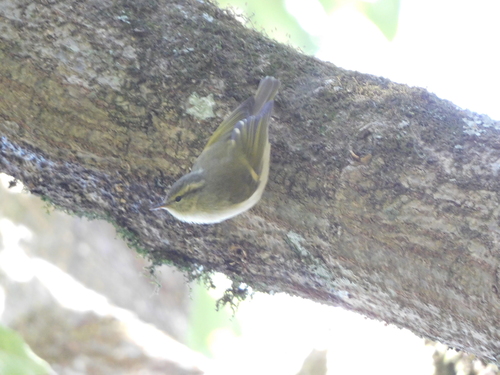
Buff-barred Warbler (Phylloscopus pulcher) Buff-barred Warbler
Brooks's Leaf Warbler (Phylloscopus subviridis) Brooks's Leaf Warbler

Media

Loading…

In short

The most reliable difference between Buff-barred Warbler and Brooks's Leaf Warbler is size: Buff-barred averages noticeably heavier, though both are small leaf warblers. In the field, separation is challenging due to their similar structure and lack of distinctive age-specific wing or flight marks in the available notes. Focus on subtle differences in overall bulk and, if known, local abundance or range. Both species belong to the same genus and family, so expect similar jizz and behavior; plumage and vocal differences are not detailed in the provided sources.

Identification tips

  1. Size is the most reliable field mark: Buff-barred Warbler averages about 1.3g heavier than Brooks's Leaf Warbler. In hand or with experience, Buff-barred should appear slightly bulkier. This is subtle but consistent for adults.
  2. No distinctive age-specific wing or flight patterns: Neither species is described as having unique juvenile or immature upperwing marks, so do not rely on wing panels, triangles, or trailing edges for separation.
  3. Structure is similar: Both are typical Phylloscopus warblers with no noted differences in bill shape, tail length, or wing projection.
  4. Plumage is not diagnostic: The notes do not describe any plumage features that reliably separate these two species at any age or season.
  5. Behavior is not a separator: Expect similar foraging and movement styles; do not use jizz or behavioral cues for identification.
  6. Habitat and range may help locally: Buff-barred Warbler's range is given, but Brooks's is not. If you are in a region where only one is expected, this may help, but check local field guides.
  7. Voice is not covered: No vocal differences are described; do not use song or call for separation based on these notes.
  8. Sex and seasonal variation: No differences between sexes or seasonal plumages are described for either species.
  9. Fallback to size when in doubt: If you must separate these two in the field, focus on subtle differences in overall size and bulk, especially if you have a direct comparison or experience with both.
  10. Check local abundance: If one species is much more common in your area, this may be a clue, but always confirm with current local data.
  11. Avoid over-interpreting minor plumage details: Without specific marks, do not rely on faint bars, shades of green, or other subtle hues, as these are not documented as diagnostic here.
  12. Do not assume habitat differences unless supported: Both can occur in overlapping regions; only use habitat as a clue if you have up-to-date, region-specific information.
  13. If in doubt, document carefully: Photograph or note as many features as possible for later review, especially if you suspect an out-of-range individual.
  14. Consult additional sources for vocal or subtle plumage marks: If you need to separate these species regularly, seek out more detailed regional guides or recordings.
  15. Be honest about uncertainty: Given the lack of strong field marks in these notes, some individuals may not be safely identified to species in the field.

Size

Buff-barred Warbler is consistently heavier, averaging 6.8g compared to Brooks's Leaf Warbler at 5.5g [wikidata]. This difference, while subtle, may translate to a slightly bulkier appearance in Buff-barred, especially if seen side-by-side or with experience. Both are small Phylloscopus warblers, but Buff-barred should look a touch more robust. No other structural or proportional differences are supported by the sources.

Plumage

No age-specific or diagnostic plumage differences are detailed in the provided notes for either species. There is no mention of distinctive juvenile or immature wing patterns, such as unique panels, triangles, or trailing edges, for either Buff-barred or Brooks's Leaf Warbler. Both are typical leaf warblers, and without further detail, plumage is not reliably separable based on the current information.

Behaviour

Behavior is not described as diagnostic in the available sources. Both species are typical Phylloscopus warblers, likely to show active foraging and similar movements. No differences in flight style, tail movement, or foraging behavior are noted.

Habitat

Buff-barred Warbler is reported from a broad range in the Himalayas and Southeast Asia (Bhutan, China, India, Laos, Myanmar, Nepal, Thailand, Vietnam) [wikipedia]. No specific habitat or range information is given for Brooks's Leaf Warbler in the provided notes, so habitat is not a reliable separator here unless local status is known from other sources.

Submit a better description

Use the same sections as the comparison. Your text is published immediately.

The most reliable difference between Buff-barred Warbler and Brooks's Leaf Warbler is size: Buff-barred averages noticeably heavier, though both are small leaf warblers. In the field, separation is challenging due to their similar structure and lack of distinctive age-specific wing or flight marks in the available notes. Focus on subtle differences in overall bulk and, if known, local abundance or range. Both species belong to the same genus and family, so expect similar jizz and behavior; plumage and vocal differences are not detailed in the provided sources.

  1. Size is the most reliable field mark: Buff-barred Warbler averages about 1.3g heavier than Brooks's Leaf Warbler. In hand or with experience, Buff-barred should appear slightly bulkier. This is subtle but consistent for adults.
  2. No distinctive age-specific wing or flight patterns: Neither species is described as having unique juvenile or immature upperwing marks, so do not rely on wing panels, triangles, or trailing edges for separation.
  3. Structure is similar: Both are typical Phylloscopus warblers with no noted differences in bill shape, tail length, or wing projection.
  4. Plumage is not diagnostic: The notes do not describe any plumage features that reliably separate these two species at any age or season.
  5. Behavior is not a separator: Expect similar foraging and movement styles; do not use jizz or behavioral cues for identification.
  6. Habitat and range may help locally: Buff-barred Warbler's range is given, but Brooks's is not. If you are in a region where only one is expected, this may help, but check local field guides.
  7. Voice is not covered: No vocal differences are described; do not use song or call for separation based on these notes.
  8. Sex and seasonal variation: No differences between sexes or seasonal plumages are described for either species.
  9. Fallback to size when in doubt: If you must separate these two in the field, focus on subtle differences in overall size and bulk, especially if you have a direct comparison or experience with both.
  10. Check local abundance: If one species is much more common in your area, this may be a clue, but always confirm with current local data.
  11. Avoid over-interpreting minor plumage details: Without specific marks, do not rely on faint bars, shades of green, or other subtle hues, as these are not documented as diagnostic here.
  12. Do not assume habitat differences unless supported: Both can occur in overlapping regions; only use habitat as a clue if you have up-to-date, region-specific information.
  13. If in doubt, document carefully: Photograph or note as many features as possible for later review, especially if you suspect an out-of-range individual.
  14. Consult additional sources for vocal or subtle plumage marks: If you need to separate these species regularly, seek out more detailed regional guides or recordings.
  15. Be honest about uncertainty: Given the lack of strong field marks in these notes, some individuals may not be safely identified to species in the field.

Buff-barred Warbler is consistently heavier, averaging 6.8g compared to Brooks's Leaf Warbler at 5.5g [wikidata]. This difference, while subtle, may translate to a slightly bulkier appearance in Buff-barred, especially if seen side-by-side or with experience. Both are small Phylloscopus warblers, but Buff-barred should look a touch more robust. No other structural or proportional differences are supported by the sources.

No age-specific or diagnostic plumage differences are detailed in the provided notes for either species. There is no mention of distinctive juvenile or immature wing patterns, such as unique panels, triangles, or trailing edges, for either Buff-barred or Brooks's Leaf Warbler. Both are typical leaf warblers, and without further detail, plumage is not reliably separable based on the current information.

Behavior is not described as diagnostic in the available sources. Both species are typical Phylloscopus warblers, likely to show active foraging and similar movements. No differences in flight style, tail movement, or foraging behavior are noted.

Buff-barred Warbler is reported from a broad range in the Himalayas and Southeast Asia (Bhutan, China, India, Laos, Myanmar, Nepal, Thailand, Vietnam) [wikipedia]. No specific habitat or range information is given for Brooks's Leaf Warbler in the provided notes, so habitat is not a reliable separator here unless local status is known from other sources.

Discard your changes?

You have unsaved edits. If you leave now, those changes will be lost.

Buff-barred Warbler · Brooks's Leaf Warbler · My Tricky Birds