

Brahminy Kite vs Sanford's Sea-Eagle
Haliastur indus versus Icthyophaga sanfordi
Play a quiz with Brahminy Kite and Sanford's Sea-Eagle
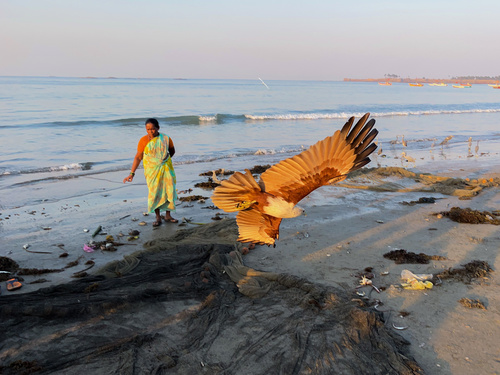 Brahminy Kite
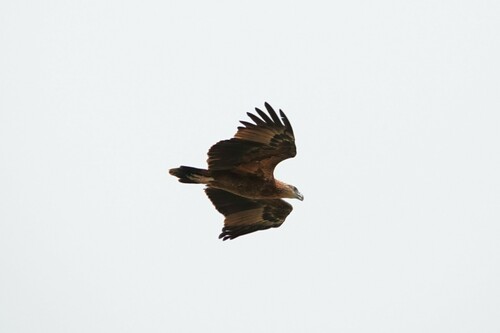 Sanford's Sea-Eagle
In short
The most reliable field mark to separate Brahminy Kite from Sanford's Sea-Eagle is the combination of tail color and head pattern: Brahminy Kite of all ages shows a distinctly white head and breast with a contrasting chestnut body and a rounded, pale tail, while Sanford's Sea-Eagle always has a uniformly dark tail and a much larger, bulkier build. Juvenile Brahminy Kites are paler and smaller than Sanford's, with a shorter, rounded tail and never the all-dark tail of Sanford's. In flight, Brahminy Kites appear more buoyant and kite-like, whereas Sanford's Sea-Eagle is massive and eagle-like. Habitat can help: Brahminy Kite is widespread in coastal and wetland areas across Asia and Australia, while Sanford's is endemic to the Solomon Islands.
Identification tips
- Tail color is critical: Sanford's Sea-Eagle always has an entirely dark tail at all ages; Brahminy Kite has a pale, rounded tail, never all dark. This is the single most reliable mark in flight or perched.
- Head and breast contrast: Adult Brahminy Kite shows a crisp white head and breast contrasting with chestnut body and wings. Sanford's has a brownish or pale brown head blending into darker body, never pure white or sharply contrasting.
- Size and bulk: Sanford's Sea-Eagle is much larger and heavier than Brahminy Kite. Even at a distance, Sanford's appears bulkier, with broader wings and a more massive bill. Brahminy Kite is noticeably lighter and more slender.
- Flight style: Brahminy Kite soars with wings angled and tail rounded, giving a buoyant, agile impression. Sanford's has broad, heavy wings and a slower, more powerful flight, typical of large sea eagles.
- Juvenile confusion: Young Brahminy Kites are brownish overall but still show a paler head and underparts, and their tail is always pale and rounded. They never show the all-dark tail of Sanford's. Juvenile Sanford's is large, dark-tailed, and lacks any crisp pale head.
- Underwing pattern: Juvenile Brahminy Kite shows a squarish pale patch at the carpal (wrist) on the underwing, which is absent in Sanford's. Sanford's underwing is more uniformly dark.
- Tail shape: Brahminy Kite has a rounded tail; Sanford's tail is more straight-edged but always dark. Milvus kites (not in this comparison) have forked tails, but both these species do not.
- Bill and feet: Sanford's has a much heavier, more powerful bill and talons, suited to its sea eagle lifestyle. Brahminy Kite's bill is finer and less robust.
- Habitat and range: Brahminy Kite is widespread in Asia and Australia, often seen over wetlands and coasts. Sanford's is endemic to the Solomon Islands and not found elsewhere.
- Perched posture: Brahminy Kite perches more lightly, often on exposed branches or posts. Sanford's appears massive and heavy when perched, often in large trees.
- Context with other birds: If seen with other raptors, Brahminy Kite is similar in size to Black Kite, while Sanford's dwarfs other birds in its range.
- Upperparts color: Brahminy Kite's upperparts are rich chestnut; Sanford's are dark brown to gray-black.
- Eye color: Sanford's has bright brown eyes; Brahminy Kite's eye color is less distinctive in the field.
- No white-headed Sanford's: If the bird has a crisp white head and breast, it is Brahminy Kite, not Sanford's.
- No pale-tailed Sanford's: Any bird with a pale or white tail is not Sanford's Sea-Eagle.
Size
Sanford's Sea-Eagle is dramatically larger than Brahminy Kite: it reaches 70–90 cm in length and 1.1–2.7 kg in weight, with a wingspan of 165–185 cm. In contrast, Brahminy Kite is much smaller, measuring 45–51 cm in length, 320–673 g in weight, and a wingspan of 109–124 cm. This size difference is obvious in direct comparison or when seen perched or soaring with other birds. Sanford's is a true sea eagle, with a bulkier body and heavier bill, while Brahminy Kite is a medium-sized, lighter raptor with a more slender build. [wikipedia][avonet][wikidata]
Plumage
Juvenile and immature Brahminy Kites are brownish overall but always show a paler head and underparts compared to Sanford's, and their tail is rounded and pale, never solid dark. The underwing of Brahminy Kite juveniles shows a squarish pale patch at the carpal (wrist) area, and the wings are shorter and more angled than in Sanford's. Adults are unmistakable: Brahminy Kite has a striking white head and breast, rich chestnut body and wings, and black wingtips, with a rounded, pale tail. Sanford's Sea-Eagle, at all ages, has a dark tail, brown to reddish-brown underparts, and a head and neck that are whitish brown to bright brown, blending into the darker upperparts. The upperparts are dark brown to gray-black, and the bird lacks any white on the head or tail. This combination of a dark tail and lack of crisp white head is diagnostic for Sanford's. [wikipedia]
Behaviour
Brahminy Kite typically soars with wings angled and tail rounded, showing agile, buoyant flight reminiscent of other kites. It often scavenges or hunts over water or wetlands, sometimes seen gliding low or perching conspicuously. Sanford's Sea-Eagle, being much larger, soars with broad, heavy wings and a more ponderous, powerful flight style typical of sea eagles. It is the apex predator in its range and is often seen perched high in coastal forests or flying over large bodies of water. [wikipedia]
Habitat
Brahminy Kite is found mainly along coasts and inland wetlands throughout the Indian subcontinent, Southeast Asia, and Australia. It is common in open habitats near water, including rivers, lakes, and estuaries. Sanford's Sea-Eagle is restricted to the Solomon Islands archipelago, inhabiting coastal forests and lakes up to 1500 m elevation. It is the only large raptor in its range and is always associated with large tracts of forest near water. Thus, location is a strong clue: outside the Solomons, Sanford's does not occur. [wikipedia][ebird]