
Booted Warbler vs Upcher's Warbler
Iduna caligata versus Hippolais languida
Play a quiz with Booted Warbler and Upcher's Warbler
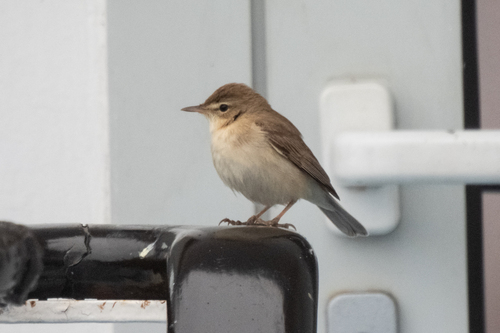 Booted Warbler
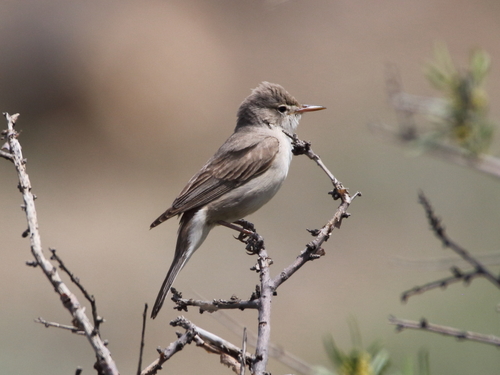 Upcher's Warbler
In short
The most reliable field mark between Booted Warbler and Upcher's Warbler is structural: Upcher's Warbler has a distinctly longer tail and often flicks it, while Booted Warbler appears pot-bellied with a square-tipped, shorter tail. Both species are plain and greyish-brown, but Booted Warbler is smaller and more compact, with a clear pale supercilium and short wings. Upcher's Warbler is larger, longer-tailed, and its frequent tail movement is a strong behavioral clue. In the field, focus on tail length and movement, overall jizz, and subtle differences in bill and wing proportions, as plumage is otherwise very similar and undistinguished.
Identification tips
- Tail length and movement: Upcher's Warbler has a distinctly longer tail which it flicks or swings frequently; Booted Warbler's tail is shorter, square-tipped, and usually held still. This is the single most reliable field mark for all ages and seasons.
- Overall jizz: Booted Warbler looks pot-bellied, compact, and short-winged, while Upcher's Warbler is longer, lankier, and more elongated in posture, especially when perched.
- Supercilium: Booted Warbler shows a clear, pale supercilium above the eye, which is usually more obvious than in Upcher's Warbler. However, this can be subtle in poor light or worn plumage.
- Bill shape: Upcher's Warbler has a slightly longer bill than Booted Warbler, but this is best judged in direct comparison or with experience.
- Wing length: Booted Warbler is short-winged, with wings noticeably shorter than the tail; Upcher's has slightly longer wings, but the effect is masked by its even longer tail.
- Plumage coloration: Both are plain greyish-brown above and paler below, lacking strong contrasts or wing bars. Do not rely on color alone.
- Flight silhouette: In flight, Booted Warbler appears compact and short-winged, while Upcher's Warbler looks more stretched with a longer tail trailing behind.
- Behavior: Upcher's Warbler's tail-flicking is diagnostic; Booted Warbler rarely moves its tail in this way.
- Size impression: Booted Warbler is noticeably smaller and more compact than Upcher's, which is medium-sized and closer to icterine warbler in size.
- Habitat context: If seen in Western Europe, Booted Warbler is the more likely vagrant; Upcher's is rare and mainly eastern in distribution.
- Song: If heard, Upcher's Warbler's song is distinctive among Hippolais, but not directly compared to Booted Warbler here—use with caution.
- Pitfalls: Both species can appear very similar in poor light or at distance; always try to observe tail length and movement, and overall structure, rather than relying on subtle plumage shades.
- Age/season: No strong age-specific flight or wing pattern marks are present in either species, so these tips apply to all ages and seasons.
- Direct comparison: If both species are present, Upcher's will stand out as longer, lankier, and more active in tail movement; Booted will look dumpier and more static.
- When in doubt: If you cannot see the tail clearly or the bird is not moving, focus on overall size, jizz, and supercilium, but be aware that separation may not always be possible without a good view.
Size
Booted Warbler is a small warbler, about the size of a chiffchaff, and appears short-winged and compact. Upcher's Warbler is medium-sized, closer to an icterine warbler in bulk, with a noticeably longer tail and slightly longer bill. In direct comparison, Upcher's will look lankier and more elongated, especially when perched or in flight. [wikipedia]
Plumage
Neither species shows strong age-specific upperwing patterns or contrasting panels in any plumage; both are plain greyish-brown above and paler below. Booted Warbler of all ages shows a clear, pale supercilium, plain greyish-brown upperparts, and a pot-bellied look. Upcher's Warbler is also greyish, but with a longer tail and a slightly longer bill; its plumage is similar to olivaceous warbler but with a diagnostic tail movement. Both lack strong wing bars or obvious flight marks, so structure and behavior are more useful than plumage for separation at all ages. [wikipedia]
Behaviour
Upcher's Warbler is notable for its frequent tail movement—flicking or swinging its long tail in a manner reminiscent of Sylvia warblers or chats. Booted Warbler does not show this behavior and tends to appear more pot-bellied and static. In flight, Booted Warbler looks short-winged and compact, while Upcher's shows a longer tail and more elongated jizz. Watching how the bird moves its tail and body is often the quickest way to separate these two in the field. [wikipedia]
Habitat
Both species breed in open, shrubby habitats, but their ranges overlap only marginally. Booted Warbler breeds from Eastern Europe to western Asia and is a regular vagrant in Western Europe, while Upcher's Warbler breeds from Turkey east to Pakistan and winters in eastern Africa. In areas of overlap, habitat is not a strong separator, but Booted Warbler may be more likely in northern or western vagrancy contexts. [wikipedia]
Voice
Upcher's Warbler has a distinctive song, different from olivaceous warbler and other Hippolais, but the notes do not compare it directly to Booted Warbler. Booted Warbler's voice is not described here, so vocalization is not a reliable separator based on these notes. [wikipedia]