
Booted Eagle vs Bonelli's Eagle
Hieraaetus pennatus versus Aquila fasciata
Play a quiz with Booted Eagle and Bonelli's Eagle
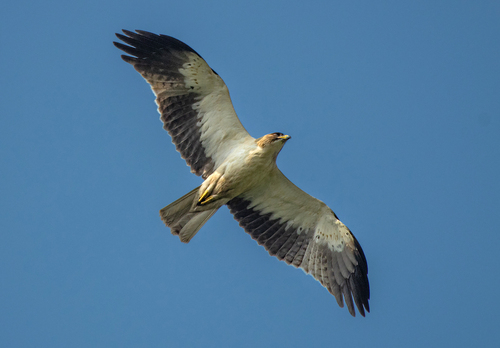 Booted Eagle
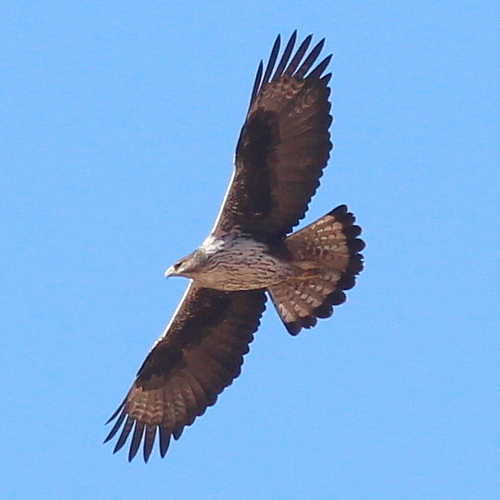 Bonelli's Eagle
In short
The most reliable field mark to separate Booted Eagle from Bonelli's Eagle is size and structure: Bonelli's is much larger, bulkier, and longer-winged, with a proportionally longer tail and broader wings, especially obvious in flight. For immature birds, Bonelli's juvenile shows a pale rufous underside with minimal streaking and a more clearly barred tail, while Booted Eagle immatures (in both pale and dark morphs) lack Bonelli's distinctive tail and underpart pattern. Adult Bonelli's Eagles show a white mantle patch and broad pale wing covert edges, while Booted Eagles have two distinct color morphs (pale and dark) but never show Bonelli's combination of mantle patch and tail pattern. In perched birds, Bonelli's Eagle's larger size, longer tail, and heavier bill are key. Both species can be confused in dark morphs or at distance, but careful attention to structure and juvenile plumage usually resolves the ID.
Identification tips
- Size and bulk: Bonelli's Eagle is much larger and heavier than Booted Eagle; this is often the first clue, especially when seen with other raptors for scale. Applies to all ages and seasons.
- Wings and tail in flight: Bonelli's has longer, broader wings and a longer, broader tail, often held square-ended or slightly pinched. Booted Eagle is more compact and lighter-winged. This is especially clear in soaring or gliding birds.
- Juvenile underparts: Juvenile Bonelli's Eagle is pale rufous or buff below with minimal dark streaks, mainly on the chest sides. Booted Eagle juveniles (both morphs) lack this coloration and pattern; pale morphs are light below but not rufous, and dark morphs are uniformly darker.
- Juvenile tail pattern: Bonelli's juvenile shows a clearly barred tail with a thin white tip and a subterminal band only slightly thicker than other bars. Booted Eagle juveniles do not show this combination.
- Adult mantle patch: Adult Bonelli's Eagle almost always shows a white patch on the mantle (sometimes large, sometimes small), which Booted Eagle never shows. Look for this in perched or flying birds.
- Adult wing coverts: Bonelli's Eagle adults have broad pale edges to median wing coverts, giving a lighter brown panel on the upperwing. Booted Eagle lacks this feature in both morphs.
- Tail pattern in adults: Bonelli's Eagle adults have a grey tail with faint bars, a broad blackish subterminal band, and a creamy white tip. Booted Eagle's tail is less distinctly patterned and lacks the broad subterminal band and white tip.
- Underpart streaking: Adult Bonelli's Eagle shows variable dark streaking on a cream base below, strongest on breast and flanks. Booted Eagle pale morph is cleaner below, while dark morph is uniformly dark.
- Head and neck: Bonelli's Eagle has a dark brown head with a paler, often streaky neck and white throat; Booted Eagle's head is darker than the body in pale morph, but lacks Bonelli's streaky neck and white throat.
- Bill and feet: Bonelli's Eagle has a heavier bill and larger feet, but this is subtle at distance.
- Perched structure: Bonelli's Eagle appears larger, longer-tailed, and more upright when perched. Booted Eagle is more compact and less imposing.
- Flight style: Bonelli's Eagle uses powerful, loose wingbeats and often glides on flat wings; Booted Eagle is lighter and less powerful in flight.
- Plumage morphs: Booted Eagle has two morphs (pale and dark); Bonelli's does not. Dark morph Booted Eagle can be confused with Bonelli's, but is smaller and lacks Bonelli's tail and mantle features.
- Habitat context: Bonelli's Eagle is more likely in rocky, mountainous terrain; Booted Eagle is more versatile and migratory, often in wooded or open areas.
- Voice: Booted Eagle gives a shrill 'kli-kli-kli' call; Bonelli's Eagle's voice is not distinctive in the provided notes, so use with caution.
Size
Bonelli's Eagle is substantially larger and heavier than Booted Eagle. Bonelli's averages around 2190 g, while Booted Eagle is much lighter at about 842 g [wikidata]. In the field, Bonelli's appears bulkier, with a longer, broader tail and more massive build. Booted Eagle is a small eagle, more compact and lighter in flight and when perched. This size difference is often obvious when seen together or when compared with other raptors in the area.
Plumage
- Juvenile/immature birds: Juvenile Bonelli's Eagle is medium brown above with paler edges, sometimes a creamy patch on the back, and a rusty-buff underside with minimal black streaks (mainly on chest sides). Its tail is more clearly barred than adults, with a thin white tip and a subterminal band only slightly thicker than other bars. By contrast, Booted Eagle juveniles (in both morphs) do not show Bonelli's combination of pale underparts and finely barred tail; instead, pale morph Booted Eagles are light below with darker head and flight feathers, while dark morphs are mid-brown overall with dark flight feathers. Booted Eagle juveniles lack the extensive pale covert edges and mantle patch of Bonelli's.
- Adults: Adult Bonelli's Eagle is dark brown above with broad pale edges to median coverts (making these appear lighter brown), and a variable white patch on the mantle (almost always present to some degree). The tail is grey with faint bars, a broad blackish subterminal band, and a creamy white tip. Underparts are cream with variable dark streaking, especially on breast and flanks. Booted Eagle adults come in two morphs: pale (light grey with darker head and flight feathers) and dark (mid-brown with dark grey flight feathers). Booted Eagles never show Bonelli's white mantle patch or the same tail pattern. The pale morph Booted Eagle can appear much lighter overall, but lacks Bonelli's streaked underparts and mantle patch. Dark morph Booted Eagle can be confused with Bonelli's at a distance, but is smaller and lacks Bonelli's structural features and tail pattern.
Behaviour
Bonelli's Eagle typically flies with powerful, loose, shallow wingbeats and often glides on flat wings with well-spread feathers, carpals slightly forward. It soars infrequently, but when it does, the wings are flat or slightly raised. Bonelli's often appears in pairs in flight. Booted Eagle usually flies at relatively low heights and is often seen alone or in pairs. Its flight is lighter and less powerful than Bonelli's, reflecting its smaller size. Booted Eagle hunts by stooping quickly on prey from the wing, while Bonelli's is more likely to be seen soaring or gliding over open country.
Habitat
Both species can occur in overlapping habitats, but Bonelli's Eagle is more associated with open, rocky hills, cliffs, and mountainous areas, often nesting on cliffs. Booted Eagle is more migratory and can be found across a wider range, including woodlands, forest edges, and sometimes open country. In Southern Africa, Booted Eagles may nest on cliff ledges, but this is less typical in their Palearctic range. Habitat alone is not diagnostic, but Bonelli's is more likely in rugged, rocky terrain, while Booted Eagle is more versatile and often found in areas with more tree cover.
Voice
Booted Eagle gives a shrill 'kli-kli-kli' call. Bonelli's Eagle's vocalizations are not described in detail in the provided notes, so voice is not a strong separator here.