
Motmot

Bonelli's Eagle vs Western Marsh Harrier

Aquila fasciata versus Circus aeruginosus

Play a quiz with Bonelli's Eagle and Western Marsh Harrier
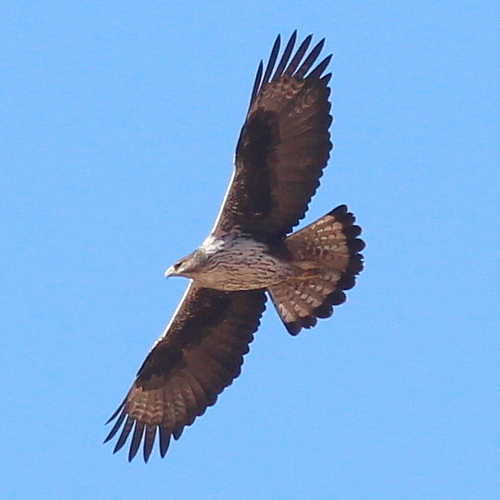
Bonelli's Eagle (Aquila fasciata) Bonelli's Eagle
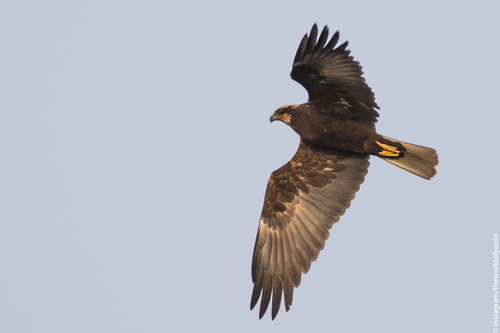
Western Marsh Harrier (Circus aeruginosus) Western Marsh Harrier

Media

Loading…

In short

The most reliable field mark to separate Bonelli's Eagle from Western Marsh Harrier is overall structure and flight style: Bonelli's Eagle is a much bulkier, more powerful raptor with broad, square-ended wings and a long tail, while Western Marsh Harrier is slimmer, with narrower wings held in a shallow V and a more buoyant, gliding flight. Juvenile Bonelli's Eagles are pale below with minimal streaking and a long, barred tail, whereas juvenile Marsh Harriers are dark brown with contrasting pale head and shoulders. In adults, Bonelli's shows a white mantle patch and heavy streaking below, while Marsh Harrier males are tricolored with grey, brown, and black wings. Size difference is extreme: Bonelli's Eagle is over twice as heavy as even the largest Marsh Harrier. Use structure and flight first, then plumage details by age.

Identification tips

  1. Size and bulk: Bonelli's Eagle is much larger and heavier than Western Marsh Harrier; use this when seen with other birds or familiar objects for scale.
  2. Wing shape in flight: Bonelli's Eagle has broad, long, square-ended wings, sometimes appearing pinched at the body and slightly tapered at the tips. Marsh Harrier has narrower wings, often held in a shallow V ('dihedral') when gliding.
  3. Tail shape and length: Bonelli's Eagle shows a long, broad tail, sometimes appearing narrow if pinched, with a clear white tip and (in adults) a broad blackish subterminal band. Marsh Harrier's tail is shorter and less broad, lacking the white tip and strong subterminal band.
  4. Juvenile underparts: Juvenile Bonelli's Eagle is pale rufous to buff below with very little streaking, while juvenile Marsh Harrier is dark brown overall with a pale yellowish head and shoulders.
  5. Juvenile upperparts: Juvenile Bonelli's Eagle is medium brown above with paler edges and sometimes a creamy patch on the back; Marsh Harrier juveniles are darker, with less contrast except for the pale head/shoulders.
  6. Adult upperwing: Adult Bonelli's Eagle is dark brown with broad pale margins on the median coverts and a variable white mantle patch. Marsh Harrier males have a striking tricolor pattern: brown forewing, grey secondaries and tail, black wingtips.
  7. Adult underparts: Bonelli's Eagle adults are cream below with strong blackish streaks, especially on the breast and flanks; adult Marsh Harrier males have a streaked breast but otherwise are not as heavily marked below.
  8. Adult female/juvenile Marsh Harrier head: Female and juvenile Marsh Harrier have a conspicuously pale yellowish head and shoulders, contrasting with a dark eye area; Bonelli's Eagle never shows this pattern.
  9. White mantle patch: Bonelli's Eagle adults (and sometimes immatures) show a white patch on the mantle, variable in size but almost always present; Marsh Harrier never shows this.
  10. Flight style: Bonelli's Eagle soars or glides on flat wings, often in pairs, with powerful wingbeats; Marsh Harrier glides low over ground with wings in a shallow V and often with dangling legs.
  11. Bill and cere: Both species have yellow cere and feet, but Bonelli's Eagle's bill is heavier and more powerful; not always visible at distance.
  12. Eye color: Adult Bonelli's Eagle has yellow to yellow-orange eyes, juveniles hazel-brown; Marsh Harrier has yellow irides in both sexes, but this is rarely diagnostic at range.
  13. Habitat context: Bonelli's Eagle is found in rocky hills and open woodlands, rarely over marshes; Marsh Harrier is almost always in or near wetlands.
  14. Sexual dimorphism: Bonelli's Eagle females are darker and more heavily patterned below than males; Marsh Harrier shows strong sexual dimorphism, with males tricolored and females dark brown with pale head.
  15. Rare morphs: Marsh Harrier can show a hypermelanic (very dark) morph, especially in the east; Bonelli's Eagle does not show this variation.

Size

Bonelli's Eagle is dramatically larger and heavier than Western Marsh Harrier. Bonelli's averages about 2190 g in body mass [wikidata], while Marsh Harrier females (the larger sex) top out at 800 g and males are even lighter. In the field, Bonelli's Eagle appears as a large, broad-winged, long-tailed raptor, whereas Marsh Harrier is noticeably slimmer, lighter, and less imposing. This size gap is obvious when seen together or with familiar birds for scale.

Plumage

Juvenile Bonelli's Eagle is medium brown above with paler edges, a rusty-brown head, and a long, clearly barred tail with a thin white tip; the underparts are light rufous to buff with very little streaking, mostly on the chest sides. By contrast, juvenile Western Marsh Harrier is dark chocolate-brown overall with a conspicuously paler yellowish head and shoulders, and lacks the pale underparts and long, barred tail of Bonelli's. Adult Bonelli's Eagle is dark brown above with broad pale margins on the wing coverts, a variable white mantle patch, and a grey tail with a broad blackish subterminal band and white tip; the underparts are cream with blackish streaks, especially on the breast and flanks. Adult male Marsh Harrier is tricolored: brown forewing, pale grey secondaries and tail, and black wingtips, with a pale head and streaked breast. Adult female Marsh Harrier is mostly chocolate-brown with a pale yellowish head, throat, and shoulders, and a dark eye area. Bonelli's Eagle never shows the grey wing and tail panels of male Marsh Harrier, nor the strongly contrasting pale head of female Marsh Harrier. In flight, Bonelli's Eagle looks bulkier and the tail is longer and broader, while Marsh Harrier's wings are narrower and held in a shallow V.

Behaviour

Bonelli's Eagle typically soars or glides on flat or slightly raised wings, often flying in pairs, with powerful but loose wingbeats. Its flight is strong and purposeful, with a well-projected head and broad, long wings. Western Marsh Harrier hunts by gliding low over open ground with wings held in a shallow V and often with dangling legs, giving a buoyant, less direct impression. Marsh Harrier rarely soars high and is more likely to be seen quartering over marshes and fields.

Habitat

Bonelli's Eagle prefers rocky hills, cliffs, and open woodlands, often far from water, while Western Marsh Harrier is strongly tied to wetlands, marshes, and reedbeds. Seeing a large raptor over open water or extensive marsh is much more likely to be Marsh Harrier; Bonelli's Eagle is rarely found in such habitats.

Submit a better description

Use the same sections as the comparison. Your text is published immediately.

The most reliable field mark to separate Bonelli's Eagle from Western Marsh Harrier is overall structure and flight style: Bonelli's Eagle is a much bulkier, more powerful raptor with broad, square-ended wings and a long tail, while Western Marsh Harrier is slimmer, with narrower wings held in a shallow V and a more buoyant, gliding flight. Juvenile Bonelli's Eagles are pale below with minimal streaking and a long, barred tail, whereas juvenile Marsh Harriers are dark brown with contrasting pale head and shoulders. In adults, Bonelli's shows a white mantle patch and heavy streaking below, while Marsh Harrier males are tricolored with grey, brown, and black wings. Size difference is extreme: Bonelli's Eagle is over twice as heavy as even the largest Marsh Harrier. Use structure and flight first, then plumage details by age.

  1. Size and bulk: Bonelli's Eagle is much larger and heavier than Western Marsh Harrier; use this when seen with other birds or familiar objects for scale.
  2. Wing shape in flight: Bonelli's Eagle has broad, long, square-ended wings, sometimes appearing pinched at the body and slightly tapered at the tips. Marsh Harrier has narrower wings, often held in a shallow V ('dihedral') when gliding.
  3. Tail shape and length: Bonelli's Eagle shows a long, broad tail, sometimes appearing narrow if pinched, with a clear white tip and (in adults) a broad blackish subterminal band. Marsh Harrier's tail is shorter and less broad, lacking the white tip and strong subterminal band.
  4. Juvenile underparts: Juvenile Bonelli's Eagle is pale rufous to buff below with very little streaking, while juvenile Marsh Harrier is dark brown overall with a pale yellowish head and shoulders.
  5. Juvenile upperparts: Juvenile Bonelli's Eagle is medium brown above with paler edges and sometimes a creamy patch on the back; Marsh Harrier juveniles are darker, with less contrast except for the pale head/shoulders.
  6. Adult upperwing: Adult Bonelli's Eagle is dark brown with broad pale margins on the median coverts and a variable white mantle patch. Marsh Harrier males have a striking tricolor pattern: brown forewing, grey secondaries and tail, black wingtips.
  7. Adult underparts: Bonelli's Eagle adults are cream below with strong blackish streaks, especially on the breast and flanks; adult Marsh Harrier males have a streaked breast but otherwise are not as heavily marked below.
  8. Adult female/juvenile Marsh Harrier head: Female and juvenile Marsh Harrier have a conspicuously pale yellowish head and shoulders, contrasting with a dark eye area; Bonelli's Eagle never shows this pattern.
  9. White mantle patch: Bonelli's Eagle adults (and sometimes immatures) show a white patch on the mantle, variable in size but almost always present; Marsh Harrier never shows this.
  10. Flight style: Bonelli's Eagle soars or glides on flat wings, often in pairs, with powerful wingbeats; Marsh Harrier glides low over ground with wings in a shallow V and often with dangling legs.
  11. Bill and cere: Both species have yellow cere and feet, but Bonelli's Eagle's bill is heavier and more powerful; not always visible at distance.
  12. Eye color: Adult Bonelli's Eagle has yellow to yellow-orange eyes, juveniles hazel-brown; Marsh Harrier has yellow irides in both sexes, but this is rarely diagnostic at range.
  13. Habitat context: Bonelli's Eagle is found in rocky hills and open woodlands, rarely over marshes; Marsh Harrier is almost always in or near wetlands.
  14. Sexual dimorphism: Bonelli's Eagle females are darker and more heavily patterned below than males; Marsh Harrier shows strong sexual dimorphism, with males tricolored and females dark brown with pale head.
  15. Rare morphs: Marsh Harrier can show a hypermelanic (very dark) morph, especially in the east; Bonelli's Eagle does not show this variation.

Bonelli's Eagle is dramatically larger and heavier than Western Marsh Harrier. Bonelli's averages about 2190 g in body mass [wikidata], while Marsh Harrier females (the larger sex) top out at 800 g and males are even lighter. In the field, Bonelli's Eagle appears as a large, broad-winged, long-tailed raptor, whereas Marsh Harrier is noticeably slimmer, lighter, and less imposing. This size gap is obvious when seen together or with familiar birds for scale.

Juvenile Bonelli's Eagle is medium brown above with paler edges, a rusty-brown head, and a long, clearly barred tail with a thin white tip; the underparts are light rufous to buff with very little streaking, mostly on the chest sides. By contrast, juvenile Western Marsh Harrier is dark chocolate-brown overall with a conspicuously paler yellowish head and shoulders, and lacks the pale underparts and long, barred tail of Bonelli's. Adult Bonelli's Eagle is dark brown above with broad pale margins on the wing coverts, a variable white mantle patch, and a grey tail with a broad blackish subterminal band and white tip; the underparts are cream with blackish streaks, especially on the breast and flanks. Adult male Marsh Harrier is tricolored: brown forewing, pale grey secondaries and tail, and black wingtips, with a pale head and streaked breast. Adult female Marsh Harrier is mostly chocolate-brown with a pale yellowish head, throat, and shoulders, and a dark eye area. Bonelli's Eagle never shows the grey wing and tail panels of male Marsh Harrier, nor the strongly contrasting pale head of female Marsh Harrier. In flight, Bonelli's Eagle looks bulkier and the tail is longer and broader, while Marsh Harrier's wings are narrower and held in a shallow V.

Bonelli's Eagle typically soars or glides on flat or slightly raised wings, often flying in pairs, with powerful but loose wingbeats. Its flight is strong and purposeful, with a well-projected head and broad, long wings. Western Marsh Harrier hunts by gliding low over open ground with wings held in a shallow V and often with dangling legs, giving a buoyant, less direct impression. Marsh Harrier rarely soars high and is more likely to be seen quartering over marshes and fields.

Bonelli's Eagle prefers rocky hills, cliffs, and open woodlands, often far from water, while Western Marsh Harrier is strongly tied to wetlands, marshes, and reedbeds. Seeing a large raptor over open water or extensive marsh is much more likely to be Marsh Harrier; Bonelli's Eagle is rarely found in such habitats.

Discard your changes?

You have unsaved edits. If you leave now, those changes will be lost.

Bonelli's Eagle · Western Marsh Harrier · My Tricky Birds