

Bobolink vs Tricoloured Blackbird
Dolichonyx oryzivorus versus Agelaius tricolor
Play a quiz with Bobolink and Tricoloured Blackbird
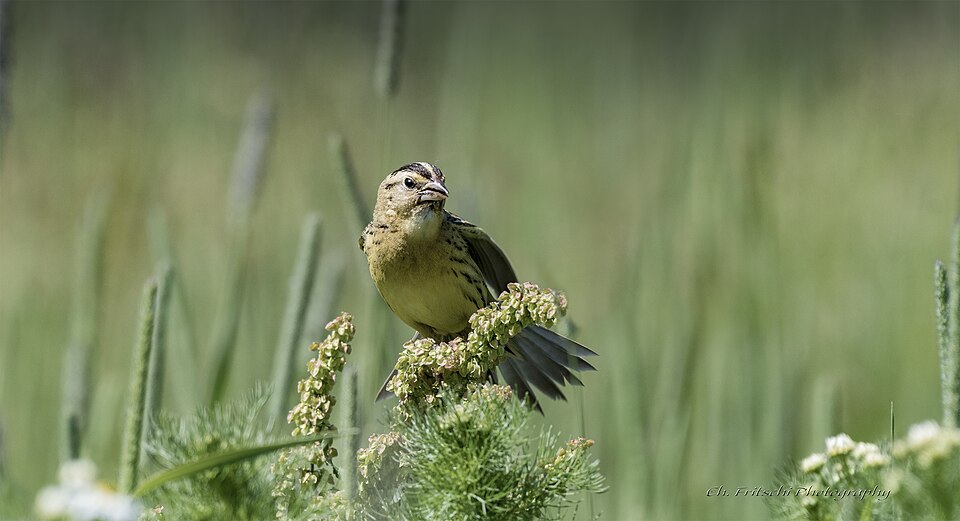 Bobolink
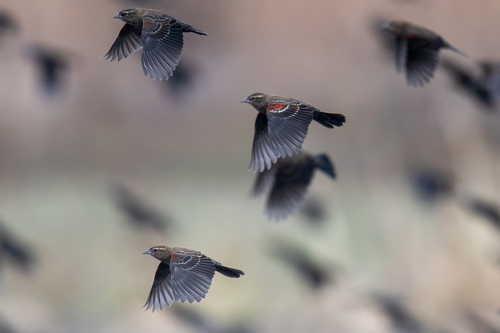 Tricoloured Blackbird
In short
The most reliable field mark between Bobolink and Tricolored Blackbird is the adult male Bobolink’s unique breeding plumage: a black body with a pale yellow nape and striking white lower back and rump, which is never shown by Tricolored Blackbird. Females and immatures of both species are more challenging, but Bobolink females are pale brown and heavily streaked, while Tricolored Blackbird females are darker, less streaked, and generally resemble a typical blackbird. In flight, neither species shows a distinctive wing panel or pattern in juveniles or immatures that would separate them at a distance, so focus on overall color and structure. Habitat and range are also strong clues: Bobolink is a grassland breeder of the northern US and Canada, while Tricolored Blackbird is restricted to California and adjacent areas, often in large colonies in wetlands or agricultural fields.
Identification tips
- Adult male Bobolink in breeding plumage is diagnostic: Look for a black bird with a pale yellow nape and large white patches on the back and rump. No Tricolored Blackbird ever shows this.
- Tricolored Blackbird male has red and white shoulder patch: Adult males are glossy black with a red epaulet bordered below by a white bar, never yellow. Bobolink males never show a red shoulder or white bar on the wing.
- Female/immature Bobolink is pale and heavily streaked: Females and immatures are pale brown with strong black streaks above and on the flanks, and a pale face with dark crown and eye stripes. Tricolored Blackbird females are darker, less streaked, and more uniform.
- Tricolored Blackbird female resembles Red-winged Blackbird female: Dark brown, less streaked, and more uniform than Bobolink female. If the bird looks like a typical blackbird, it is not a Bobolink.
- No distinctive juvenile wing pattern in flight: Neither species shows a unique juvenile or immature upperwing pattern that separates them at a distance. Focus on overall color and structure.
- Bill shape is similar: Both have short, conical blackbird bills; not a reliable separator.
- Habitat is a strong clue: Bobolink is found in open grasslands and hay fields, never in California wetlands or dairy farms. Tricolored Blackbird is almost entirely restricted to California and adjacent Baja, in wetlands or agricultural settings.
- Range is nearly exclusive: Bobolink breeds in the northern US and Canada, migrates to South America. Tricolored Blackbird is a California specialty. Out-of-range records are extremely rare.
- Flock size and behavior: Tricolored Blackbirds are highly colonial, often in huge, noisy flocks. Bobolinks are usually less gregarious outside migration.
- Non-breeding male Bobolink is paler than Tricolored Blackbird female: Even in non-breeding plumage, Bobolink males are pale and streaky, not dark and uniform.
- No white rump or back on Tricolored Blackbird: Any bird with a white lower back or rump is a Bobolink.
- Red on wing only in Tricolored Blackbird: Never present in Bobolink.
- If in doubt, check for yellow nape (Bobolink) or red/white epaulet (Tricolored): These are the quickest checks for adult males.
- Juvenile/immature confusion: If the bird is pale, streaky, and in a grassland, lean Bobolink; if dark, uniform, and in a colony, lean Tricolored Blackbird.
- Vocalizations not described: Use visual marks first, as calls/songs are not detailed in the notes.
Size
Adult Bobolinks are about 16–18 cm (6.3–7.1 in) long with a wingspan of about 27 cm (10.6 in) and weigh around 28 g (1 oz) [wikipedia]. Tricolored Blackbird size is not specified in the notes, but as a typical Agelaius blackbird, it is likely similar or slightly larger. In the field, size is not a reliable separator between these two, as both are medium-small icterids with similar proportions.
Plumage
Adult male Bobolinks in breeding plumage are unmistakable: black below and on the face, with a pale yellow nape and large white patches on the scapulars, lower back, and rump. No Tricolored Blackbird ever shows this pattern. Female and immature Bobolinks are pale brown with heavy black streaking above and on the flanks, and a pale face with dark crown and eye stripes. Tricolored Blackbird females are darker brown, less streaked, and more uniformly colored, resembling a duller Red-winged Blackbird female. Males of Tricolored Blackbird are glossy black with a red shoulder patch bordered below by a distinct white (not yellow) bar, but lack the pale nape and white rump of male Bobolink. In non-breeding plumage, Bobolink males become more like females, but still tend to be paler and more streaked than Tricolored Blackbird females. Juvenile and immature wing patterns are not described as distinctive for either species in the sources.
Behaviour
Bobolinks are often seen singly or in small groups in grasslands, especially during breeding, but may form large flocks on migration. They have a bouncy, undulating flight typical of blackbirds. Tricolored Blackbirds are highly colonial, often nesting and feeding in very large, noisy flocks, especially in agricultural or wetland settings. If you see a large, dense colony of blackbirds in California, Tricolored is much more likely.
Habitat
Bobolink breeds in open grasslands and hay fields in the northern US and southern Canada, and migrates long distances to South America. It is not found in California or the Pacific coast. Tricolored Blackbird is almost entirely restricted to California and adjacent Baja California, breeding in large colonies in wetlands, marshes, and agricultural fields. If you are in a wetland or dairy farm in California, Tricolored Blackbird is the default; in a northern grassland, Bobolink is expected.