
Blue-winged Teal vs Ruddy Duck
Spatula discors versus Oxyura jamaicensis
Play a quiz with Blue-winged Teal and Ruddy Duck
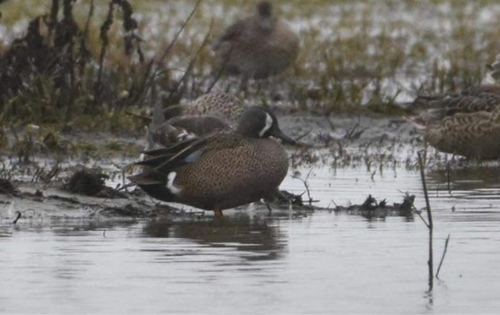 Blue-winged Teal
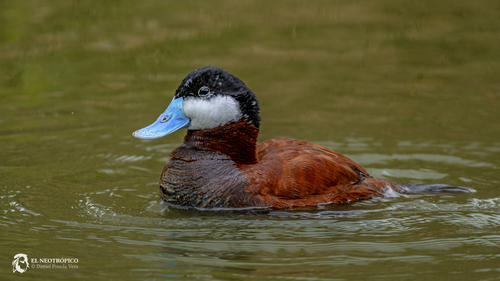 Ruddy Duck
In short
The most reliable field mark to separate Blue-winged Teal from Ruddy Duck in any age or season is the sky-blue wing coverts and green speculum of the teal, visible in flight or at rest, versus the solidly dark upperwing of the Ruddy Duck. In addition, Ruddy Duck’s stiff, often cocked tail and thick, scoop-shaped bill are unique structural clues, while Blue-winged Teal is more slender and lacks the stiff tail. Female and immature Blue-winged Teal can be confused with female/immature Ruddy Ducks at a distance, but the face pattern and wing coloration remain strong separators. Ruddy Duck males in breeding plumage are unmistakable with their blue bills and white cheeks, but in winter or immature plumage, careful attention to structure and wing pattern is essential.
Identification tips
- Upperwing pattern in flight (all ages/seasons): Blue-winged Teal always shows sky-blue wing coverts and a green speculum; Ruddy Duck’s upperwing is solidly dark with no color patches.
- Tail shape and carriage: Ruddy Duck has a long, stiff tail often held cocked upward, visible both on water and when perched; Blue-winged Teal’s tail is short, never stiff or cocked.
- Bill shape: Ruddy Duck’s bill is thick, short, and scoop-shaped, especially obvious in profile; Blue-winged Teal’s bill is slender and more typical of dabbling ducks.
- Body shape and posture: Ruddy Duck is compact, thick-necked, and sits low in the water; Blue-winged Teal is slim, long-necked, and sits higher.
- Adult male face pattern: Blue-winged Teal has a bold white crescent in front of the eye and a gray-blue head; Ruddy Duck male (breeding) has a white cheek patch and blackish cap, with a bright blue bill.
- Female/immature face pattern: Blue-winged Teal female/immature has a mottled brown face with a pale base to the bill; Ruddy Duck female/immature has a pale cheek patch crossed by a blurry dark stripe.
- Bill color (breeding males): Ruddy Duck’s bill is bright blue in breeding males; Blue-winged Teal’s bill is always dark.
- Plumage color (breeding males): Ruddy Duck males are rich chestnut with white cheeks; Blue-winged Teal males are light brown with a white rear patch and no chestnut tones.
- Flight style: Blue-winged Teal is agile, with rapid, twisting flight and often flushes in tight flocks; Ruddy Duck flies rarely, with rapid, direct wingbeats, low over water.
- Feeding behavior: Blue-winged Teal dabbles at the surface or tips up; Ruddy Duck dives and forages underwater, often with its tail up.
- Habitat context: Blue-winged Teal is more likely along shorelines, mudflats, or in dense emergent vegetation; Ruddy Duck prefers open water, away from dense cover.
- Vocalizations: Listen for the male Blue-winged Teal’s short whistle or the Ruddy Duck’s unique bill-drumming bubbling sound (mainly during display).
- Seasonal confusion: In winter, Ruddy Duck males lose their bright colors and resemble females, but the white cheek patch and stiff tail remain distinctive.
- Group composition: Blue-winged Teal often in flocks, especially in migration; Ruddy Duck more often solitary or in small groups.
- When in doubt: Focus on the combination of wing pattern (blue and green vs. plain dark), tail shape, and bill structure for the most reliable separation in any season or age.
Size
Ruddy Duck is noticeably heavier and more compact, with a body mass around 545 g [wikidata], compared to Blue-winged Teal’s much lighter and slimmer build (typically under 400 g [wikipedia]). Ruddy Duck appears short-necked and thick-bodied, while Blue-winged Teal is more streamlined and slender. In the field, Blue-winged Teal will look smaller and longer-winged, especially in flight, while Ruddy Duck sits lower in the water and appears more squat.
Plumage
- Juvenile/immature and female Blue-winged Teal: Always show sky-blue upperwing coverts and a green speculum in flight, regardless of age or sex. At rest, these may be partly hidden but are often glimpsed. The face is mottled brown with a pale base to the bill.
- Juvenile/immature and female Ruddy Duck: Upperwing is solidly dark with no blue or green, and the face is brown with a pale cheek patch crossed by a blurry dark stripe. The tail is always stiff and often held upright. Bill is thick and scoop-shaped, grayish in non-breeding birds.
- Adult male Blue-winged Teal: Striking white crescent in front of the eye, gray-blue head, and the same blue and green wing pattern. No stiff tail.
- Adult male Ruddy Duck (breeding): Rich chestnut body, bright blue bill, white cheeks, blackish cap. In winter, males resemble females but retain the white cheek patch.
- Flight views: Blue-winged Teal always shows the blue and green wing panels; Ruddy Duck’s wings are uniformly dark from above and below, with no color patches.
Behaviour
Ruddy Duck is a diving duck, foraging underwater with a stiff tail often held upright, and is rarely seen flying except with rapid, low, direct flight. It is awkward on land and takes off with effort. Blue-winged Teal is a dabbling duck, feeding at the surface or tipping up, and is agile in flight, often seen in tight flocks. Teal are more likely to flush easily from the water’s edge, while Ruddy Ducks tend to dive when disturbed.
Habitat
Both species use marshes and ponds, but Blue-winged Teal prefers shallow, calm water with dense emergent vegetation and is often seen along shorelines or mudflats. Ruddy Duck favors deeper, open water in marshy lakes and ponds, and is less likely to be seen close to shore or in dense vegetation. In migration and winter, Blue-winged Teal is more likely to be found in brackish or saltwater marshes, while Ruddy Duck remains in freshwater habitats.
Voice
Blue-winged Teal males give a short whistle, and females a soft quack. Ruddy Ducks are generally quiet, but males can produce a distinctive drumming or 'bubbling' sound by beating their bill on their chest during display. Neither species is highly vocal, but the bubbling display is unique to Ruddy Duck.