

Blue-and-white Flycatcher vs Verditer Flycatcher
Cyanoptila cyanomelana versus Eumyias thalassinus
Play a quiz with Blue-and-white Flycatcher and Verditer Flycatcher
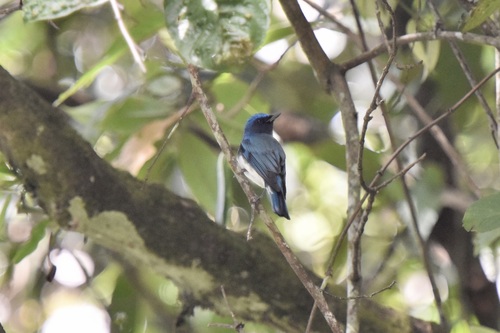 Blue-and-white Flycatcher
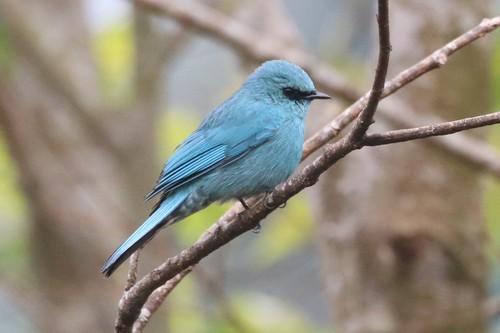 Verditer Flycatcher
In short
The most reliable field mark is overall coloration: adult male Blue-and-white Flycatchers show a deep cobalt blue upperparts with sharp black on the face and upper breast, contrasting strongly with pure white underparts, while Verditer Flycatcher males are a uniform, intense copper-sulphate blue all over, with only a small black patch between the eyes and above the bill. Females and immatures are trickier, but Blue-and-white Flycatcher females are grey-brown above and pale below, lacking any blue except in immature males' wings, while Verditer Flycatcher females and young are pale blue overall. Blue-and-white is heavier and bulkier, with a more contrasting plumage pattern; Verditer is smaller, slimmer, and more evenly colored. In flight or perched, look for the Blue-and-white's white outer tail base and sharp color contrast, versus the Verditer's uniform blue and dark lores.
Identification tips
- Adult male coloration: Blue-and-white Flycatcher males have deep cobalt blue upperparts, black face and upper breast, and pure white underparts; Verditer Flycatcher males are uniform copper-sulphate blue with a small black patch between the eyes and above the bill. This is the most reliable mark for adult males.
- Female and immature coloration: Female Blue-and-white is grey-brown above and pale below, never blue overall; female and immature Verditer is pale blue all over, lacking brown or strong contrast. Immature male Blue-and-white may show blue in the wings but remain brownish elsewhere.
- White tail patch: Blue-and-white Flycatcher (all ages) shows a prominent white patch at the base of the outer tail feathers, especially visible in flight or when tail is spread. Verditer Flycatcher lacks this, showing a uniform blue tail.
- Face pattern: Verditer Flycatcher of all ages has a distinct dark patch between the eyes and above the bill (lores and forehead), even in females and immatures. Blue-and-white Flycatcher males have black on the face but not this isolated patch; females and immatures lack any dark lores.
- Underpart contrast: Blue-and-white Flycatcher shows a sharp contrast between dark upper breast and pure white belly; Verditer Flycatcher is blue or pale blue throughout, with only a greyish vent.
- Size and structure: Blue-and-white is larger and bulkier, with a heavier build; Verditer is smaller, slimmer, and more delicate. This is subtle but can help with experience.
- Perching behavior: Verditer often perches high in the open, on wires or exposed branches above the canopy; Blue-and-white prefers more sheltered, forested perches.
- Habitat context: In dense, mature forest, Blue-and-white is more likely; in open, edge, or disturbed habitats, especially above the canopy, Verditer is more likely.
- Wing coloration in immatures: Immature male Blue-and-white shows blue only in the wings, not overall; Verditer immatures are blue all over.
- Head and bill shape: Blue-and-white female has a smaller-headed profile compared to other brown flycatchers, but this is subtle and less useful for separating from Verditer.
- Vocalization: If you hear a short, melancholic series of whistles, it points to Blue-and-white; Verditer's song is not described here.
- Seasonal context: Blue-and-white is a migrant in East Asia, present in breeding season in Japan, Korea, NE China, Russian Far East; Verditer is resident or winter visitor in much of South and Southeast Asia.
- Potential pitfall: Immature Blue-and-white males with blue wings but brown body can be mistaken for dull Verditer, but Verditer never shows brown upperparts or white tail base.
- Tail pattern in flight: Always check for the Blue-and-white's white outer tail base when the bird fans its tail or in flight; Verditer never shows this.
- Overall impression: Blue-and-white gives a more contrasting, sharply marked impression; Verditer is more uniform and softly colored.
Size
Blue-and-white Flycatcher is distinctly larger and heavier (average 23.0 g) than Verditer Flycatcher (average 18.1 g) [wikidata]. Blue-and-white also appears bulkier and longer overall (16–17 cm), while Verditer is more slender and compact. This difference is subtle at a distance but can be apparent when both are seen together or compared to other flycatchers in the area.
Plumage
- Juvenile and immature birds: Immature male Blue-and-white Flycatchers show blue wings but are otherwise brown like females, with a white underside and a white patch at the base of the outer tail feathers. Female Blue-and-white Flycatchers are grey-brown above, pale beige-white below, and lack any blue except in young males' wings. By contrast, Verditer Flycatcher females and sub-adults are pale blue all over, lacking the brown tones and wing contrast of Blue-and-white.
- Adult males: Blue-and-white Flycatcher males have deep cobalt blue upperparts, black face and upper breast, and pure white underparts, with a prominent white base to the outer tail feathers. Verditer Flycatcher males are a striking, uniform copper-sulphate blue over the entire body, with only a small black patch between the eyes and above the bill, and a grey vent.
- Key in flight: Blue-and-white shows a sharp white patch at the base of the outer tail feathers, visible when the tail is spread. Verditer lacks this, showing a uniform blue tail.
- Potential confusion: Young male Blue-and-white may show blue in the wings but are otherwise brownish, while Verditer of all ages is blue overall.
Behaviour
Verditer Flycatcher often perches high on exposed branches or even on electric wires, and frequently forages above the canopy, making it more visible and often in open situations. Blue-and-white Flycatcher is less likely to be seen in such open, elevated perches, and tends to stay within or just above the forest canopy. Both species sally for insects, but Verditer's preference for high, exposed perches is distinctive.
Habitat
Blue-and-white Flycatcher breeds in temperate forests of Japan, Korea, northeastern China, and the Russian Far East, typically in mature woodland. Verditer Flycatcher is found from the Himalayas through Southeast Asia to Sumatra, favoring forest edges, clearings, and often perching in the open above the canopy or on wires. Overlap is possible in migration or winter, but habitat preference may help: Blue-and-white in denser, mature forest; Verditer in more open, edge, or disturbed habitats.
Voice
Blue-and-white Flycatcher's song is a short, melancholic series of whistles. No distinctive vocalization is described for Verditer Flycatcher in the provided notes, so song is not a reliable separator unless Blue-and-white's unique whistled song is heard.
Blue-and-white Flycatcher · Verditer Flycatcher · My Tricky Birds