

Black-winged Stilt vs Pied Avocet
Himantopus himantopus versus Recurvirostra avosetta
Play a quiz with Black-winged Stilt and Pied Avocet
 Black-winged Stilt
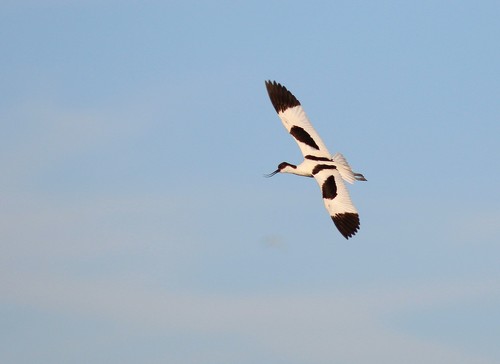 Pied Avocet
In short
The most reliable field mark between Black-winged Stilt and Pied Avocet is the bill: the stilt has a long, straight, needle-like bill, while the avocet’s is long, thin, and distinctly upturned. In flight, both show striking black-and-white patterns, but the avocet’s black cap and more extensive black on the wings and back of neck stand out, while the stilt is white-headed with black upperparts. Juvenile stilts show sandy-grey wings with pale fringes, unlike the dingier, vermiculated coverts of young avocets. Stilt legs are much longer and bright pink, compared to the avocet’s bluish legs. Both species are elegant waders of shallow wetlands, but their structure and head patterns are unmistakably different with a good view.
Identification tips
- Bill shape: Black-winged Stilt has a perfectly straight, needle-like black bill; Pied Avocet’s bill is long, thin, and distinctly upturned. This is the single most reliable mark at any age or season.
- Head pattern (adults): Avocet has a bold black cap extending down the nape and neck; stilt’s head is mostly white, sometimes with variable black on the crown/nape (more in males in summer, but never a full cap).
- Leg color and length: Stilt’s legs are bright pink and extremely long, far longer than the body; avocet’s legs are bluish and long, but not as exaggerated.
- Flight silhouette: Both show long legs trailing behind, but the stilt’s legs project much further past the tail, making it look almost stilt-walking in the air.
- Juvenile wing pattern: Juvenile stilt shows sandy-grey upperwings with pale fringes forming a whitish line in flight; juvenile avocet has duller, dingy grey coverts with reddish-brown vermiculations, and the black cap is already visible.
- Adult wing pattern in flight: Avocet shows black wingtips and shoulders with a white panel at the base of the inner primaries; stilt has black wings contrasting with a white body and head, lacking the avocet’s black shoulder and cap.
- Body shape and jizz: Stilt is slimmer, lighter, and more delicate, with a small head and very long legs; avocet is bulkier, with a proportionally larger head and thicker neck.
- Foraging behavior: Avocet sweeps its bill side-to-side in water; stilt picks and probes more delicately. Watch for this if birds are feeding.
- Sexual dimorphism: Both species show subtle sex differences, but these are rarely diagnostic in the field. Avocet males have longer, less curved bills; stilt males may have more black on the head in summer.
- Seasonal variation: Avocet shows no seasonal plumage change; stilt males can show more black on the head in breeding season, but this is variable and not always reliable.
- Iris color (close view only): Avocet males have a red or reddish-brown iris, females hazel-brown; this is subtle and rarely visible at distance.
- Tail pattern: Avocet has a white tail with pale grey-brown in the center; stilt’s tail is not a key field mark.
- Habitat context: Both can occur together, but avocet is more likely in saline or coastal lagoons; stilt is more flexible, including inland marshes.
- Size impression: Avocet is larger and heavier, but stilt’s long legs can make it appear taller when standing.
- Pitfalls: Immature birds can be confusing—focus on bill shape and head pattern first, then check leg color and length. In poor light, the avocet’s black cap is often the clincher.
Size
Pied Avocet is the larger and heavier bird: it measures 42–46 cm in length with a wingspan of 67–77 cm and an average weight around 325 g. Black-winged Stilt is slimmer and lighter, at 33–36 cm long (body mass ~160 g). The stilt’s legs are proportionally much longer, making it appear taller and more delicate, especially when standing. In flight, both have long legs trailing behind, but the stilt’s legs are more conspicuous and extend further beyond the tail.
Plumage
Juvenile and immature birds are often confused. Juvenile Black-winged Stilts have greyish, sandy-toned wings with pale feather fringes, forming a whitish line in flight; their heads are mostly white, sometimes with a little dark on the crown or nape. Juvenile Pied Avocets have dingy grey wing coverts and scapulars with reddish-brown vermiculations, and their black-and-white pattern is less crisp than adults, but the black cap and upturned bill are already present. Adult Black-winged Stilts are white below and on the head, with a black back (males glossy, females browner), and long pink legs. Adult Pied Avocets have a bold black cap extending down the nape, black scapulars and primaries, a white body, and bluish legs. Avocets show no seasonal plumage change; stilt males may have more black on the head in summer, but both sexes can show variable black on the head and neck. In flight, avocets show black wingtips and shoulders with a white panel at the base of the inner primaries, while stilts show black wings contrasting with a mostly white body and head.
Behaviour
Both species feed by wading in shallow water, but their foraging styles differ: Black-winged Stilts pick at the surface or probe delicately, often moving with quick steps. Pied Avocets sweep their upturned bills side-to-side through the water, a unique feeding behavior. Avocets are more likely to be seen in dense colonies and may nest in large groups, while stilts are less colonial. In flight, both are graceful, but the stilt appears more spindly due to its extremely long legs.
Habitat
Both species favor shallow wetlands, lagoons, and marshes, but Pied Avocet is more closely associated with coastal lagoons and saline habitats, while Black-winged Stilt is found in a wider range of marshes, shallow lakes, and ponds, sometimes further inland. Both can occur together in suitable habitat, especially during migration or in large wetland complexes.