

Black-winged Pratincole vs Collared Pratincole
Glareola nordmanni versus Glareola pratincola
Play a quiz with Black-winged Pratincole and Collared Pratincole
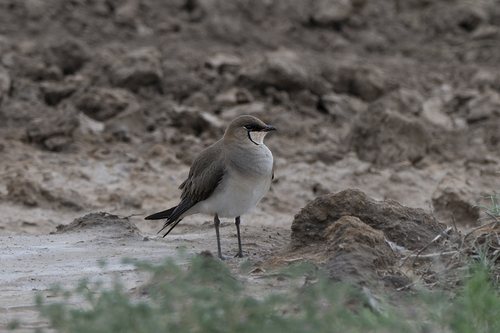 Black-winged Pratincole
 Collared Pratincole
In short
The most reliable field mark to separate Black-winged Pratincole from Collared Pratincole is the color of the underwing in flight: Black-winged Pratincole shows truly black underwings, while Collared Pratincole has chestnut underwings that may look dark but are never fully black. This difference is diagnostic but requires excellent views, as Collared's chestnut can appear almost black in poor light. Structurally, Black-winged Pratincole is marginally larger, with longer legs and a shorter tail, while Collared Pratincole has a longer, more deeply forked tail. Both species are similar in overall brown-and-white coloration and aerial feeding behavior, so careful attention to underwing color and subtle differences in structure is key, especially when viewing birds in flight.
Identification tips
- Underwing color in flight (all ages): Black-winged Pratincole has truly black underwings, while Collared Pratincole's are chestnut. In poor light, Collared's underwings can look very dark, so only trust this mark with excellent views.
- White trailing edge to wing: Collared Pratincole shows a white trailing edge to the wing, which Black-winged lacks. This can be hard to see unless the bird is banking or the light is good.
- Tail shape and length: Collared Pratincole has a longer, more deeply forked tail; Black-winged's tail is shorter and less deeply forked. This is most noticeable when birds are perched or fanned in flight.
- Leg length: Black-winged Pratincole has longer legs, which may be visible when the bird is standing or running on the ground, but this is subtle and often hard to judge unless both species are present.
- Overall size: Black-winged is marginally larger and heavier, but the difference is slight and rarely diagnostic in the field unless birds are side by side.
- Flight style: Both species are agile and graceful in flight, so flight style is not a reliable separator.
- Bill shape and color: No reliably described differences; both have short bills adapted for aerial feeding.
- Upperwing pattern (all ages): Both species have brown upperwings with darker flight feathers; no distinct age-specific upperwing marks are described to separate them.
- Plumage pitfalls: In poor light, Collared Pratincole's chestnut underwing can appear almost black, leading to confusion. Always try for a direct view of the underwing in good light.
- Perched birds: Tail length and fork depth are most useful when birds are at rest; Collared's tail projects further beyond the wingtips.
- Habitat and context: Both species occur in similar open, often gravelly habitats near water, so do not rely on habitat for separation.
- Season and sex: No described seasonal or sexual plumage differences that aid separation.
- Juvenile/immature birds: No specific juvenile or immature upperwing or body plumage marks are described; underwing color remains the key mark for all ages.
- Voice: No diagnostic vocal differences are described in the sources provided.
- When in doubt: If views are distant or light is poor, be cautious—many experienced observers struggle with these species without clear underwing or tail views.
Size
Black-winged Pratincole is slightly heavier (97g vs 77g) and is described as marginally larger than Collared Pratincole, though both measure 24–28 cm in length. The difference in mass is subtle and may not be obvious in the field, but Black-winged Pratincole also has longer legs and a proportionally shorter tail, while Collared Pratincole's tail is longer and more deeply forked. These differences are best appreciated when both species are side by side or with experience.
Plumage
For all ages, the most critical plumage difference is the underwing color in flight: Black-winged Pratincole has black underwings, while Collared Pratincole's are chestnut, though the latter can appear very dark in poor light or at a distance. Both species have brown upperparts, white bellies, and brown wings with darker flight feathers. The upperwing pattern is not described as distinctly different for juveniles or immatures in the sources, so underwing color remains the key mark for all ages. Black-winged Pratincole lacks the white trailing edge to the wing that Collared Pratincole shows, but this is subtle and not always visible. Tail shape is also a clue: Collared Pratincole has a longer, more deeply forked tail, while Black-winged's is shorter. Bill and leg color are not described as reliably different. In summary, focus on underwing color in flight and tail shape when perched or flying.
Behaviour
Both species share similar feeding behavior, hawking insects on the wing like swallows, and can also feed on the ground. There are no described behavioral differences that are diagnostic between the two in the field. Both are agile, graceful fliers, often seen near water or over open country in the evening.
Habitat
Both species are birds of open country, often near water, and both nest in gravelly or open habitats. There is no strong habitat separation in areas where their ranges overlap, so habitat alone is not a reliable field mark.
Black-winged Pratincole · Collared Pratincole · My Tricky Birds