

Black-winged Pratincole vs Arctic Skua
Glareola nordmanni versus Stercorarius parasiticus
Play a quiz with Black-winged Pratincole and Arctic Skua
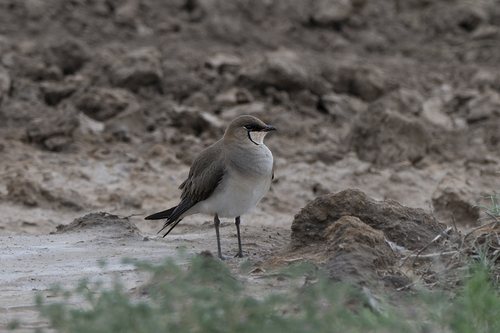 Black-winged Pratincole
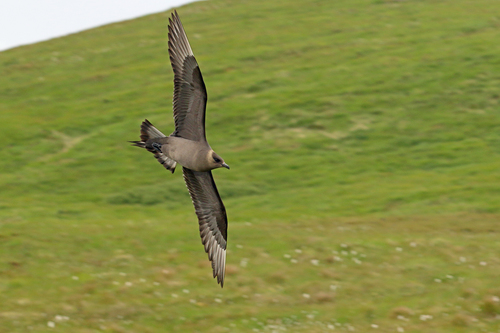 Arctic Skua
In short
The most reliable field mark to separate Black-winged Pratincole from Arctic Skua is the underwing pattern in flight: Black-winged Pratincole shows entirely dark (black) underwings without a white flash, while all Arctic Skuas (regardless of age or morph) show a distinct white wing flash at the base of the primaries. Structure is also helpful: pratincole is much smaller, with long pointed wings, short legs, and a forked tail, giving a tern- or swallow-like jizz, while Arctic Skua is bulkier, larger, and has a more falcon-like flight with a pointed central tail projection (streamers) in adults. Plumage can be confusing, especially at distance or in poor light, but careful attention to wing pattern and structure will separate them in almost all field conditions.
Identification tips
- Underwing pattern in flight (all ages): Black-winged Pratincole shows entirely black underwings with no white flash; Arctic Skua always shows a bold white wing flash at the base of the primaries. This is the single most reliable mark.
- Size and bulk: Pratincole is much smaller and lighter, with a delicate build; Arctic Skua is robust, heavy-bodied, and much larger.
- Tail shape: Pratincole has a deeply forked tail (not long streamers); adult breeding Arctic Skua has pointed central tail projections (streamers) extending beyond the rest of the tail. Juvenile skuas lack long streamers but still have a more square or slightly pointed tail compared to pratincole.
- Wing shape and flight style: Pratincole has long, pointed wings and a swift, buoyant, swallow-like flight; Arctic Skua has broader wings and a more direct, powerful, falcon-like flight.
- Leg length and posture: Pratincole has short legs and a horizontal stance; Arctic Skua is bulkier and stands more upright.
- Upperpart color: Both can appear brown above, but pratincole is more uniform; Arctic Skua (light morph) has a browner back with contrasting pale head and neck, while dark morph is overall dark brown.
- Head pattern: Pratincole has a plain brown head; Arctic Skua (light morph) has a yellowish-white head and neck with a black cap, which can be striking at close range.
- Underpart color: Pratincole has a white belly; Arctic Skua (light morph) also has white underparts, but dark morph is much darker below.
- Bill: Pratincole has a short, fine bill suited to catching insects; Arctic Skua has a heavier, hooked bill for predation and kleptoparasitism.
- Behavior: Pratincole is usually seen hawking insects low over fields or water; Arctic Skua is often seen chasing other birds at sea or along coasts.
- Habitat context: Pratincole is found in open, often inland habitats; Arctic Skua is coastal or pelagic outside the breeding season, and breeds on tundra or islands.
- Voice: Arctic Skua gives nasal mewing and wailing calls, especially on breeding grounds; pratincole's calls are not described here and are not a reliable separator.
- Juvenile confusion: Even juvenile Arctic Skuas show the white wing flash; pratincole juveniles do not. This is critical for separating young birds in flight.
- Seasonal context: Pratincole is a rare vagrant outside its breeding/wintering range; Arctic Skua is widespread in northern seas and coasts during migration and winter.
- Potential pitfalls: In poor light, the chestnut underwing of Collared Pratincole (not Arctic Skua) can look dark, but Arctic Skua always shows the white wing flash. Never rely solely on upperpart color or general darkness; always check the underwing and wing flash.
Size
Black-winged Pratincole is much smaller and lighter (body mass ~97g) than Arctic Skua (typically 300–650g). In length, pratincole is 24–28 cm, while Arctic Skua is 41–48 cm (excluding tail streamers). The skua also has a much greater wingspan (107–125 cm vs. pratincole's shorter, unlisted span). In the field, pratincole appears delicate and swift, while Arctic Skua is robust and predatory.
Plumage
The most diagnostic plumage difference is in the underwing: Black-winged Pratincole of all ages shows black underwings with no white flash, while Arctic Skua (all morphs and ages) shows a prominent white wing flash at the base of the primaries, visible both at rest and in flight. Adult pratincole has brown upperparts, white belly, and black flight feathers; Arctic Skua varies greatly by morph, but light morphs have brown backs, white underparts, yellowish-white head and neck with a black cap, and always the white wing flash. Dark morph skuas are overall dark brown but still retain the white wing flash. Juvenile and immature Arctic Skuas are variable but always show the white flash, whereas pratincole juveniles resemble adults in underwing pattern. Pratincole lacks the Arctic Skua's pointed central tail projection (streamers) in breeding adults and has a more deeply forked tail.
Behaviour
Black-winged Pratincole hunts insects on the wing, often in swift, swallow-like flight, especially near water in the evening. It is agile, buoyant, and often seen hawking low over open ground. Arctic Skua is a predatory seabird, often seen chasing gulls and terns to steal food (kleptoparasitism), with a more direct, powerful, and falcon-like flight. On the ground, pratincole stands with a horizontal posture and short legs, while Arctic Skua is bulkier and more upright.
Habitat
Black-winged Pratincole is a bird of open country, gravelly flats, and often near water, mainly in southeastern Europe and southwest Asia, wintering in tropical Africa. Arctic Skua breeds on tundra, fells, and islands in the far north, and is most often seen at sea or along coasts during migration and winter. Pratincole is rarely seen far from its breeding range, while Arctic Skua is the most common jaeger/sku seen from shore in northern latitudes.
Voice
Arctic Skua gives nasal mewing and wailing calls, especially on the breeding grounds, and a shorter alarm call. Black-winged Pratincole's vocalizations are not described in the provided notes, so are not reliably diagnostic for separation.