

Black-tailed Gull vs Heermann's Gull
Larus crassirostris versus Larus heermanni
Play a quiz with Black-tailed Gull and Heermann's Gull
 Black-tailed Gull
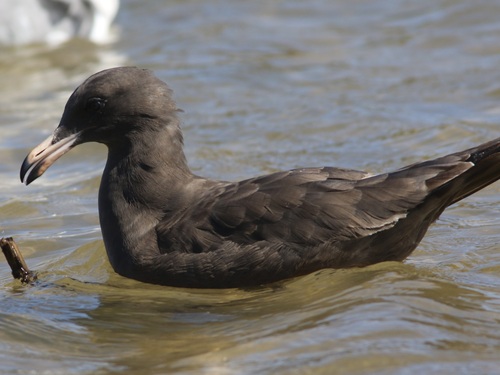 Heermann's Gull
In short
The most reliable field mark to separate Black-tailed Gull from Heermann's Gull is the tail and overall plumage: Black-tailed Gull adults always show a crisp black tail band and paler upperparts, while Heermann's Gull adults have a dark gray body, blackish tail, and a striking red bill with a black tip. In flight, immature Black-tailed Gulls show a contrasting black tail and paler wings, while immature Heermann's are overall darker and browner with less contrast. Bill color is a key difference at all ages: Black-tailed has a yellow bill with red and black near the tip, while Heermann's has a red bill (black-tipped in adults, pink in immatures). Both are medium-sized gulls, but Black-tailed is slightly heavier. Range and context are also strong clues: Black-tailed is East Asian, Heermann's is Pacific North American.
Identification tips
- Tail pattern (all ages): Black-tailed Gull always shows a crisp black tail band with white base; Heermann's Gull has a dark tail but lacks the sharp black-and-white contrast. This is especially obvious in flight.
- Bill color (adults): Black-tailed Gull has a yellow bill with a red and black spot near the tip; Heermann's Gull has a bright red bill with a black tip. This is visible both perched and in flight.
- Bill color (immatures): Immature Black-tailed Gulls have a duller yellowish bill with some dark at the tip; immature Heermann's Gulls have a pink bill until their second winter, with a dark tip developing later.
- Leg color: Black-tailed Gull has yellow legs; Heermann's Gull has dark legs. This is a reliable mark when birds are standing.
- Head color (seasonal in Heermann's): Adult Heermann's Gull has a white head in breeding season, but a dusky gray head in non-breeding; Black-tailed Gull's head is always white in adults.
- Body and wing color: Black-tailed Gull is pale gray above and white below; Heermann's Gull is medium gray overall with blackish wings and tail, and white edges to the tail and primaries (sometimes forming a white spot if primary coverts are white, but this is rare).
- Immature upperwing pattern: Juvenile and immature Black-tailed Gulls show a contrasting black tail band and paler upperwing panels; Heermann's immatures are overall darker brown with less contrast between wing and tail.
- Primary coverts (rare Heermann's variant): About 1 in 200 Heermann's Gulls show white primary coverts, forming a bold white spot on the upperwing—this is never seen in Black-tailed Gull.
- Voice: Black-tailed Gull's cat-like 'mew' call is unique; Heermann's call is deeper and lacks this quality.
- Range and context: Black-tailed Gull is expected in East Asia, Heermann's Gull on the Pacific coast of North America; vagrancy is rare but possible, so always check plumage.
- Colony behavior: Black-tailed Gulls form dense, noisy colonies, often very tame; Heermann's breed almost exclusively on one island and are more pelagic outside the season.
- Sex differences: Both species are sexually monomorphic in plumage; size difference is subtle and not reliable in the field.
- Flight jizz: Black-tailed Gull in flight shows a pale, clean look with a sharp black tail band; Heermann's appears darker and more uniform, with white edges to the primaries and tail.
- Pitfalls: Non-breeding Heermann's with dusky heads may look paler, but the overall gray body and red bill remain distinctive. Immature Black-tailed Gulls may seem dull, but the tail band and pale wing panels are key.
- When in doubt: Focus on tail pattern, bill color, and overall body tone; these are the most consistent field marks across ages and seasons.
Size
Black-tailed Gull is slightly heavier (body mass ~556.5g) than Heermann's Gull (no direct mass given, but both are medium-sized gulls) [wikidata]. Both are similar in length and wingspan, so size alone is not a reliable separator in the field.
Plumage
Adult Black-tailed Gulls have pale gray upperparts, white underparts, yellow legs, and a yellow bill with a red and black spot near the tip. The tail is white with a bold black terminal band, visible both perched and in flight. Heermann's Gull adults are much darker overall: medium gray body, blackish-gray wings and tail, with white edges to the tail and primaries. Their bill is bright red with a black tip, and the legs are dark. In non-breeding season, Heermann's head is dusky gray; in breeding, it is white. Immature Black-tailed Gulls are paler brownish with a black tail band and contrasting pale panels on the upperwing; Heermann's immatures are darker brown overall, with a pink bill and less contrast between wing and tail. Rarely, Heermann's may show white primary coverts (a striking white spot on the upperwing), but this is exceptional. Sexes are similar in both species; age-related differences are most obvious in head and bill color for Heermann's, and tail/wing contrast for Black-tailed.
Behaviour
Both species are coastal gulls that often follow fishing boats and scavenge, but Black-tailed Gulls are noted for their tameness and tendency to form very large, dense breeding colonies in East Asia. Heermann's Gulls are more pelagic outside the breeding season, often seen well offshore as well as along the Pacific coast. Both can be aggressive around food.
Habitat
Black-tailed Gull is native to East Asian shorelines, especially Japan and Korea, and breeds in huge colonies on islands and peninsulas. It is rare outside this region. Heermann's Gull breeds almost entirely on Isla Rasa in the Gulf of California and disperses along the Pacific coast of North America (US, Mexico, SW Canada), rarely found inland. Thus, range and context are strong clues: Black-tailed in Asia, Heermann's in Pacific North America.
Voice
Black-tailed Gull is famous for its cat-like 'mew' call, which is distinctive and frequently heard, especially at colonies. Heermann's Gull has a deeper call, similar in pattern to other gulls but different in quality; it lacks the cat-like quality of Black-tailed. Voice is a useful clue if heard well.