
Black-tailed Godwit vs Common Snipe
Limosa limosa versus Gallinago gallinago
Play a quiz with Black-tailed Godwit and Common Snipe
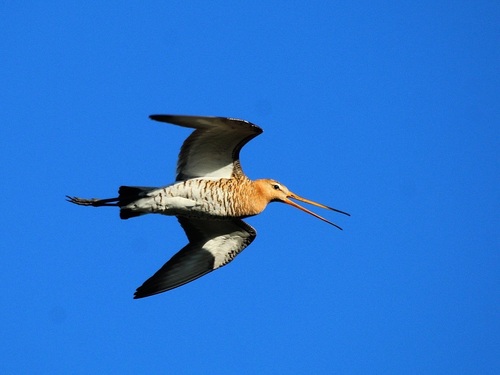 Black-tailed Godwit
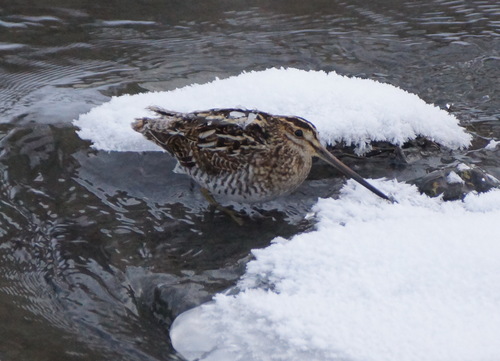 Common Snipe
In short
The most reliable way to separate Black-tailed Godwit from Common Snipe is by overall structure and flight pattern: godwits are much larger, with long legs trailing well beyond the tail and a straight, very long bill, while snipe are compact, short-legged, and have a shorter, straight bill. In flight, Black-tailed Godwit shows a bold black-and-white wingbar and white rump, visible at all ages and seasons, while Common Snipe has cryptic, mottled upperparts and lacks any strong wingbar. On the ground, godwits stand tall and upright, while snipe crouch low and are extremely well-camouflaged. Even at a distance, the godwit's long neck and legs are diagnostic, while snipe's rapid, zig-zag flight and sudden flush are unique among these two.
Identification tips
- Wing pattern in flight: Black-tailed Godwit of all ages shows a bold black-and-white wingbar and white rump, visible from above and below; Common Snipe never shows a wingbar or white rump, instead showing cryptic, mottled upperparts. This is the single most reliable field mark in flight.
- Size and shape: Godwits are much larger, tall, and lanky with long legs and neck; snipe are small, compact, and crouched with short legs and neck. Even at a distance, godwits stand out as much bigger.
- Bill: Godwits have a very long (7.5–12 cm), straight bill with a pink or orange base (depending on season), while snipe have a shorter (5.5–7 cm), straight, always dark bill. Bill length and color are useful at close range.
- Legs: Godwit's legs are long, dark, and extend well beyond the tail in flight; snipe's legs are short, greenish-grey, and do not project beyond the tail in flight. This is a key mark when birds are airborne.
- Plumage on ground: Godwits in non-breeding plumage are plain grey-brown above and below; snipe are always intricately patterned with straw-yellow and brown stripes, with a strong dark eye-stripe and pale supercilium. Juvenile godwits may show a pale orange wash but never the strong striping of snipe.
- Breeding plumage: Godwits show orange on the head, neck, and chest (males brighter), while snipe remain mottled brown. This is useful in spring and early summer.
- Behavior when approached: Snipe are extremely shy and flush only when you are very close, flying off in a rapid, zig-zag pattern; godwits are less wary, often allow closer approach, and take off in a steady, direct flight.
- Flight style: Snipe's flight is erratic, zig-zagging, and low to the ground; godwits fly with steady, direct wingbeats, legs trailing, and are often seen in loose flocks.
- Habitat: Godwits prefer open, shallow wetlands and exposed mud; snipe are found in dense, grassy, or boggy areas with plenty of cover. Habitat context can be a strong clue.
- Vocalization: If you hear a sharp 'scape' call as a bird flushes, or a 'drumming' sound overhead, it is a snipe. Godwits do not make these sounds.
- Jizz at rest: Godwits stand tall and upright, often in open, muddy areas; snipe crouch low, often motionless, blending into vegetation.
- Group size: Godwits often gather in flocks, especially outside breeding season; snipe are usually solitary or in small groups.
- Tail in flight: Snipe's tail is short and rounded, with no white rump; godwit's tail is longer, with a striking white rump and black terminal band.
- Sex and age: Both species are sexually similar in the field, but male godwits are brighter in breeding plumage. Juvenile godwits are plainer than any snipe.
- Common pitfalls: At a distance, a crouched godwit may seem smaller, and a snipe in open mud may appear larger; always check for wingbar, bill length, and leg projection in flight for confirmation.
Size
Black-tailed Godwit is much larger and heavier (average mass ~290 g) compared to Common Snipe (~120 g) [wikidata]. Godwits measure about 42 cm in length with a 70–82 cm wingspan, while snipe are only 25–27 cm long with a 44–47 cm wingspan [wikipedia]. In the field, godwits look tall and lanky, with long legs and neck, whereas snipe are squat, short-necked, and stocky. This size difference is obvious even at a distance, especially if both species are seen together.
Plumage
At all ages and seasons, Black-tailed Godwit shows a bold black-and-white wingbar and white rump in flight, which Common Snipe never shows. Juvenile and adult godwits in non-breeding plumage are plain grey-brown above and below, lacking the intricate striping of snipe. Snipe of all ages are intricately patterned with straw-yellow and brown stripes on the upperparts, and have a dark eye-stripe with pale supercilium. On the ground, godwits may look plain, but snipe always appear cryptic and streaked. In breeding plumage, godwits show orange on the head, neck, and chest, while snipe remain mottled brown. Juvenile godwits have a pale orange wash to the neck and breast, but still lack the strong striping of snipe. The godwit's bill base is orange-pink in breeding, pink in winter; snipe's bill is always dark.
Behaviour
Black-tailed Godwits are usually seen wading or feeding in open, shallow water, walking upright with long strides. They are often in loose flocks and are not particularly shy. Common Snipe, by contrast, are solitary or in small groups, extremely wary, and rely on camouflage, crouching motionless until flushed. When flushed, snipe explode into a rapid, zig-zag flight, often uttering a sharp 'scape' call, and quickly drop back into cover. Godwits take off more steadily and fly with steady, direct wingbeats, showing their white wingbars and trailing legs. Snipe's courtship display involves aerial 'winnowing' dives producing a drumming sound, which godwits do not perform.
Habitat
Black-tailed Godwit prefers open wetlands, flooded meadows, and shallow lakes, often in exposed areas with little cover. Common Snipe breeds and feeds in marshes, bogs, wet meadows, and tundra, always where there is dense ground vegetation for concealment. If you flush a bird from thick, grassy or boggy cover, it is much more likely to be a snipe; godwits are rarely found in such dense habitat.
Voice
Common Snipe gives a sharp 'scape' call when flushed and, in breeding season, produces a unique 'drumming' or 'winnowing' sound during display flights, caused by vibrating outer tail feathers. Black-tailed Godwit does not produce this sound and is generally quieter; its calls are not described as diagnostic in the provided notes.