
Black Kite vs Rough-legged Buzzard
Milvus migrans versus Buteo lagopus
Play a quiz with Black Kite and Rough-legged Buzzard
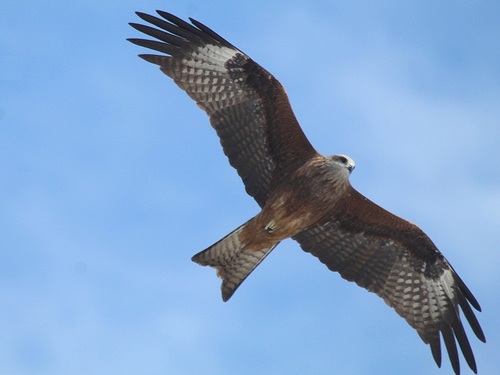 Black Kite
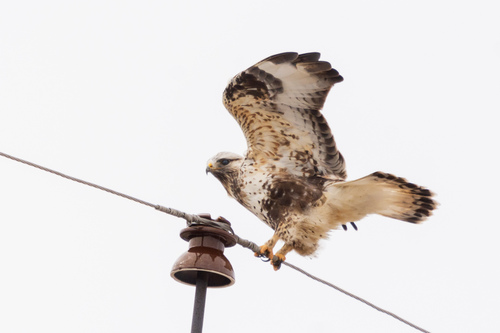 Rough-legged Buzzard
In short
The most reliable separation between Black Kite and Rough-legged Buzzard in the field is the tail and wing pattern in flight: Black Kite shows a distinctly less forked, often almost square tail (especially when fanned), and lacks the strong white underwing contrast and dark carpal 'wrist' patches of Rough-legged Buzzard. Juvenile and adult Rough-legged Buzzards (especially light morphs) display a striking white underwing with a bold dark carpal patch and a white tail with a dark subterminal band, while Black Kites are overall darker and more uniform below, with no such contrast. Structurally, Black Kite is slimmer, longer-tailed, and more buoyant in flight, while Rough-legged Buzzard appears bulkier, with broader wings and feathered legs. If you see a hovering raptor with a pale underwing and dark wrist patches, it's a Rough-legged Buzzard; a dark, agile, fork-tailed kite is a Black Kite.
Identification tips
- Tail shape in flight: Black Kite has a shallowly forked tail (less forked than Red Kite), often appearing square or only slightly notched when fanned; Rough-legged Buzzard's tail is broad and rounded, never forked.
- Underwing pattern (all ages): Rough-legged Buzzard (especially light morphs) shows a striking white underwing with a bold, square dark carpal patch ('wrist'); Black Kite's underwing is uniformly dark brown with only subtle pale mottling, lacking any bold contrast or carpal patch.
- Tail pattern: Rough-legged Buzzard has a white tail with a broad dark subterminal band (all ages); Black Kite's tail is uniformly dark brown, sometimes with a slightly paler base, but never with a white field or dark band.
- Legs: Rough-legged Buzzard has feathered legs to the toes (giving a 'trousered' look when perched); Black Kite's legs are yellow and unfeathered.
- Flight style: Black Kite is agile, buoyant, and often glides with wings in a shallow V; Rough-legged Buzzard is steadier, with slower wingbeats, and often hovers (unique among large raptors).
- Perched structure: Rough-legged Buzzard appears bulkier, with long wings reaching or exceeding the tail tip; Black Kite is slimmer, with a proportionally longer tail and shorter wings.
- Plumage tone: Black Kite is overall dark brown with paler head and neck, no rufous; Rough-legged Buzzard is variable but always shows some combination of brown and white, with a broad brown chest-band and often a pale head.
- Habitat: Black Kite is common near water, farmland, and urban areas; Rough-legged Buzzard prefers open, treeless landscapes, especially in winter, and avoids urban settings.
- Behavior: Black Kite rarely hovers; Rough-legged Buzzard frequently hovers over fields.
- Bill and cere: Both have yellow cere, but Black Kite's bill is black, and the gape is yellow; not a strong field mark at distance.
- Voice: Black Kite gives a shrill whistle and whinnying call; Rough-legged Buzzard is usually silent in winter.
- Seasonal context: In Europe, Black Kite is a summer visitor or resident; Rough-legged Buzzard is a winter visitor from the Arctic.
- Sex/age differences: Both sexes are similar in plumage; female Rough-legged Buzzards are bulkier. Juvenile buzzards retain the same underwing and tail pattern as adults.
- Common pitfalls: Juvenile Black Kites can look paler-headed but never show the white underwing or tail of Rough-legged Buzzard. Dark morph Rough-legged Buzzards can be confused with kites, but still show feathered legs and a broad, rounded tail.
- Summary tip: If you see a large raptor hovering with a white underwing and dark wrist patch, it's a Rough-legged Buzzard; if it's dark, fork-tailed, and agile, it's a Black Kite.
Size
Rough-legged Buzzard is slightly heavier on average (ca. 926 g vs. 828 g for Black Kite [wikidata]), and appears bulkier and broader-winged in the field. Black Kite is more slender, with a longer, shallower-forked tail, and a more graceful, agile flight. Wingspan is similar, but Black Kite's wings are narrower and more pointed, while Rough-legged Buzzard's are broader and more rounded. Both species overlap in size, but the buzzard is generally chunkier and more robust, especially when perched.
Plumage
Juvenile and adult Rough-legged Buzzards (especially light morphs) show a diagnostic white underwing with a bold, square dark carpal ('wrist') patch, and a white tail with a strong dark subterminal band—these marks are present in all ages and are visible in flight. Black Kite, of any age, lacks this contrast: its underwing is overall dark brown with only subtle pale mottling, and the tail is uniformly dark brown, sometimes with a slightly paler base, but never with a white field and dark band. Black Kite's plumage is generally uniform brown above and below, with paler head and neck, and dark streaks on the body; no rufous tones. Rough-legged Buzzard is highly variable but always shows some combination of brown and white, with a broad brown chest-band, and feathered legs (which can give a pale 'trousered' look when perched). In perched birds, Rough-legged Buzzard's long wings reach or pass the tail tip, and the legs are feathered to the toes; Black Kite's legs are yellow and unfeathered. Both sexes are similar in both species, but female buzzards are bulkier.
Behaviour
Black Kite is agile, often seen soaring, circling, or gliding with wings slightly raised in a shallow V, and is highly buoyant and acrobatic. It rarely hovers. Rough-legged Buzzard is unique among large raptors for its frequent hovering (kestrel-like), often holding position over fields while searching for prey. In flight, buzzards are steadier, with deeper, slower wingbeats, and appear more eagle-like due to their broad wings and large head. Perched, Rough-legged Buzzard sits upright, often on posts or trees in open country; Black Kite is more likely to be seen soaring or perched in urban or semi-urban areas.
Habitat
Black Kite is highly adaptable, often found near water, in open country, farmland, and especially around human settlements, including cities and rubbish dumps. Rough-legged Buzzard breeds in arctic and subarctic tundra, and in winter is found in open, treeless landscapes—marshes, moorland, and farmland—rarely near urban areas. In Europe, a kite in a city is almost always Black Kite; a large raptor hovering over open fields in winter is likely Rough-legged Buzzard.
Voice
Black Kite gives a distinctive shrill whistle followed by a rapid whinnying call, often heard when birds are circling or at the nest. Rough-legged Buzzard is generally silent away from the breeding grounds; calls are rarely heard in wintering areas and are not a reliable field mark for separation.