

Black Heron vs Western Reef-Heron
Egretta ardesiaca versus Egretta gularis
Play a quiz with Black Heron and Western Reef-Heron
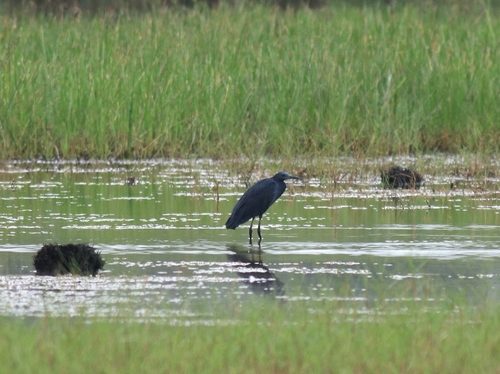 Black Heron
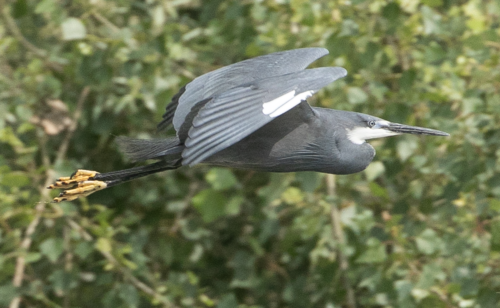 Western Reef-Heron
In short
The most reliable way to separate Black Heron from Western Reef-Heron is by overall plumage and leg/foot color: Black Heron is uniformly black with bright yellow feet, while Western Reef-Heron (dark morph) is dark grey with a paler throat and lacks the Black Heron's striking yellow feet. Black Heron is unique for its canopy feeding posture, forming a full umbrella with its wings, while Western Reef-Heron is more active and variable in foraging, sometimes flicking or shading with its wings but never creating a full canopy. In flight or at rest, check for the Black Heron's all-black look and the Western Reef-Heron's paler throat and variable leg color. Structure and size are similar, but context (inland vs. coastal, solitary vs. mixed groups) can help. White morph Western Reef-Heron is not a confusion risk with Black Heron.
Identification tips
- Plumage color: Black Heron is uniformly black all over, including the head, body, wings, and bill, with no pale throat or white areas at any age or season. Western Reef-Heron (dark morph) is dark grey, not jet black, and always shows a paler whitish throat.
- Feet color: Black Heron has bright yellow feet that contrast sharply with its black legs and body—this is a key field mark, especially in flight or when wading. Western Reef-Heron's feet and legs are variable, often yellowish but sometimes reddish in breeding season, and never as strikingly yellow as Black Heron's.
- Bill color and shape: Black Heron's bill is black and fairly slender. Western Reef-Heron's bill is usually paler (yellowish or horn-colored, especially in white morph), and may appear slightly heavier, but this is subtle and best used in good light.
- Throat color: Western Reef-Heron (dark morph) always has a paler, whitish throat—look for this contrast, especially when the bird is facing you or preening. Black Heron is black throughout, with no pale throat.
- Breeding plumes: Both species develop long nape plumes in breeding season, so this is not a strong separator. However, Black Heron's plumes are on the crown and nape, while Western Reef-Heron's are on the sides of the nape.
- Feeding behavior: Watch for Black Heron's unique canopy feeding—if you see a heron forming a complete umbrella with its wings, it's a Black Heron. Western Reef-Heron may flick or shade with its wings, but never forms a full canopy.
- Habitat: If the bird is inland, especially at freshwater lakes or marshes, Black Heron is more likely. On tidal mudflats, creeks, or coastal lagoons, Western Reef-Heron is more likely, though Black Heron can occur in some coastal settings.
- Group size: Black Heron may feed in large groups (up to 50 or more), but also alone. Western Reef-Heron is usually solitary or in small groups.
- White morph: If the bird is all white, it's a Western Reef-Heron (white morph) and not a Black Heron. Black Heron is never white at any age.
- Intermediate morphs: Western Reef-Heron can show intermediate grey-and-white plumages, but always with some white or pale areas, never the uniform black of Black Heron.
- Flight views: In flight, Black Heron appears all black with yellow feet trailing behind; Western Reef-Heron (dark morph) is dark grey with a paler throat and less contrasty feet.
- Jizz: Both species are similar in size and shape, but Black Heron may appear slightly more compact and hunched when feeding, especially during canopy feeding. Western Reef-Heron is often more active and upright.
- Voice: Not useful for separation; both are quiet and rarely vocalize.
- Season/sex: No strong seasonal or sex-based differences aid separation in the field.
- Pitfalls: Beware of poor light making Western Reef-Heron appear blacker than it is, and always check for the pale throat and lack of yellow feet to rule out Black Heron.
Size
Both species are medium-sized herons with overlapping size ranges. Black Heron typically stands 42.5–66 cm tall and weighs 0.27–0.39 kg [wikipedia]. Western Reef-Heron is also medium-sized, and no significant structural difference is noted in the sources. Bill size may be slightly larger and paler in Western Reef-Heron, especially in the white morph, but this is subtle and not always reliable at a distance.
Plumage
- Juvenile and immature plumages: No specific age-dependent upperwing or flight pattern differences are described in the sources for either species. Both attain adult-like plumage early, so separation relies on overall coloration and soft part colors at all ages.
- Adult plumage: Black Heron is entirely black, including the bill, with bright yellow feet; in breeding season, it shows long crown and nape plumes. Western Reef-Heron (dark morph) is dark grey (not true black), with a whitish throat and variable leg color (yellowish to reddish in breeding season), and two long nape plumes in breeding birds. The white morph of Western Reef-Heron is all white and not confusable with Black Heron. Intermediate morphs occur in Western Reef-Heron, but always show some grey and/or white, never the uniform black of Black Heron.
Behaviour
Black Heron is famous for its 'canopy feeding'—it spreads its wings fully over its head to create a shaded 'umbrella' that attracts fish, often feeding solitarily or in groups. Western Reef-Heron is more active, often running, stirring water with its feet, or flicking its wings to disturb prey; it may use its wings to shade the water but never forms a full umbrella. Both species feed in shallow water, but Black Heron's feeding posture is unique and diagnostic.
Habitat
Black Heron is mostly found inland at the edges of freshwater lakes, ponds, marshes, and flooded grasslands, but can also occur in coastal tidal flats and alkaline lakes. Western Reef-Heron is primarily coastal, frequenting tidal rivers, creeks, and mudflats, and is rarely found far inland. Overlap is possible in some coastal areas, but habitat context can be a useful clue: Black Heron is more likely inland, Western Reef-Heron on the coast.
Voice
No useful vocal differences are described in the sources for field separation. Both are generally quiet, with Western Reef-Heron occasionally giving a low 'kwok' or grating call when disturbed.