

Black-crowned Night Heron vs Little Blue Heron
Nycticorax nycticorax versus Egretta caerulea
Play a quiz with Black-crowned Night Heron and Little Blue Heron
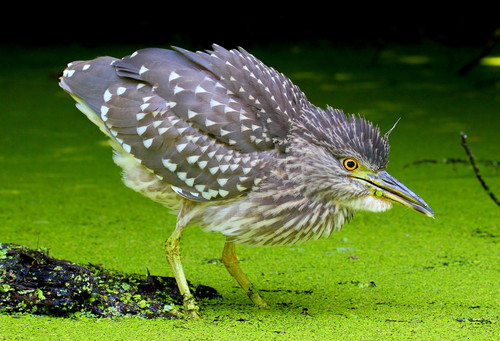 Black-crowned Night Heron
 Little Blue Heron
In short
The most reliable way to separate Black-crowned Night Heron and Little Blue Heron is by age-specific plumage: juvenile Black-crowned Night Herons are streaky brown with pale teardrop spots and orange eyes, while juvenile Little Blue Herons are almost entirely white with only slightly darker upper primaries. Adults are also distinct: Black-crowned Night Herons have a black crown and back with pale grey wings and red eyes, whereas adult Little Blue Herons are uniformly dark bluish with maroon to purple heads and two-toned bills. Structurally, Black-crowned Night Herons are stockier with shorter necks and legs, and their posture is more hunched, especially when perched. Size is also a clue, as Black-crowned Night Herons are nearly twice as heavy as Little Blue Herons.
Identification tips
- Juvenile plumage is the quickest separator: Juvenile Black-crowned Night Herons are brown with pale teardrop spots and streaked underparts, never white; juvenile Little Blue Herons are almost entirely white, with only slightly darker upper primaries.
- Immature Little Blue Herons in molt: Look for patchy white and blue feathers; never brown or streaked as in Night Heron.
- Adult plumage: Black-crowned Night Heron adults have a black crown/back, pale grey wings, white underparts, and red eyes. Little Blue Heron adults are dark blue overall with maroon/purple head and neck, yellow eyes, and a two-toned bill.
- Bill color: Little Blue Herons have a distinctive two-toned bill (blue base, black tip) at all ages; Black-crowned Night Herons have a stouter, dark bill.
- Eye color: Adult Night Herons have red eyes; Little Blue Herons have yellow eyes. Juvenile Night Herons have orange eyes.
- Leg color: Night Heron adults have yellow legs, turning salmon-pink in breeding; Little Blue Herons have greenish legs, turning black in breeding.
- Head plumes: Breeding Black-crowned Night Herons show long white nape plumes; Little Blue Herons show long, dark plumes on the crest and back.
- Posture: Night Herons are stocky and hunched, especially when perched; Little Blue Herons are slender and more upright.
- Neck length: Night Herons have a short, thick neck, often retracted; Little Blue Herons have a longer, slender neck, especially noticeable in flight or when feeding.
- Flight silhouette: Night Herons fly with necks retracted, broad wings, and heavy flight; Little Blue Herons fly with neck extended, appearing more graceful.
- Size: Night Herons are much heavier and bulkier; Little Blue Herons are smaller and more delicate.
- Habitat context: Night Herons are more likely to be seen roosting in dense cover or in large colonies; Little Blue Herons are often seen foraging alone in open wetlands.
- Vocalizations: Night Herons are noisy with harsh 'quok' calls, especially at colonies; Little Blue Herons are quieter.
- Seasonal changes: In breeding season, note the color changes: Night Herons' legs become salmon-pink, Little Blue Herons' legs and feet turn black, and their lores become turquoise.
- Pitfalls: Do not confuse white juvenile Little Blue Herons with juvenile Night Herons—Night Herons are never all white at any age. Similarly, do not mistake streaky brown juvenile Night Herons for any age of Little Blue Heron.
Size
Black-crowned Night Herons are substantially heavier (636 g) than Little Blue Herons (339.5 g) [wikidata]. The Night Heron is a medium-sized, robust bird with a stocky build, while the Little Blue Heron is smaller and more slender. In the field, the Night Heron's shorter neck and legs make it appear more compact, especially when perched, compared to the longer-legged, longer-necked Little Blue Heron.
Plumage
Juvenile Black-crowned Night Herons are brownish overall with heavy pale teardrop-shaped spots on the upperparts and streaked underparts; their eyes are orange and legs dull yellowish-green. In contrast, juvenile Little Blue Herons are almost entirely white, with only the upper primaries showing a slightly darker tone—this can lead to confusion with Snowy Egret, but not with Night Heron. Immature Little Blue Herons in transition show a patchwork of white and blue feathers, never the brown-streaked look of young Night Herons. Adult Black-crowned Night Herons have a striking black crown and back, pale grey wings, white underparts, and red eyes, with long white nape plumes in breeding season. Adult Little Blue Herons are uniformly dark blue with a maroon to purple head and neck, yellow eyes, and a two-toned bill (blue at base, black tip). During breeding, Little Blue Herons' heads turn darker red, and their legs and feet become black, while Night Herons' legs turn bright salmon-pink and the skin around the eyes turns blue.
Behaviour
Black-crowned Night Herons are often seen hunched and motionless during the day, becoming more active at dusk and night. Their flight is direct and somewhat heavy, with retracted necks and broad wings. Little Blue Herons are more diurnal, actively foraging during the day, and have a more graceful, elongated posture both in flight and when wading. They often forage alone or in loose groups, while Night Herons are more likely to be seen in colonies or roosts.
Habitat
Both species can be found in wetlands, but Little Blue Herons are more likely to be seen in open, shallow waters, both freshwater and saltwater, and are more widespread in the Americas. Black-crowned Night Herons are found in a variety of wetland habitats but are more secretive and often roost in dense cover during the day. Both may nest in colonies, sometimes together, but Night Herons are more likely to be found in larger, mixed-species colonies.
Voice
Black-crowned Night Herons are noisy in colonies, giving harsh, barking calls like 'quok' or 'woc.' Little Blue Herons are generally quieter and less vocal, and their calls are not as distinctive or commonly heard as those of the Night Heron.
Black-crowned Night Heron · Little Blue Heron · My Tricky Birds