

Barnacle Goose vs Gadwall
Branta leucopsis versus Mareca strepera
Play a quiz with Barnacle Goose and Gadwall
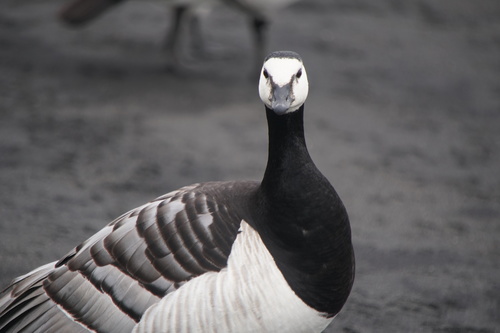 Barnacle Goose
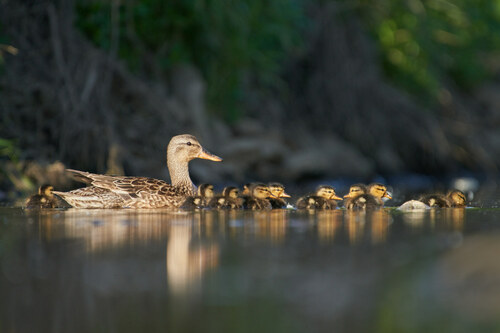 Gadwall
In short
The most reliable way to separate Barnacle Goose from Gadwall is by overall structure and plumage: Barnacle Goose is a medium-sized, black-and-white goose with a striking white face and black neck, while Gadwall is a smaller, subtly patterned dabbling duck with a plain brown or gray appearance and a white wing patch (speculum) visible in flight. Juvenile Barnacle Geese look much like adults, but their rounded mantle and flank feathers can help distinguish them from the more mottled juvenile Gadwall. In flight, Barnacle Goose shows a white rump and silvery underwing linings, whereas Gadwall flashes a white speculum on the wing. Bill shape and size are also very different: Barnacle Goose has a short, stubby black bill, while Gadwall has a longer, flatter duck bill. These two species differ so much in structure and flight style that confusion is rare except at great distance or in poor light.
Identification tips
- Face pattern: Barnacle Goose always shows a bold white face and black neck; Gadwall never shows this pattern at any age or sex.
- Bill shape: Barnacle Goose has a short, stubby black bill; Gadwall has a longer, flatter duck bill, often with orange edges in females.
- Flight pattern: In flight, Barnacle Goose shows a prominent white rump patch and silvery underwing linings; Gadwall shows a white wing speculum (patch) on the trailing edge of the wing.
- Juvenile marks: Juvenile Barnacle Goose has rounded mantle and flank feathers, but otherwise resembles adult; Gadwall juveniles are mottled brown and lack any bold black-and-white pattern.
- Body structure: Barnacle Goose stands upright and appears bulkier and taller; Gadwall is more compact and sits lower on water.
- Plumage color: Barnacle Goose is black, white, and silvery-gray; Gadwall is gray or brown with subtle patterning, never showing strong contrast.
- Leg color: Barnacle Goose has black legs; Gadwall legs are duller and less striking.
- Sex differences: Gadwall males and females differ (males gray, females brown), but both have the white speculum; Barnacle Goose sexes look alike.
- Habitat: Barnacle Goose is more likely on open grass or mudflats; Gadwall is usually on water or in marshes.
- Feeding behavior: Barnacle Goose grazes on land; Gadwall dabbles or dives for food in water.
- Flock structure: Barnacle Goose forms tight, upright flocks; Gadwall flocks are looser, often on water.
- Vocalizations: Gadwall is quiet, with soft quacks and grunts; Barnacle Goose is expected to be louder and more honking.
- Seasonal change: Gadwall males become duller in eclipse but retain the white speculum; Barnacle Goose does not show strong seasonal plumage change.
- Size: Barnacle Goose is much larger and heavier than Gadwall; size difference is obvious when seen together.
- Potential pitfalls: At great distance or in poor light, Gadwall's white speculum could be mistaken for Barnacle Goose's white rump in flight, but overall shape and flight style are very different.
Size
Barnacle Goose is significantly larger and heavier than Gadwall. Barnacle Goose averages about 1687 g in mass [wikidata], with a length of 55–70 cm and a wingspan of 120–145 cm [wikipedia]. Gadwall is smaller, with males weighing around 990 g and females about 850 g, length 47–58 cm, and wingspan 78–85 cm [wikipedia]. In the field, Barnacle Goose stands taller and bulkier, with a more upright posture, while Gadwall is more compact and sits lower on the water.
Plumage
Juvenile Barnacle Geese closely resemble adults, but their mantle and flank feathers are rounded rather than square-ended. Both ages have a white face, black neck and breast, and silvery-gray barred upperparts, with a distinctive white rump and silvery underwing linings visible in flight. Gadwall, by contrast, is much plainer: males in breeding plumage are patterned gray with a black rear and chestnut wing coverts, while females are mottled brown, resembling a female Mallard but with a white belly and white speculum. In flight, both sexes of Gadwall show a bright white speculum on the wing, which is a key field mark. Gadwall males retain the white speculum even in eclipse (non-breeding) plumage, but become duller and more like females otherwise. The Barnacle Goose's bold black-and-white pattern is never matched by Gadwall at any age or season.
Behaviour
Barnacle Goose is a grazing goose, often seen in flocks on grassland or coastal areas, walking upright and feeding on land. In flight, it has strong, direct wingbeats and flies in lines or V-formations. Gadwall is a dabbling duck, usually found on water, feeding by tipping up or occasionally diving. Gadwall is less gregarious outside breeding season, forming smaller flocks than some other ducks. Their flight is more rapid and agile, with a lower, more horizontal body carriage compared to the upright, heavier flight of Barnacle Goose.
Habitat
Barnacle Goose prefers open grasslands, coastal marshes, and estuaries, often far from dense vegetation. Gadwall is a bird of open wetlands, marshes, lakes, and ponds with dense fringing vegetation. While both can be found near water, Gadwall is much more likely to be seen dabbling or swimming, while Barnacle Goose is more often grazing on land or resting on open mud or sandbanks.
Voice
Gadwall is generally quiet, but females give a high-pitched quack and males a soft grunt or whistle, especially during courtship. Barnacle Goose calls are not described in the notes, but as a goose, its vocalizations are expected to be louder and more honking compared to the soft calls of Gadwall. In the field, the difference in voice is usually obvious if both are heard.