

Barnacle Goose vs Canada Goose
Branta leucopsis versus Branta canadensis
Play a quiz with Barnacle Goose and Canada Goose
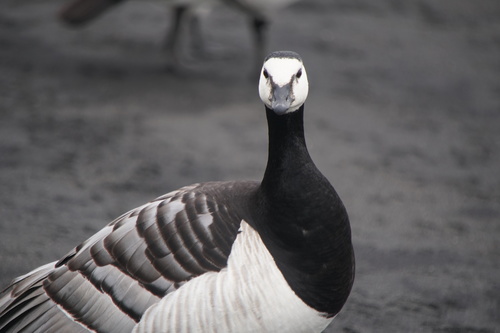 Barnacle Goose
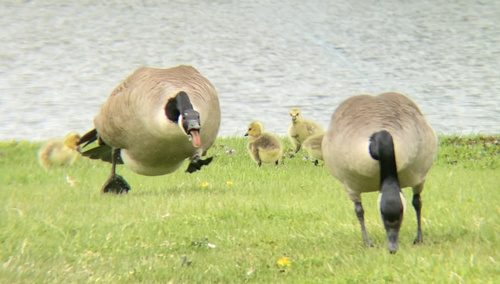 Canada Goose
In short
The most reliable field mark between Barnacle Goose and Canada Goose is the body color: Barnacle Goose shows a striking silver-grey back and wings with bold black-and-white barring, a crisp white face, and a black breast, while Canada Goose has a brown body, a black neck with a white chinstrap, and lacks the extensive white face. In flight, Barnacle Goose reveals a distinctive V-shaped white rump patch and silvery underwings, contrasting with the Canada Goose's plainer brown upperparts and less contrasting rump. Barnacle Goose is much smaller and more compact, with a shorter neck and a small, stubby bill, compared to the large, long-necked, and heavy-billed Canada Goose. Juvenile Barnacle Geese closely resemble adults but can be separated from Canada Goose by the same structural and plumage differences. Both species have black necks and heads, but the face pattern and body color are the fastest ways to separate them at any age.
Identification tips
- Face Pattern: Barnacle Goose has a clean white face extending up to the crown, contrasting sharply with the black head and neck. Canada Goose has a white cheek patch and chinstrap, but the rest of the face is black; it never shows an all-white face.
- Body Color: Barnacle Goose has a silver-grey back and wings with bold black-and-white barring, and a white belly. Canada Goose always has a brown body, never grey or barred.
- Neck and Bill Structure: Barnacle Goose is compact, with a short neck and a small, stubby black bill. Canada Goose is much larger, with a long neck and a longer, more robust bill. This is obvious in side-by-side views or mixed flocks.
- Flight Pattern: In flight, Barnacle Goose shows a distinct V-shaped white rump patch and silvery underwing linings. Canada Goose lacks the V-shaped rump and has plainer brown upperparts and underwings.
- Juvenile Plumage: Juvenile Barnacle Geese look like adults but have slightly rounder mantle and flank feathers; the overall grey and white pattern is still diagnostic. Juvenile Canada Geese are brown-bodied with the same face pattern as adults.
- Breast Color: Barnacle Goose has a black breast that merges into the white belly. Canada Goose's breast is brownish and blends with the rest of the brown body.
- Size in Flock: Barnacle Goose is much smaller and more compact. In mixed flocks, Canada Goose towers over Barnacle Goose, with a longer neck and bulkier body.
- Bill Shape: The bill of Barnacle Goose is noticeably shorter and stubbier than the long, sloping bill of Canada Goose. This can be a quick check at close range.
- Leg Color: Both have black legs, so this is not useful for separation.
- Leucistic Individuals: Rare leucistic Barnacle Geese are all white but retain black eyes, bill, and legs. Canada Goose may show leucistic patches but never a fully white face or body with black bill and legs.
- Habitat Context: In Europe, Canada Goose is common in parks and urban lakes; Barnacle Goose is more coastal or estuarine in winter. Context can help but is not definitive.
- Vocalizations: Canada Goose gives deep honks; Barnacle Goose gives higher-pitched, yapping calls. Useful when birds are vocalizing.
- Head Shape: Barnacle Goose has a rounder head, while Canada Goose's head is more elongated, especially with the long neck.
- Mixed Flocks: When both species are present, use size, neck length, and face pattern for rapid separation.
- Pitfalls: Do not rely on the black neck alone; both species share this feature. Focus on face pattern and body color for the fastest, most reliable ID.
Size
Barnacle Goose is significantly smaller and lighter than Canada Goose. Barnacle averages about 1.7 kg in mass, while Canada Goose is more than twice as heavy at about 3.6 kg. In the field, Barnacle Goose appears compact, with a shorter neck and a small, stubby bill. Canada Goose is noticeably larger, with a long neck and a more robust, longer bill. Even the smallest Canada Geese are still bulkier and longer-necked than Barnacle Geese.
Plumage
Juvenile and adult Barnacle Geese both show a white face, black head, neck, and upper breast, and a silver-grey back and wings with bold black-and-white barring. In flight, Barnacle Geese display a V-shaped white rump patch and silvery underwing linings, which are visible at all ages. Juveniles may have slightly rounder mantle and flank feathers, but the overall pattern is consistent. Canada Goose, regardless of age, has a brown body, black head and neck, and a white cheek patch that forms a 'chinstrap' under the throat. The body is always brownish, never grey, and the face is never entirely white. Canada Goose does not show the V-shaped white rump or the silvery underwing of Barnacle Goose in flight. Some Canada Geese may show minor plumage variation (leucistic patches, peppered necks), but never the clean white face or barred grey upperparts of Barnacle Goose.
Behaviour
Both species are typically seen grazing or swimming in flocks, but Canada Goose often appears more upright and elongated due to its longer neck and larger size. Barnacle Goose flocks tend to look more compact and uniform. In flight, Barnacle Geese appear neat and fast-winged, with a shorter neck and more compact body, while Canada Geese have a heavier, more languid flight style with long necks extended straight out.
Habitat
Canada Goose is native to North America but is now common in Europe, especially in parks, lakes, and grassy fields. Barnacle Goose is mainly a winter visitor to northwestern Europe, breeding in the high Arctic and wintering in coastal pastures, estuaries, and sometimes inland fields. In mixed flocks, Canada Goose is often the dominant, larger species, while Barnacle Goose is more likely in coastal or estuarine habitats outside the breeding season.
Voice
Canada Goose is famous for its deep, resonant honking calls, with males giving a lower-pitched 'honk' and females a higher-pitched 'hrink.' Barnacle Goose has a higher-pitched, yapping or barking call, much less resonant than Canada Goose. In mixed flocks, the difference in call quality is obvious, but vocalizations are not always diagnostic at distance.