

Baltimore Oriole vs Blackpoll Warbler
Icterus galbula versus Setophaga striata
Play a quiz with Baltimore Oriole and Blackpoll Warbler
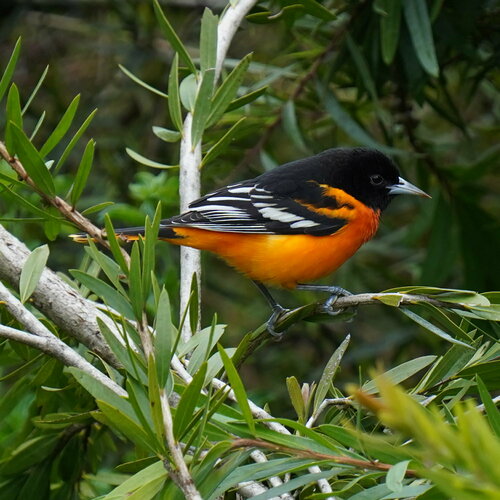 Baltimore Oriole
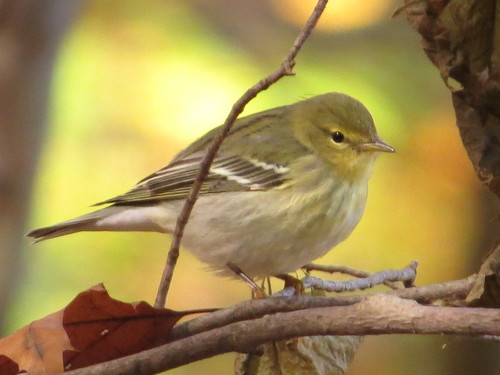 Blackpoll Warbler
In short
The most reliable field mark is overall structure and bill shape: Baltimore Oriole is a robust, thick-billed icterid, while Blackpoll Warbler is a much smaller, fine-billed warbler. In all plumages, Baltimore Oriole shows strong white wing bars on dark wings and a longer, wedge-shaped tail, while Blackpoll Warbler (all ages) is more compact, with two white wing bars but a much smaller, thinner bill and a shorter tail. Juvenile and female Baltimore Orioles are dull orange-yellow below and brownish above, easily confused with fall Blackpolls, but the oriole's heavier build and bill are always distinctive. In flight, the oriole's larger size and more deliberate, undulating flight contrast with the warbler's quick, fluttery movements. Voice, habitat, and context can help, but focus first on structure, bill, and wing pattern.
Identification tips
- Bill shape and size: Baltimore Oriole always has a thick, pointed bill, much stouter than the fine, needle-like bill of Blackpoll Warbler. This is the most reliable mark at any distance or angle.
- Overall size and structure: Orioles are much larger and bulkier than Blackpolls. Even at a distance, the oriole's longer body and tail stand out.
- Tail length and shape: Oriole tails are longer and wedge-shaped, while Blackpoll tails are shorter and more squared.
- Wing bars: Both species have two white wing bars, but the oriole's are broader and more contrasting on a darker wing. Blackpoll's wing bars are narrower and set on a lighter, streaked background.
- Adult male plumage: Male Baltimore Oriole is bright orange below with a black hood and back, never shown by Blackpoll. Male Blackpoll Warbler in breeding plumage is black-capped with white cheeks and underparts streaked black, never orange.
- Female/immature confusion: Female and juvenile Baltimore Orioles are yellow-brown above, dull orange-yellow below, and can look similar to fall Blackpolls, but always check for the oriole's heavier build and bill. Blackpolls in fall are greenish or grayish above, yellowish below, and more finely streaked, with a much smaller, thinner bill.
- Leg color: Blackpoll Warbler has bright orangish-pink legs, a subtle but unique feature if seen well. Oriole legs are dark.
- Flight style: Orioles fly with strong, direct, sometimes undulating flight, while Blackpolls are quick, fluttery, and make short, direct flights between branches.
- Feeding behavior: Orioles often feed on fruit, nectar, or at feeders, sometimes hanging upside down. Blackpolls glean insects from foliage and rarely visit feeders.
- Habitat context: Orioles prefer open woods, parks, and suburban areas with tall trees. Blackpolls are more often in dense woods or high in the canopy during migration.
- Vocalizations: Oriole song is a rich, clear whistle; Blackpoll's is a thin, high-pitched series of notes. If you hear a melodious whistle, it's an oriole.
- Seasonal timing: Blackpoll Warblers are most often seen in migration (spring and especially fall), while Baltimore Orioles are present during the breeding season in the east.
- Wing pattern in flight: Both show white wing bars, but the oriole's are broader and more striking, especially in flight. Blackpoll's wing bars can be less obvious at a distance.
- Mixed flocks: Blackpolls often join mixed warbler flocks in migration; orioles are more solitary or in pairs.
- Pitfall: Do not rely on overall color alone—female/immature orioles and fall Blackpolls can be surprisingly similar in tone. Always check bill, size, and structure first.
Size
Baltimore Oriole is much larger and heavier than Blackpoll Warbler. The oriole measures 17–22 cm in length with a wingspan of 23–32 cm and an average mass around 34 g [wikipedia], while Blackpoll Warbler is only 12.5–15 cm long, with a wingspan of 20–25 cm and an average mass of 12.3 g [wikidata]. Even at a distance, the oriole's size and bulk are apparent, especially when seen near other songbirds. The oriole's bill is thick and pointed, suited for fruit and nectar, while the warbler's bill is thin and delicate, adapted for insect gleaning. Tail length is also a clue: oriole tails are longer and more wedge-shaped, while Blackpoll's is shorter and more squared.
Plumage
Juvenile and female Baltimore Orioles are yellow-brown above with darker wings and dull orange-yellow below, sometimes resembling the yellowish, streaked fall Blackpoll Warbler. However, all ages of Baltimore Oriole show strong white wing bars on dark wings, and the bill is always thick and pointed. Adult male Baltimore Orioles are unmistakable: bright orange below, black hood and back, with white wing bars. Blackpoll Warbler (breeding male) is black-capped with white cheeks, white underparts with black streaks, and two white wing bars. Females and non-breeding Blackpolls are paler, with greenish or grayish upperparts, yellowish underparts, and always two white wing bars. The warbler's legs are orangish-pink, a subtle but unique mark if seen well. In flight, the oriole's larger wings and longer tail contrast with the warbler's compact, quick wingbeats. Both species have white wing bars, but the oriole's are broader and more contrasting against the dark wing.
Behaviour
Baltimore Orioles are often seen moving deliberately through tree canopies, sometimes hanging to feed on fruit or nectar, and may visit feeders. Their flight is strong, direct, and somewhat undulating. Blackpoll Warblers are more active and restless, flitting quickly through foliage, often higher in trees during migration, and rarely visit feeders. In flight, Blackpolls appear light and fluttery, with rapid wingbeats and short, direct flights between branches. Orioles are more solitary or in pairs during breeding, while Blackpolls may be seen in mixed-species flocks during migration.
Habitat
Baltimore Orioles breed in open woodlands, forest edges, parks, and suburban areas with tall deciduous trees, often near water. They are common in the eastern US during the breeding season. Blackpoll Warblers breed in northern coniferous forests and are seen in a wide range of habitats during migration, especially in the eastern US, often high in the canopy. During migration, both species can overlap in range, but the oriole is more likely in open, park-like settings, while Blackpolls are usually found in more wooded or brushy habitats.
Voice
Baltimore Oriole's song is a rich, clear whistle with paired notes, lasting 1–2 seconds, and is often repeated. They also give harsh chattering calls and, in breeding season, a flutter-drum sound with their wings. Blackpoll Warbler's song is not described in the notes, but is known to be a very high-pitched, thin series of 'tsit-tsit-tsit' notes, often hard to hear. Calls are not diagnostic between the two, but the oriole's song is much richer and more melodious, while the warbler's is thin and insect-like.