

Bald Eagle vs Harris's Hawk
Haliaeetus leucocephalus versus Parabuteo unicinctus
Play a quiz with Bald Eagle and Harris's Hawk
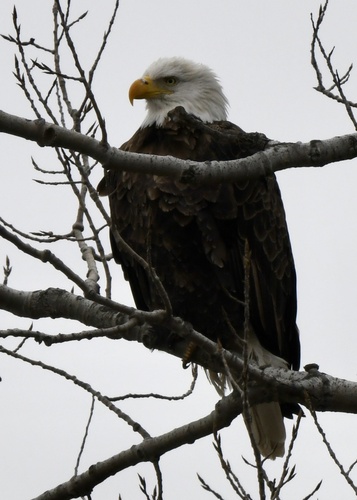 Bald Eagle
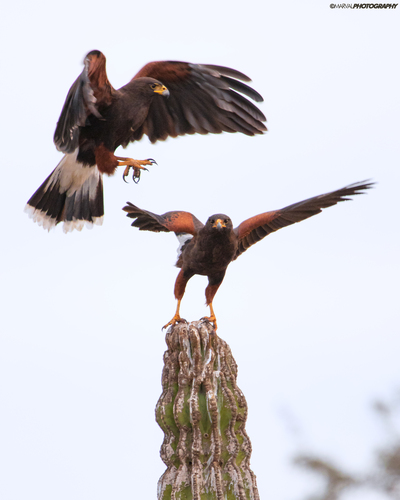 Harris's Hawk
In short
The most reliable field mark between Bald Eagle and Harris's Hawk is size: Bald Eagles are massive, with a wingspan and bulk that dwarfs even large hawks. For immature birds in flight, juvenile Harris's Hawks show pale, buffy panels on the underwings and a paler tail band, while immature Bald Eagles are dark brown with messy white streaking but lack pale wing panels. Structurally, Bald Eagles have a huge, protruding head and massive bill, while Harris's Hawks are more compact and slender. Adult Bald Eagles have a striking white head and tail, never shown by Harris's Hawk. In flight or perched, the difference in size and overall structure is usually unmistakable, but confusion is possible with distant or immature birds.
Identification tips
- Size is the single most reliable field mark: Bald Eagles are vastly larger than Harris's Hawks. If the bird appears eagle-sized, it is not a Harris's Hawk. This holds for all ages and sexes.
- Juvenile wing pattern: Juvenile Harris's Hawks show pale buff panels on the underwings (whitish primaries with dark tips) and a pale tail band—look for these in flight. Juvenile Bald Eagles are dark overall, with messy white streaking but no pale wing panels or tail bands.
- Adult plumage: Adult Bald Eagles have a white head and tail with a dark brown body and wings. Harris's Hawks are dark brown with chestnut shoulders and thighs, and a white-tipped tail, but never show a white head or tail base.
- Bill and head structure: Bald Eagles have a massive, protruding yellow bill and a large head that projects well beyond the wings in flight. Harris's Hawks have a smaller, more proportional bill and a less prominent head.
- Tail pattern: Harris's Hawks (all ages) show a white base and tip to the tail, forming a double-banded appearance, especially obvious in flight. Bald Eagles have a solid dark tail in immatures and a pure white tail in adults, never with a white base and tip together.
- Wing shape and flight: Bald Eagles have long, broad, straight-edged wings held flat in flight, with slow, deep wingbeats. Harris's Hawks have proportionally longer tails and slightly narrower wings, with more agile, maneuverable flight.
- Perched posture: Bald Eagles appear massive and heavy, often perched high in large trees. Harris's Hawks are slimmer, often seen perched in groups on cacti, utility poles, or low trees.
- Social behavior: Harris's Hawks are unique among North American raptors for their cooperative hunting and group perching. Bald Eagles are usually solitary or in loose aggregations near food sources, not hunting cooperatively.
- Habitat context: Bald Eagles are almost always near large water bodies; Harris's Hawks are birds of arid scrub, desert, and open woodland, rarely near water.
- Geographic range: In the U.S., Harris's Hawk is mostly southwestern (Arizona, New Mexico, Texas), while Bald Eagle is widespread but less likely in true desert.
- Subspecies variation in Harris's Hawk: Some subspecies show more white on the underwing and tail, but all have the pale underwing panel as juveniles—never matched by Bald Eagle.
- Confusion in immature plumage: Both species' immatures are brownish, but only Harris's Hawk juveniles have pale underwing panels and a pale tail band. Bald Eagle immatures are blotchy but dark-winged.
- Bill color: Adult Bald Eagles have a bright yellow bill; Harris's Hawk bills are dark with a yellow cere.
- Head color: Only adult Bald Eagles have a white head; all Harris's Hawks have a dark head.
- Flight jizz: Bald Eagles soar with flat wings and a heavy, ponderous style; Harris's Hawks are more buoyant and maneuverable, often flying low and using rapid flapping interspersed with glides.
Size
Bald Eagles are among the largest raptors in North America, with an average adult body mass of 4740 g, compared to the much smaller Harris's Hawk at 844 g [wikidata]. Even the largest female Harris's Hawk is less than a fifth the mass of a typical Bald Eagle. In the field, Bald Eagles appear huge, with broad wings and a long, heavy bill, while Harris's Hawks are medium-large but much more slender, with proportionally longer tails for their size. At a distance, the eagle's bulk and long, flat wings are diagnostic.
Plumage
Juvenile and immature plumages are a common source of confusion. Juvenile Harris's Hawks have buffy, streaked underparts and, crucially, pale buff panels on the underwings formed by whitish primary feathers with dark tips. Their tail shows a broad white base and tip, creating a distinctive pale banding. In contrast, immature Bald Eagles are overall dark brown with messy white streaking, but do not show pale panels on the underwing; their wing linings and flight feathers are dark, and the tail is variable but lacks the crisp white base and tip of Harris's Hawk. Adult Bald Eagles are unmistakable with their white head and tail, dark brown body, and yellow bill. Adult Harris's Hawks are dark brown with chestnut shoulders and thighs, and a white-tipped tail, but never have a white head or tail base. Subspecies differences in Harris's Hawk can affect the amount of white on the underwing and tail, but the pale underwing panel in juveniles is consistent.
Behaviour
Bald Eagles are often seen soaring high over open water or perched in tall trees near lakes and rivers. Their flight is heavy and powerful, with slow, deep wingbeats and long glides. Harris's Hawks are more agile and social, frequently hunting in groups and often seen perched together or flying low over scrub and desert. They may be observed cooperating to flush and catch prey, a behavior not seen in Bald Eagles. Harris's Hawks also use cacti and low trees for perches, unlike the typically lofty perches of Bald Eagles.
Habitat
Bald Eagles are strongly associated with large bodies of water—lakes, rivers, and coastal areas—where they hunt fish and waterfowl. They range across most of North America but are rare in arid desert regions. Harris's Hawks, in contrast, favor arid and semi-arid habitats: deserts, scrublands, and open woodlands from the southwestern U.S. south through South America. They nest in cacti or low trees and are rarely found near large water bodies. Thus, context can be a strong clue: a large raptor in a desert is far more likely to be a Harris's Hawk.