

Motmot

Atlantic Black-throated Trogon vs Elegant Trogon

Trogon chrysochloros versus Trogon elegans

Play a quiz with Atlantic Black-throated Trogon and Elegant Trogon
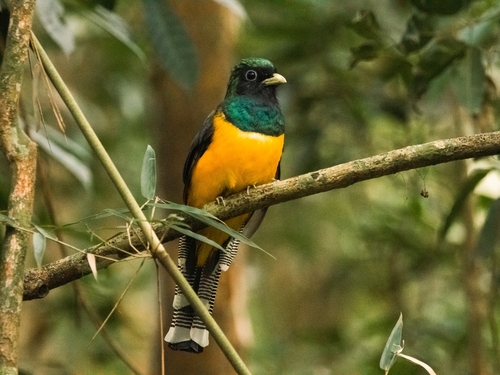
Atlantic Black-throated Trogon (Trogon chrysochloros) Atlantic Black-throated Trogon
Elegant Trogon (Trogon elegans) Elegant Trogon

Media

Loading…

In short

The single most reliable field mark to separate Atlantic Black-throated Trogon from Elegant Trogon is the color of the lower breast and belly: Atlantic Black-throated Trogon always shows a yellow belly (all ages and sexes), while Elegant Trogon has a red-orange belly in adult males and a duller brownish or grayish belly in females and immatures. Immature birds of both species can be confusing, but the belly color remains diagnostic. Tail pattern and upperwing color also help: Elegant Trogon shows a white undertail with black horizontal stripes and generally gray upperwings, while Atlantic Black-throated Trogon has a more complex black-and-white barred undertail and darker, patterned wings. Both species have a dark face and a white chest band, but the context and combination of marks will clinch the ID.

Identification tips

  1. Belly color is diagnostic: Atlantic Black-throated Trogon always has a yellow belly (all ages and sexes), while Elegant Trogon has a red-orange belly in adult males and a dull brownish or grayish belly in females and immatures.
  2. Tail pattern: In flight or when fanned, Elegant Trogon shows a white undertail with bold black horizontal stripes; Atlantic Black-throated Trogon has a black-and-white barred undertail with a wide white tip and more intricate barring.
  3. Upperwing color: Elegant Trogon has gray upperwings (all ages), while Atlantic Black-throated Trogon shows more complex black, white, and metallic green or brownish patterns depending on age and sex.
  4. Size and structure: Elegant Trogon is larger and bulkier, with a longer, square-tipped tail. Atlantic Black-throated Trogon is smaller and more compact.
  5. Back color: Both males have metallic green backs, but Elegant Trogon may show a coppery tinge on the rump and tail, especially in certain subspecies.
  6. Face and throat: Both species have a dark face and throat in males, but the pale blue or whitish eyering of Atlantic Black-throated Trogon (especially in females) can be a subtle clue; Elegant Trogon female has a white eyering.
  7. Chest band: Both species show a white band across the chest, but in Atlantic Black-throated Trogon it may be thinner and sometimes absent in certain subspecies (e.g., T. c. muriciensis).
  8. Bill color: Male Atlantic Black-throated Trogon has a mostly yellow to yellow-green bill; female's bill is variable (black/yellow mix). Elegant Trogon bills are less distinctly described but are broad and suited to fruit-eating.
  9. Iris and legs: Both have dark brown irises; Atlantic Black-throated Trogon has bluish-gray legs in adults, sometimes pinkish in juveniles.
  10. Juvenile confusion: Immature Atlantic Black-throated Trogons may show a brown throat and breast, but the yellow belly remains. Immature Elegant Trogons are duller overall, but do not show a yellow belly.
  11. Perched jizz: Elegant Trogon appears longer-tailed and more robust when perched; Atlantic Black-throated Trogon is shorter and more compact.
  12. Flight views: Focus on undertail pattern and belly color; Elegant Trogon's white and black striped undertail is unique.
  13. Habitat context: If seen in the Atlantic Forest of South America, Elegant Trogon is not expected; if in Central America, Atlantic Black-throated Trogon is not present.
  14. Vocalizations: Elegant Trogon's croaking and chattering calls can be a clue if heard; Atlantic Black-throated Trogon's voice is not described here.
  15. Season and sex: Both species show sexual dimorphism, but the belly color is always reliable. Females and immatures of both species are duller, but Elegant Trogon never shows a truly yellow belly.

Size

Elegant Trogon is noticeably larger and heavier than Atlantic Black-throated Trogon. Elegant Trogon measures 28–30 cm in length and averages about 67 grams in mass, while Atlantic Black-throated Trogon is smaller at 24–25 cm and 49–66 grams. In the field, Elegant Trogon will appear bulkier and longer-tailed, especially when perched.

Plumage

Juveniles and immatures: Both species have duller versions of the adult plumage, but the belly color is still a key separator—yellow in Atlantic Black-throated Trogon, brownish to grayish or washed-out reddish in Elegant Trogon. Immature male Atlantic Black-throated Trogons may have a brown throat and breast, but the yellow belly remains. Upperwing pattern is more complex in Atlantic Black-throated Trogon, with black and white barring and metallic green or brownish coverts depending on sex and age, while Elegant Trogon has gray upperwings and less contrast. In adults, male Atlantic Black-throated Trogon shows a metallic green back, black face and throat, and yellow belly, while Elegant Trogon male has a metallic green back, black face and throat, a white chest band, and a red-orange belly. Female Atlantic Black-throated Trogon is olive to brownish above with a yellow belly and a white chest band, while female Elegant Trogon is brownish gray with a duller, less contrasting belly and a white eyering. Tail pattern is also useful: Atlantic Black-throated Trogon has a barred black-and-white undertail with a wide white tip, while Elegant Trogon has a white undertail with black horizontal stripes.

Behaviour

Both species perch upright and motionless for long periods, typical of trogons. Elegant Trogon is noted for its tail-raising displays and more frequent vocalizations, especially by males. Both species sally for insects and hover to pick fruit, but Elegant Trogon is described as somewhat more reluctant to fly long distances. In the field, Elegant Trogon may appear more conspicuous due to its larger size and bolder tail movements.

Habitat

Atlantic Black-throated Trogon is restricted to the Atlantic Forest region of Argentina, Brazil, and Paraguay, favoring humid forest interiors. Elegant Trogon is native to Central America, often found in more open woodlands, pine-oak forests, and forest edges. If you are in the Atlantic Forest, Elegant Trogon is extremely unlikely; if in Central America, Atlantic Black-throated Trogon is absent.

Voice

Elegant Trogon gives a distinctive croaking "co-ah co-ah co-ah" and sometimes chatters, with males being more vocal. There is no specific vocal description for Atlantic Black-throated Trogon in the provided notes, so voice is not a reliable separator unless you are familiar with the calls from other sources.

Submit a better description

Use the same sections as the comparison. Your text is published immediately.

The single most reliable field mark to separate Atlantic Black-throated Trogon from Elegant Trogon is the color of the lower breast and belly: Atlantic Black-throated Trogon always shows a yellow belly (all ages and sexes), while Elegant Trogon has a red-orange belly in adult males and a duller brownish or grayish belly in females and immatures. Immature birds of both species can be confusing, but the belly color remains diagnostic. Tail pattern and upperwing color also help: Elegant Trogon shows a white undertail with black horizontal stripes and generally gray upperwings, while Atlantic Black-throated Trogon has a more complex black-and-white barred undertail and darker, patterned wings. Both species have a dark face and a white chest band, but the context and combination of marks will clinch the ID.

  1. Belly color is diagnostic: Atlantic Black-throated Trogon always has a yellow belly (all ages and sexes), while Elegant Trogon has a red-orange belly in adult males and a dull brownish or grayish belly in females and immatures.
  2. Tail pattern: In flight or when fanned, Elegant Trogon shows a white undertail with bold black horizontal stripes; Atlantic Black-throated Trogon has a black-and-white barred undertail with a wide white tip and more intricate barring.
  3. Upperwing color: Elegant Trogon has gray upperwings (all ages), while Atlantic Black-throated Trogon shows more complex black, white, and metallic green or brownish patterns depending on age and sex.
  4. Size and structure: Elegant Trogon is larger and bulkier, with a longer, square-tipped tail. Atlantic Black-throated Trogon is smaller and more compact.
  5. Back color: Both males have metallic green backs, but Elegant Trogon may show a coppery tinge on the rump and tail, especially in certain subspecies.
  6. Face and throat: Both species have a dark face and throat in males, but the pale blue or whitish eyering of Atlantic Black-throated Trogon (especially in females) can be a subtle clue; Elegant Trogon female has a white eyering.
  7. Chest band: Both species show a white band across the chest, but in Atlantic Black-throated Trogon it may be thinner and sometimes absent in certain subspecies (e.g., T. c. muriciensis).
  8. Bill color: Male Atlantic Black-throated Trogon has a mostly yellow to yellow-green bill; female's bill is variable (black/yellow mix). Elegant Trogon bills are less distinctly described but are broad and suited to fruit-eating.
  9. Iris and legs: Both have dark brown irises; Atlantic Black-throated Trogon has bluish-gray legs in adults, sometimes pinkish in juveniles.
  10. Juvenile confusion: Immature Atlantic Black-throated Trogons may show a brown throat and breast, but the yellow belly remains. Immature Elegant Trogons are duller overall, but do not show a yellow belly.
  11. Perched jizz: Elegant Trogon appears longer-tailed and more robust when perched; Atlantic Black-throated Trogon is shorter and more compact.
  12. Flight views: Focus on undertail pattern and belly color; Elegant Trogon's white and black striped undertail is unique.
  13. Habitat context: If seen in the Atlantic Forest of South America, Elegant Trogon is not expected; if in Central America, Atlantic Black-throated Trogon is not present.
  14. Vocalizations: Elegant Trogon's croaking and chattering calls can be a clue if heard; Atlantic Black-throated Trogon's voice is not described here.
  15. Season and sex: Both species show sexual dimorphism, but the belly color is always reliable. Females and immatures of both species are duller, but Elegant Trogon never shows a truly yellow belly.

Elegant Trogon is noticeably larger and heavier than Atlantic Black-throated Trogon. Elegant Trogon measures 28–30 cm in length and averages about 67 grams in mass, while Atlantic Black-throated Trogon is smaller at 24–25 cm and 49–66 grams. In the field, Elegant Trogon will appear bulkier and longer-tailed, especially when perched.

Juveniles and immatures: Both species have duller versions of the adult plumage, but the belly color is still a key separator—yellow in Atlantic Black-throated Trogon, brownish to grayish or washed-out reddish in Elegant Trogon. Immature male Atlantic Black-throated Trogons may have a brown throat and breast, but the yellow belly remains. Upperwing pattern is more complex in Atlantic Black-throated Trogon, with black and white barring and metallic green or brownish coverts depending on sex and age, while Elegant Trogon has gray upperwings and less contrast. In adults, male Atlantic Black-throated Trogon shows a metallic green back, black face and throat, and yellow belly, while Elegant Trogon male has a metallic green back, black face and throat, a white chest band, and a red-orange belly. Female Atlantic Black-throated Trogon is olive to brownish above with a yellow belly and a white chest band, while female Elegant Trogon is brownish gray with a duller, less contrasting belly and a white eyering. Tail pattern is also useful: Atlantic Black-throated Trogon has a barred black-and-white undertail with a wide white tip, while Elegant Trogon has a white undertail with black horizontal stripes.

Both species perch upright and motionless for long periods, typical of trogons. Elegant Trogon is noted for its tail-raising displays and more frequent vocalizations, especially by males. Both species sally for insects and hover to pick fruit, but Elegant Trogon is described as somewhat more reluctant to fly long distances. In the field, Elegant Trogon may appear more conspicuous due to its larger size and bolder tail movements.

Atlantic Black-throated Trogon is restricted to the Atlantic Forest region of Argentina, Brazil, and Paraguay, favoring humid forest interiors. Elegant Trogon is native to Central America, often found in more open woodlands, pine-oak forests, and forest edges. If you are in the Atlantic Forest, Elegant Trogon is extremely unlikely; if in Central America, Atlantic Black-throated Trogon is absent.

Elegant Trogon gives a distinctive croaking "co-ah co-ah co-ah" and sometimes chatters, with males being more vocal. There is no specific vocal description for Atlantic Black-throated Trogon in the provided notes, so voice is not a reliable separator unless you are familiar with the calls from other sources.

Discard your changes?

You have unsaved edits. If you leave now, those changes will be lost.

Atlantic Black-throated Trogon · Elegant Trogon · My Tricky Birds