
Ash-coloured Tapaculo vs Ancash Tapaculo
Myornis senilis versus Scytalopus affinis
Play a quiz with Ash-coloured Tapaculo and Ancash Tapaculo
 Ash-coloured Tapaculo
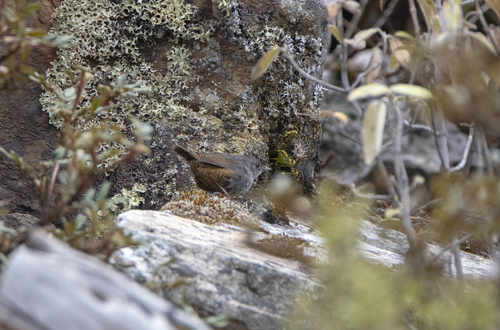 Ancash Tapaculo
In short
The most reliable way to separate Ash-coloured Tapaculo from Ancash Tapaculo is by focusing on the plumage of juveniles and the patterning on the flanks and vent in all ages. Juvenile Ash-coloured Tapaculo is reddish brown above and ochre brown below, while juvenile Ancash Tapaculo is brownish gray to olive brown above, with strong barring on both upperparts and underparts. Adults are best separated by the Ancash Tapaculo’s buffy, distinctly barred flanks and vent, contrasting with the Ash-coloured Tapaculo’s mostly plain gray underparts and only occasional cinnamon wash on the flanks. Both species are similar in size and shape, so careful attention to these plumage details is key.
Identification tips
- Juvenile plumage is the best separator: Juvenile Ash-coloured Tapaculo is reddish brown above and ochre brown below, with no barring. Juvenile Ancash Tapaculo is brownish gray to olive brown above, and all upperparts are barred; underparts are gray with olive brown, dusky-barred flanks and vent. If you see barring in a young bird, it is Ancash.
- Adult flank and vent pattern: Ancash Tapaculo of all ages shows buffy, distinctly barred flanks and vent, while Ash-coloured Tapaculo is plain gray below with at most a cinnamon wash, never strong barring. Look for this in perched or foraging birds.
- Upperpart color in adults: Ash-coloured Tapaculo is medium gray above, while Ancash Tapaculo males have a gray head and upper back but dark brown rest of the upperparts. Females of Ancash are browner above than Ash-coloured.
- Underpart tone: Ash-coloured Tapaculo is lighter gray below, sometimes with a cinnamon tinge on the flanks. Ancash Tapaculo is pale gray below but always with buffy, barred flanks and vent.
- Sex differences: Female Ancash Tapaculo is browner above than the male and than Ash-coloured Tapaculo of either sex, but this is subtle and best used in combination with flank barring.
- No strong structural differences: Both species are similar in size, shape, and structure; bill, tail, and overall jizz are not reliable for separation.
- Flight views: No distinctive upperwing or flight pattern marks are described for either species; focus on flank and vent pattern if visible in flight.
- Range as a secondary clue: Ancash Tapaculo is only found in Peru, while Ash-coloured Tapaculo ranges into Colombia and Ecuador. In Peru, both may occur in similar habitats, so do not rely on range alone.
- Habitat overlap: Both species occur in humid montane forests and shrubby areas; habitat is not diagnostic where ranges overlap.
- No vocal differences provided: Vocalizations are not described in the notes, so do not use song or call for separation based on this information.
- Beware population variation: Ash-coloured Tapaculo shows some variation in plumage darkness between populations, but never develops the strong barring of Ancash Tapaculo.
- Immature birds: If the bird is not a clean adult gray, check for barring on the upperparts and flanks—barring always points to Ancash Tapaculo.
- Cinnamon on flanks: A cinnamon wash on the flanks or crissum is possible in Ash-coloured Tapaculo, but this is never as bold or patterned as the buffy, barred flanks of Ancash.
- Barred upperparts: Only Ancash Tapaculo juveniles show barred upperparts; Ash-coloured Tapaculo juveniles are plain reddish brown above.
- Use a combination of marks: When in doubt, prioritize flank/vent barring and juvenile upperpart pattern, as these are the most consistently diagnostic.
Size
Both species are small tapaculos with similar overall structure. Ash-coloured Tapaculo averages about 21 g in body mass and is 14 cm long. No direct mass data is available for Ancash Tapaculo, but it is in the same genus as other small Scytalopus and is not expected to be noticeably larger or smaller in the field. Size is not a reliable separator between these two.
Plumage
Juvenile plumage is the most diagnostic: juvenile Ash-coloured Tapaculo is reddish brown above and ochre brown below, lacking any barring. In contrast, juvenile Ancash Tapaculo is brownish gray on the head and upper back, olive brown on the rest of the upperparts, and all of these areas are barred; the underparts are gray with olive brown, dusky-barred flanks and vent. For adults, Ash-coloured Tapaculo is medium gray above and lighter gray below, sometimes with a cinnamon wash on the flanks and crissum, but never with strong barring. Ancash Tapaculo males have a gray head and upper back, dark brown rest of the upperparts, pale gray underparts, and buffy, distinctly barred flanks and vent. Females are similar but browner above. The presence or absence of barring on the flanks and vent is a key field mark at all ages.
Habitat
Ash-coloured Tapaculo is found in humid montane forests and shrubby areas in Colombia, Ecuador, and Peru. Ancash Tapaculo is endemic to Peru, so range can be a clue, but both can occur in similar high-elevation Andean habitats within Peru. Habitat alone is not a reliable separator where ranges overlap.