

Arctic Skua vs Atlantic Puffin
Stercorarius parasiticus versus Fratercula arctica
Play a quiz with Arctic Skua and Atlantic Puffin
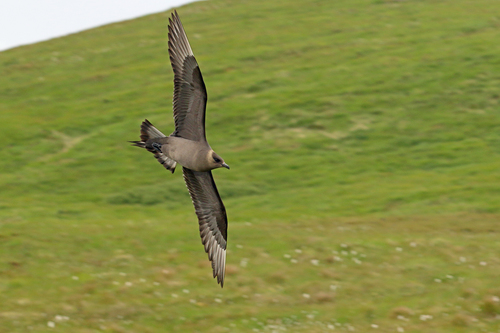 Arctic Skua
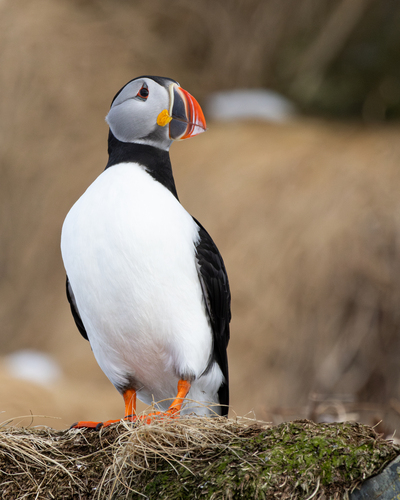 Atlantic Puffin
In short
The most reliable field mark to separate Arctic Skua (Parasitic Jaeger) from Atlantic Puffin is overall structure and flight jizz: Arctic Skua is a streamlined, predatory-looking seabird with pointed wings, a longish tail (with streamers in adults), and a falcon-like flight, while Atlantic Puffin is a compact, short-necked, and short-tailed auk with a large, colorful bill and rapid, whirring wingbeats. In all plumages, the skua shows a distinctive white wing flash (on the base of the primaries), and in adults, long central tail feathers; puffins never show these. Juvenile and non-breeding plumages can be confusing at sea, but the skua is always more gull- or falcon-like, whereas the puffin is unmistakably dumpy and penguin-like, especially when perched. Puffins are usually seen close to cliffs or on the water, while skuas are more often seen harrying other seabirds in flight.
Identification tips
- White wing flash (Arctic Skua only): All ages of Arctic Skua show a bold white patch at the base of the primaries in flight, visible from above and below; puffins never show this.
- Tail shape: Adult skuas in breeding plumage have long, pointed central tail streamers; puffins have a very short, stubby tail. Juvenile skuas lack streamers but still have a longer, more pointed tail than puffins.
- Bill structure: Puffins have a huge, triangular, multicolored bill (red, yellow, blue in adults during breeding), while skuas have a much smaller, hooked, dark bill. Even juvenile puffins have a noticeably deep bill, though duller in color.
- Body shape and jizz: Skuas are streamlined, long-winged, and predatory in flight, with a strong, direct, and sometimes falcon-like flight style. Puffins are compact, short-necked, and round-bodied, with rapid, whirring wingbeats and a much more awkward, penguin-like flight.
- Leg color: Puffins have bright orange legs in breeding plumage; skuas have dark legs.
- Head pattern: Adult light-morph skuas have a yellowish-white neck and head sides with a black cap; puffins have a black cap but with a white face and cheeks, and never the skua's yellowish tinge.
- Plumage tone: Skuas (especially juveniles and dark morphs) are brownish or dark overall, sometimes with paler underparts; puffins are always sharply black above and white below.
- Perched posture: Puffins stand upright, almost like a penguin, often outside burrows or on rocks; skuas have a more horizontal, gull-like stance.
- Behavior at sea: Skuas are often seen chasing other seabirds in flight, sometimes far from land; puffins are usually seen swimming or diving for fish, rarely engaging in aerial pursuits.
- Habitat context: Puffins are almost always close to cliffs or nesting colonies during breeding season; skuas can be seen at sea, on tundra, or harrying birds along coasts.
- Juvenile confusion: Juvenile skuas can be confused with other jaegers but not with puffins, as they lack the puffin's bill and structure. Juvenile puffins are duller but still have the same overall shape and bill.
- Voice: Both species are mostly silent at sea; calls are not useful for separation unless at colonies.
- Relative abundance: Arctic Skua is the most common jaeger seen from shore, but puffins are often more numerous at coastal colonies.
- Flight style: Skuas glide and soar with deep, powerful wingbeats; puffins have rapid, continuous wingbeats and rarely glide.
- Pitfalls: At a distance, a flying puffin can look dark and short-tailed, but the large bill and whirring flight are distinctive. Skuas never show the puffin's upright, penguin-like stance or bill shape.
Size
Arctic Skua is slightly larger and longer-winged than Atlantic Puffin, though both are medium-sized seabirds. The skua measures 41–48 cm in length with a wingspan of 107–125 cm, while the puffin is smaller and more compact (adult body mass about 376 g). In the field, the skua appears sleeker and more elongated, especially in flight, while the puffin is chunky, short-necked, and round-bodied. The skua's wings are long and pointed, contrasting with the puffin's short, rapidly beating wings.
Plumage
Juvenile and immature Arctic Skuas can be tricky, but all ages show a white wing flash at the base of the primaries, visible in flight and often at rest; this mark is absent in puffins. Adult breeding skuas (light morph) have a brown back, white underparts, yellowish-white neck and head sides, and a black cap, with long pointed central tail feathers; dark morphs are mostly dark brown but still show the white wing flash. Juvenile skuas are browner and bulkier than Long-tailed Jaeger, but always lack the puffin's black-and-white contrast and never have a large, colorful bill. Atlantic Puffin adults are black above and white below, with a strikingly large, triangular, multicolored bill (red, yellow, and blue in breeding season), orange legs, and a black cap extending to the neck. Juvenile puffins are duller, with a smaller, grayish bill and dusky face, but still have the same stocky, short-tailed structure. Puffins never show a white wing flash or long tail streamers.
Behaviour
Arctic Skuas are agile, aerial predators and kleptoparasites, often seen chasing gulls, terns, or other seabirds in fast, acrobatic flight, sometimes far from land. Their flight is strong, direct, and falcon-like, with pointed wings and frequent glides. On land, they are aggressive defenders of their nests. Puffins are much less aerial: they fly with rapid, whirring wingbeats low over the water and are awkward on land, often seen waddling or standing upright outside burrows or on cliff edges. Puffins dive and swim underwater to catch fish, rarely engaging in aerial chases.
Habitat
Arctic Skuas breed on tundra, high fells, and islands, but are most often seen at sea or along coasts during migration, especially from shorelines where they chase other seabirds. Puffins are strictly coastal, breeding in colonies on grassy or rocky cliffs, often in burrows or crevices, and are usually seen near their nesting sites or bobbing on the sea close to land. Puffins are rarely seen far from land during the breeding season, while skuas can be seen well offshore.
Voice
Arctic Skuas are mostly silent at sea, but on breeding grounds give nasal mewing and wailing calls, as well as shorter alarm notes. Puffins are also generally silent at sea, but at colonies they make low growling or grunting sounds, especially in burrows. Neither species is likely to be identified by voice at sea.