
Aquatic Warbler vs Sedge Warbler
Acrocephalus paludicola versus Acrocephalus schoenobaenus
Play a quiz with Aquatic Warbler and Sedge Warbler
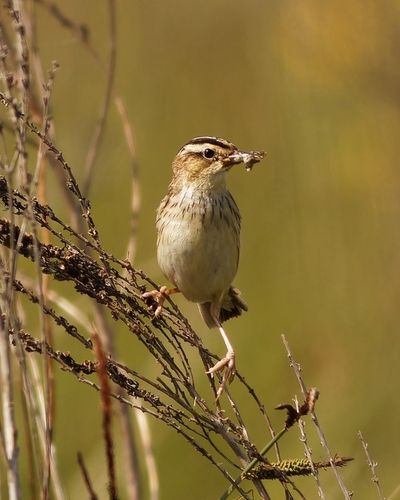 Aquatic Warbler
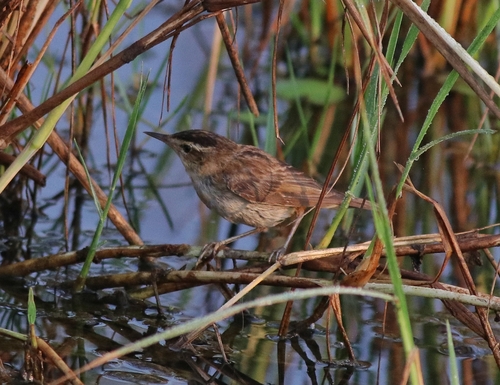 Sedge Warbler
In short
The most reliable field mark between Aquatic Warbler and Sedge Warbler is the boldness and clarity of the pale crown stripe: Aquatic Warbler shows a much more prominent, sharply defined pale crown stripe than Sedge Warbler, especially in fresh juveniles and adults. Juvenile Sedge Warblers can show a pale crown stripe, but it is typically weaker and less crisp. Both species have a strong whitish supercilium and streaked brown upperparts, but Aquatic Warbler appears paler overall and often looks spiky-tailed in flight. Careful attention to the crown pattern and underpart streaking, especially in young birds, is key to separating these two in the field.
Identification tips
- Crown stripe: Aquatic Warbler of all ages shows a broad, sharply defined pale crown stripe; Sedge Warbler's is narrower, less crisp, and often absent or weak except in some juveniles.
- Back streaking: Aquatic Warbler has a heavily streaked brown back; Sedge Warbler's back is also streaked, but the rump is warm brown and unstreaked, providing a subtle contrast.
- Underpart markings: Aquatic Warbler adults and older juveniles may show variable streaking on the pale underparts; juvenile Sedge Warblers have dark spots (not streaks) on the breast, and adults are generally unstreaked below.
- Supercilium: Both species have a strong whitish supercilium, but this is not diagnostic on its own.
- Tail shape in flight: Aquatic Warbler often appears spiky-tailed in flight, a subtle but useful jizz mark; Sedge Warbler's tail is less spiky.
- General coloration: Aquatic Warbler appears paler overall, especially on the underparts, while Sedge Warbler can look warmer brown above and below.
- Habitat: Aquatic Warbler is highly habitat-specific, favoring wet sedge beds with short vegetation; Sedge Warbler is more generalist and widespread in a variety of wetland habitats.
- Song: Sedge Warbler's song is highly varied and often includes mimicry, frequently delivered in song-flight; Aquatic Warbler's song is a more uniform, chattering sequence with whistles.
- Behavior: Sedge Warbler males perform conspicuous song-flights; Aquatic Warbler is more secretive and less likely to be seen singing in flight.
- Juvenile confusion: When faced with a juvenile showing a pale crown stripe, check for the boldness and crispness of the stripe (Aquatic) versus the presence of breast spots (Sedge).
- Rump color: Look for the warm, unstreaked rump of Sedge Warbler versus the more uniformly streaked back of Aquatic Warbler.
- Flight jizz: Aquatic Warbler may look paler and spikier-tailed in flight, especially when flushed from low vegetation.
- Breeding location: If observed in eastern Poland or southern Belarus in suitable sedge habitat, Aquatic Warbler is more likely; elsewhere, Sedge Warbler is far more common.
- Sex and age: Both species are sexually monomorphic in plumage; age differences are subtle and mainly affect underpart and crown markings.
- Pitfalls: Do not rely on supercilium alone; always check crown stripe, underpart markings, and habitat context for a confident identification.
Size
Both species are medium-sized Acrocephalus warblers and are very similar in size and structure. Aquatic Warbler averages about 10.5g in body mass [wikidata], while Sedge Warbler is slightly heavier at around 12g [wikipedia], but this difference is not easily discernible in the field. Length and proportions are nearly identical, so size alone is not a reliable separator.
Plumage
Juvenile plumage is a key pitfall: both species can show a pale crown stripe, but in Aquatic Warbler (all ages) this stripe is broader, cleaner, and more sharply defined, running from the bill to the nape and contrasting strongly with the darker crown sides. Juvenile Sedge Warblers may show a crown stripe, but it is usually less distinct and not as sharply bordered. Aquatic Warbler has a heavily streaked brown back and variable streaking on the pale underparts; Sedge Warbler's underparts are paler and juveniles have dark spots on the breast rather than streaks. Both have a strong whitish supercilium, but Aquatic Warbler's overall appearance is paler and more spiky-tailed, especially in flight. The rump of Sedge Warbler is warm brown and unstreaked, contrasting with the duller wings, while Aquatic Warbler's back is more uniformly streaked. Adult plumage is similar in both, but Aquatic Warbler maintains the bolder crown stripe and more pronounced back streaking.
Behaviour
Both species are active, insectivorous warblers often seen moving through low wetland vegetation. Sedge Warbler males are notable for their song-flights, rising above the reeds and parachuting down while singing, a behavior not described for Aquatic Warbler. Aquatic Warbler may appear more secretive and is often seen in shorter, sparser sedge beds, sometimes looking spiky-tailed in flight. Both species can be seen perched on reed stems or low bushes, but Sedge Warbler is generally more conspicuous and vocal during the breeding season.
Habitat
Aquatic Warbler is highly specialized, breeding in wet sedge beds with vegetation less than 30 cm tall, and is now largely restricted to eastern Poland and southern Belarus. Sedge Warbler is more widespread and adaptable, breeding in a variety of wetland habitats across Europe and Asia, including reedbeds, marshes, and wet meadows. While both can occur in similar habitats on migration, Aquatic Warbler is much rarer and more habitat-specific, so context and location can help inform identification.
Voice
Aquatic Warbler's song is a fast, chattering 'ja-ja-ja' with typical Acrocephalus whistles. Sedge Warbler's song is a random, varied chattering that often includes mimicry of other species and is delivered from prominent perches or in song-flight. Sedge Warbler also gives rattling alarm calls ('chirr' or 'kerr'). While both are chattery, Sedge Warbler's song is more varied and musical, and song-flights are distinctive for this species.