

Antarctic Petrel vs Pintado Petrel
Thalassoica antarctica versus Daption capense
Play a quiz with Antarctic Petrel and Pintado Petrel
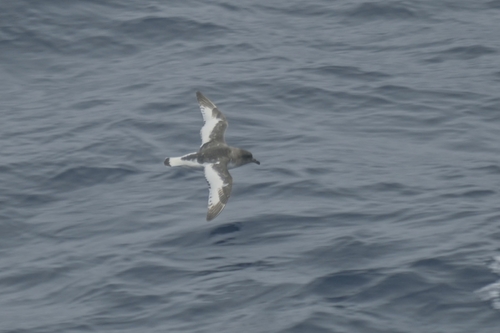 Antarctic Petrel
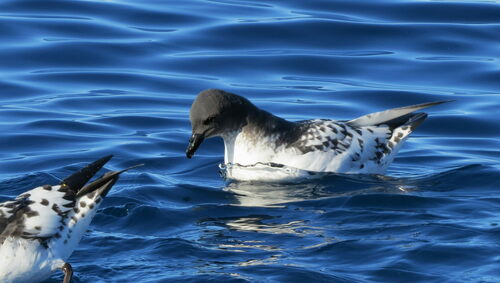 Pintado Petrel
In short
The most reliable field mark between Antarctic Petrel and Pintado (Cape) Petrel is the wing and back pattern in flight: Antarctic Petrel shows bold, clean-cut brown and white blocks with a mostly brown upperwing and a large white panel, while Pintado Petrel is distinctly speckled or checkered black-and-white above, with a black head and a white underwing bordered in black. Antarctic Petrel is also noticeably larger and heavier-bodied. If you see a petrel with a brown head and back and a strikingly white belly and rump, it's Antarctic; if the bird is spangled or 'painted' black and white above, with a black head and a white belly, it's Pintado. These differences hold for adults and immatures, though age-specific wing patterns are not detailed in the sources. Both species are found in Antarctic or sub-Antarctic waters, but Pintado is more likely to follow ships and is generally more abundant.
Identification tips
- Upperwing and back pattern in flight: Antarctic Petrel shows a bold, blocky pattern with a brown upperwing and a large, clean white panel (secondaries white with brown tips), and a brown back. Pintado Petrel is distinctly checkered or speckled black-and-white above, never showing the clean blocks of color seen in Antarctic. This is the single most reliable mark at all ages.
- Head color: Antarctic Petrel has a brown head, sides, and throat; Pintado Petrel has a black head and neck. In poor light, check for the extent and tone of dark on the face and throat.
- Underwing pattern: Pintado Petrel has a white underwing with a bold black border; Antarctic Petrel's underwing is mostly white but lacks the strong black border, instead showing brown tips to the secondaries.
- Belly and rump: Antarctic Petrel has a pure white belly and rump, sharply set off from the brown upperparts. Pintado Petrel also has a white belly, but the contrast is less stark due to the black head and speckled upperparts.
- Tail pattern: Pintado Petrel's tail is white with a black band and speckling; Antarctic Petrel's tail is white with brown tips, lacking the banded look.
- Size and structure: Antarctic Petrel is bulkier, longer-winged, and heavier; Pintado Petrel is more compact and lighter. In mixed flocks, Antarctic will stand out as the larger bird.
- Flight style: While both are strong fliers, Antarctic Petrel may appear steadier and heavier in flight, whereas Pintado can seem more agile and buoyant.
- Behavior at sea: Pintado Petrel is more likely to follow ships and scavenge, sometimes coming very close; Antarctic Petrel is less likely to approach boats but may be seen in large flocks over pack ice.
- Habitat context: If seen well north of heavy pack ice, Pintado is far more likely; Antarctic Petrel is rarely found away from high Antarctic waters.
- Bill and feet: Both have dark bills and greyish feet; these are not useful for separation in the field.
- Sex and age: No sexual dimorphism or age-specific field marks are described for either species, so all the above marks apply to both adults and immatures.
- Plumage pitfalls: In poor light or at distance, Antarctic Petrel's brown may look blackish, but the blocky, non-speckled pattern will still differ from Pintado's spangled look. Beware of partial views where only the head or underparts are visible.
- Flock composition: Large flocks in high Antarctic waters are more likely to be Antarctic Petrel; mixed flocks near ships are often dominated by Pintado.
- Voice: Not diagnostic in the field for these species.
- Seasonality: Both species breed in the Antarctic summer, but Pintado is more likely to be seen outside the breeding season in sub-Antarctic waters and near ships.
Size
Antarctic Petrel is significantly larger and heavier: average body mass is 645 g versus 424 g for Pintado Petrel [wikidata]. Antarctic Petrel measures 40–45 cm in length with a wingspan of 100–110 cm, while Pintado Petrel is 35–40 cm long with an 80–90 cm wingspan [wikipedia]. In the field, Antarctic Petrel appears bulkier and broader-winged, while Pintado is more compact and lighter built.
Plumage
The most diagnostic difference is the upperwing and back pattern. Antarctic Petrel (all ages) has a brown head, sides, throat, and back, with a sharply contrasting white belly, rump, and a large white panel on the upperwing (secondaries white with brown tips). The tail is white with brown tips. The overall look is bold and blocky, with clear-cut color boundaries. Pintado Petrel (all ages) has a black head and neck, white underparts, and a back and upperwings that are distinctly black-and-white speckled or checkered; the tail is white with a black band and speckling. The underwing is white with a strong black border. Pintado's pattern is always 'painted' or dappled, never cleanly divided. These contrasts are present in both adults and immatures, as the sources do not describe age-specific differences in wing pattern for either species.
Behaviour
Both species are pelagic and feed on krill, fish, and squid. Antarctic Petrel is more likely to be seen in large flocks in the Ross and Weddell Seas, often feeding while swimming or diving from the air or surface. Pintado Petrel is well known for following ships and is aggressive at food sources, often spitting stomach oil at competitors. Both can 'run' on water to take off, but Pintado is more likely to approach boats closely and scavenge.
Habitat
Antarctic Petrel is most common in the high Antarctic zone, especially the Ross and Weddell Seas, and is closely tied to pack ice regions. Pintado Petrel is widespread throughout the Southern Ocean, from the Antarctic up to sub-Antarctic waters, and is generally more abundant and likely to be seen near ships. Both species overlap in Antarctic waters, but Pintado is more likely farther north and in a wider range of southern oceans.