

American Tree Sparrow vs Song Sparrow
Spizelloides arborea versus Melospiza melodia
Play a quiz with American Tree Sparrow and Song Sparrow
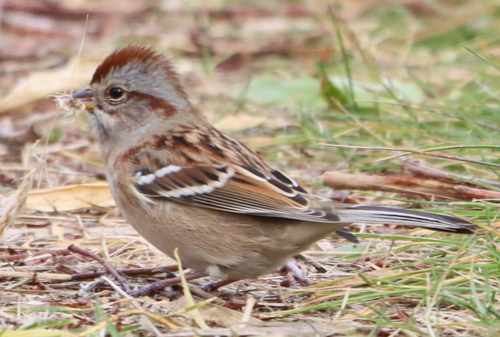 American Tree Sparrow
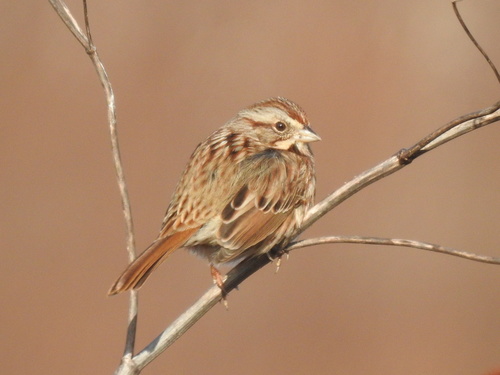 Song Sparrow
In short
The most reliable field mark to separate American Tree Sparrow from Song Sparrow is the combination of a rusty cap and a distinct central breast spot on a grayish background in American Tree Sparrow, versus the heavily streaked breast and lack of a crisp central spot in Song Sparrow. American Tree Sparrow also shows a clear rusty eye-line and gray face, while Song Sparrow’s face is more variable and generally lacks this pattern. Both are medium-sized sparrows, but Song Sparrow is slightly heavier and much more variable in plumage. Focus on head pattern and breast markings for quick separation, especially in winter flocks.
Identification tips
- Head pattern: American Tree Sparrow always shows a rusty cap and a distinct rusty eye-line on a gray face; Song Sparrow lacks both, showing a streaky brown crown and more diffuse facial markings. This is the fastest field check.
- Breast marking: Look for a single, crisp dark spot on a pale gray breast in American Tree Sparrow; Song Sparrow has heavy brown streaks across the breast and flanks, sometimes forming a messy central patch but never a neat spot.
- Back and wing pattern: American Tree Sparrow has a rusty back with lighter stripes and brown wings with white wing bars; Song Sparrow's back and wings are more uniformly streaked brown, and wing bars are less distinct.
- Flank color: American Tree Sparrow shows light brown washes on the flanks, while Song Sparrow’s flanks are heavily streaked and often darker.
- Bill color and shape: American Tree Sparrow has a small, bicolored bill (dark above, yellow below); Song Sparrow’s bill is usually all dark and slightly stouter, but this is subtle and not always visible in the field.
- Face pattern: The gray face and rusty eye-line of American Tree Sparrow are unique; Song Sparrow’s face is more variable but generally brownish and streaked, lacking the crispness of American Tree Sparrow.
- Tail: Both have slim tails, but Song Sparrow may appear to have a longer, more rounded tail when fanned; not a strong field mark.
- Overall impression: American Tree Sparrow looks cleaner and more sharply marked, especially on the head and breast; Song Sparrow looks streakier and more blended overall.
- Habitat and season: In winter, both may occur together in brushy fields, but American Tree Sparrow is absent in summer in most of the US. Song Sparrow is present year-round and in a wider range of habitats.
- Behavior: Both forage on the ground, but Song Sparrow is more likely to sing from exposed perches and is more tolerant of human-altered landscapes.
- Subspecies confusion: Song Sparrow is extremely variable, but no subspecies shows the combination of rusty cap, gray face, and neat breast spot of American Tree Sparrow.
- Juvenile and immature birds: No distinctive age-specific wing or flight marks are described for either species in the sources; focus on head and breast pattern for all ages.
- Size: Song Sparrow is slightly heavier and bulkier, but this is rarely diagnostic in the field.
- Mixed flocks: In winter, check each bird in a flock for the rusty cap and breast spot to pick out American Tree Sparrow among Song Sparrows.
- Quick scan: If you see a sparrow with a rusty cap and a single breast spot, it’s American Tree Sparrow; if it’s streaky all over with no cap, it’s Song Sparrow.
Size
Song Sparrow is slightly heavier, with an average adult mass of 24.0 g [wikidata], while American Tree Sparrow ranges from 13–28 g [wikipedia]. Both are similar in overall length (American Tree Sparrow about 14 cm/5.5 in), but Song Sparrow tends to look bulkier and may appear more robust, especially in the body and bill. In the field, this difference is subtle and often overshadowed by plumage and head pattern distinctions.
Plumage
No age-specific upperwing or flight pattern marks are described for either species in the sources, so focus is on adult and general plumage. Adult American Tree Sparrow shows a gray face with a distinct rusty eye-line and cap, pale underparts with a single, neat dark spot on the breast, rusty back with lighter stripes, brown wings with white wing bars, and flanks washed with light brown. Song Sparrow is highly variable but typically lacks a rusty cap; instead, it has a streaky brown crown, a more diffusely marked face, and a heavily streaked breast and flanks that often converge into a blurry central spot or patch, not a crisp dot. Song Sparrow’s upperparts are generally brown with heavy streaking, and the overall impression is of a more streaky, less cleanly marked bird. Subspecies variation in Song Sparrow can lead to confusion, but the lack of a rusty cap and the presence of heavy breast streaking are consistent.
Behaviour
Both species forage on the ground or in low vegetation, often in mixed flocks in winter. Song Sparrow is more likely to be seen singing from exposed perches and is generally more adaptable, occupying a wider range of habitats. American Tree Sparrow tends to be more associated with open, brushy, or weedy fields in winter and is less likely to be found in dense shrubbery or urban parks compared to Song Sparrow.
Habitat
American Tree Sparrow is a winter visitor across much of the US and southern Canada, favoring open fields, weedy edges, and brushy habitats. It breeds far north in Alaska and northern Canada, so is not present in the lower 48 states in summer. Song Sparrow is one of the most abundant and adaptable sparrows in North America, found year-round in a wide range of habitats including marshes, thickets, gardens, and urban parks. If you see a streaky sparrow in brushy habitat in summer in the US, it is almost certainly a Song Sparrow; American Tree Sparrow is only present in winter.