

Motmot

American Robin vs Brown-headed Cowbird

Turdus migratorius versus Molothrus ater

Play a quiz with American Robin and Brown-headed Cowbird
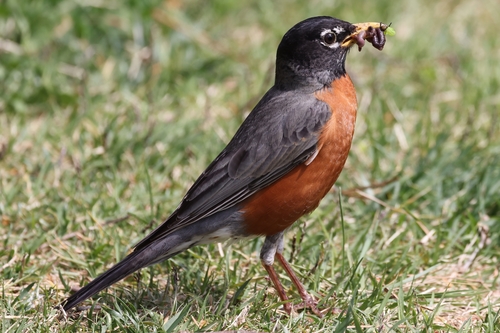
American Robin (Turdus migratorius) American Robin
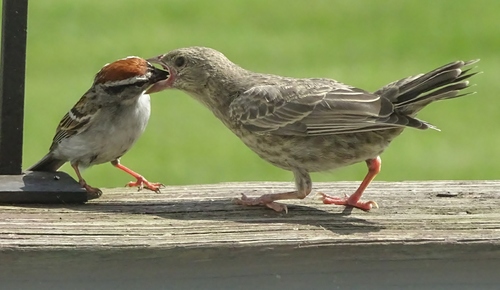
Brown-headed Cowbird (Molothrus ater) Brown-headed Cowbird

Media

Loading…

In short

The most reliable field mark between American Robin and Brown-headed Cowbird is the robin’s bold reddish-orange breast, which is never matched by the cowbird at any age or sex. Juvenile robins show pale spotting on the breast and whitish wing coverts, while cowbird juveniles are plain and streaky below. Structurally, robins are larger and longer-bodied with a thinner, yellow-based bill, whereas cowbirds are stockier with a short, thick, finch-like bill. In flight, robins show white undertail coverts and a white belly, while cowbirds are uniformly dark (males) or dull gray-brown (females/juveniles) below. Both species are common in open habitats, but cowbirds often travel in flocks and robins are more solitary or in loose groups.

Identification tips

  1. Breast color is the single best mark: American Robins of all ages (except very fresh fledglings) show a reddish-orange breast, while Brown-headed Cowbirds are always plain gray-brown (female/juvenile) or glossy black with a brown head (male).
  2. Juvenile robin spotting: Young robins have bold dark spots on the breast and whitish wing coverts, creating a speckled look; juvenile cowbirds are plain with fine streaks and lack any orange or white wing coverts.
  3. Bill shape: Robins have a slender, pointed bill that is mostly yellow with a dark tip (especially in winter); cowbirds have a short, thick, conical bill, reminiscent of a finch or sparrow.
  4. Head and eye pattern: Robins show white eye arcs and a white, streaked throat; cowbirds lack these facial markings entirely.
  5. Adult male cowbird contrast: Male cowbirds are glossy black with a distinct brown head, never showing any reddish or orange below; robins never appear black or have a brown head contrasting with a black body.
  6. Female/juvenile cowbird confusion: Female and juvenile cowbirds are plain gray-brown with fine streaking below and a pale throat, lacking any bold color or pattern; female robins are duller than males but still have a reddish breast and white belly.
  7. Underparts in flight: Robins show white undertail coverts and belly, visible in flight or when flicking the tail; cowbirds are uniformly dark or grayish below, with no white.
  8. Size and posture: Robins are larger, longer-bodied, and often stand upright; cowbirds are smaller, more compact, and short-necked.
  9. Flocking behavior: Cowbirds are often in flocks, sometimes with other blackbirds; robins are more solitary or in loose, scattered groups.
  10. Habitat context: Robins are common on lawns and in gardens, especially near trees; cowbirds are more likely in open fields, pastures, or near livestock.
  11. Nest parasitism is not a field mark: While cowbirds are brood parasites, this is not directly observable in the field and should not be used for ID.
  12. Sexing by plumage: Female robins can be dull and may resemble cowbirds at a distance, but still show a reddish breast and white belly; female cowbirds are always plain and lack any reddish tones.
  13. Bill color in season: Robin bills are more yellow in summer and duskier in winter, but always thinner than cowbird bills.
  14. No mimicry or overlap in song: Vocalizations are not described as similar or confusing in the notes.
  15. Juvenile confusion: If you see a speckled, spotted breast and white wing coverts, it's a robin; if the bird is plain, streaky, and grayish-brown with a thick bill, it's a cowbird juvenile.

Size

American Robin is distinctly larger and heavier: average body mass is about 77 g, compared to 39–49 g for Brown-headed Cowbird (females smaller, males larger but still lighter than robin). Robins measure 23–28 cm in length with a 31–41 cm wingspan, while cowbirds are 16–22 cm long with a typical 36 cm wingspan. Robins appear longer-bodied and more upright when perched, while cowbirds are compact and short-necked.

Plumage

Juvenile American Robins are pale overall with bold dark spots on the breast and whitish wing coverts, making them look speckled and contrasting above and below; these marks are absent in cowbirds. Juvenile and female Brown-headed Cowbirds are dull gray-brown with fine streaking below and lack any reddish or orange tones. Adult male robins have a rich reddish-orange breast, gray-brown back, and a dark (sometimes blackish) head with white eye arcs and a white throat with black streaks; adult male cowbirds are glossy black with a contrasting brown head and never show any orange or white below. Female robins are duller but still have a reddish breast, while female cowbirds are plain grayish-brown with a pale throat and fine streaks. In flight, robins show white undertail coverts and belly, while cowbirds are uniformly dark or grayish below depending on sex and age.

Behaviour

Robins are often seen hopping on lawns or perching upright in trees, typically alone or in loose groups, especially outside the breeding season. Cowbirds are more likely to be in tight flocks, often mixed with other blackbirds, and forage by walking on the ground, frequently following livestock or large mammals. Cowbirds are also brood parasites and may be seen near host nests, but this is rarely observed directly.

Habitat

Both species occur in open or semiopen habitats, including suburban areas, fields, and forest edges. Robins are more likely to be seen in lawns, parks, and gardens, often near trees or shrubs for nesting. Cowbirds are more associated with open fields, pastures, and areas with grazing animals, and are more likely to be found in mixed blackbird flocks, especially outside the breeding season.

Submit a better description

Use the same sections as the comparison. Your text is published immediately.

The most reliable field mark between American Robin and Brown-headed Cowbird is the robin’s bold reddish-orange breast, which is never matched by the cowbird at any age or sex. Juvenile robins show pale spotting on the breast and whitish wing coverts, while cowbird juveniles are plain and streaky below. Structurally, robins are larger and longer-bodied with a thinner, yellow-based bill, whereas cowbirds are stockier with a short, thick, finch-like bill. In flight, robins show white undertail coverts and a white belly, while cowbirds are uniformly dark (males) or dull gray-brown (females/juveniles) below. Both species are common in open habitats, but cowbirds often travel in flocks and robins are more solitary or in loose groups.

  1. Breast color is the single best mark: American Robins of all ages (except very fresh fledglings) show a reddish-orange breast, while Brown-headed Cowbirds are always plain gray-brown (female/juvenile) or glossy black with a brown head (male).
  2. Juvenile robin spotting: Young robins have bold dark spots on the breast and whitish wing coverts, creating a speckled look; juvenile cowbirds are plain with fine streaks and lack any orange or white wing coverts.
  3. Bill shape: Robins have a slender, pointed bill that is mostly yellow with a dark tip (especially in winter); cowbirds have a short, thick, conical bill, reminiscent of a finch or sparrow.
  4. Head and eye pattern: Robins show white eye arcs and a white, streaked throat; cowbirds lack these facial markings entirely.
  5. Adult male cowbird contrast: Male cowbirds are glossy black with a distinct brown head, never showing any reddish or orange below; robins never appear black or have a brown head contrasting with a black body.
  6. Female/juvenile cowbird confusion: Female and juvenile cowbirds are plain gray-brown with fine streaking below and a pale throat, lacking any bold color or pattern; female robins are duller than males but still have a reddish breast and white belly.
  7. Underparts in flight: Robins show white undertail coverts and belly, visible in flight or when flicking the tail; cowbirds are uniformly dark or grayish below, with no white.
  8. Size and posture: Robins are larger, longer-bodied, and often stand upright; cowbirds are smaller, more compact, and short-necked.
  9. Flocking behavior: Cowbirds are often in flocks, sometimes with other blackbirds; robins are more solitary or in loose, scattered groups.
  10. Habitat context: Robins are common on lawns and in gardens, especially near trees; cowbirds are more likely in open fields, pastures, or near livestock.
  11. Nest parasitism is not a field mark: While cowbirds are brood parasites, this is not directly observable in the field and should not be used for ID.
  12. Sexing by plumage: Female robins can be dull and may resemble cowbirds at a distance, but still show a reddish breast and white belly; female cowbirds are always plain and lack any reddish tones.
  13. Bill color in season: Robin bills are more yellow in summer and duskier in winter, but always thinner than cowbird bills.
  14. No mimicry or overlap in song: Vocalizations are not described as similar or confusing in the notes.
  15. Juvenile confusion: If you see a speckled, spotted breast and white wing coverts, it's a robin; if the bird is plain, streaky, and grayish-brown with a thick bill, it's a cowbird juvenile.

American Robin is distinctly larger and heavier: average body mass is about 77 g, compared to 39–49 g for Brown-headed Cowbird (females smaller, males larger but still lighter than robin). Robins measure 23–28 cm in length with a 31–41 cm wingspan, while cowbirds are 16–22 cm long with a typical 36 cm wingspan. Robins appear longer-bodied and more upright when perched, while cowbirds are compact and short-necked.

Juvenile American Robins are pale overall with bold dark spots on the breast and whitish wing coverts, making them look speckled and contrasting above and below; these marks are absent in cowbirds. Juvenile and female Brown-headed Cowbirds are dull gray-brown with fine streaking below and lack any reddish or orange tones. Adult male robins have a rich reddish-orange breast, gray-brown back, and a dark (sometimes blackish) head with white eye arcs and a white throat with black streaks; adult male cowbirds are glossy black with a contrasting brown head and never show any orange or white below. Female robins are duller but still have a reddish breast, while female cowbirds are plain grayish-brown with a pale throat and fine streaks. In flight, robins show white undertail coverts and belly, while cowbirds are uniformly dark or grayish below depending on sex and age.

Robins are often seen hopping on lawns or perching upright in trees, typically alone or in loose groups, especially outside the breeding season. Cowbirds are more likely to be in tight flocks, often mixed with other blackbirds, and forage by walking on the ground, frequently following livestock or large mammals. Cowbirds are also brood parasites and may be seen near host nests, but this is rarely observed directly.

Both species occur in open or semiopen habitats, including suburban areas, fields, and forest edges. Robins are more likely to be seen in lawns, parks, and gardens, often near trees or shrubs for nesting. Cowbirds are more associated with open fields, pastures, and areas with grazing animals, and are more likely to be found in mixed blackbird flocks, especially outside the breeding season.

Discard your changes?

You have unsaved edits. If you leave now, those changes will be lost.

American Robin · Brown-headed Cowbird · My Tricky Birds