

Motmot

American Bittern vs Little Bittern

Botaurus lentiginosus versus Botaurus minutus

Play a quiz with American Bittern and Little Bittern
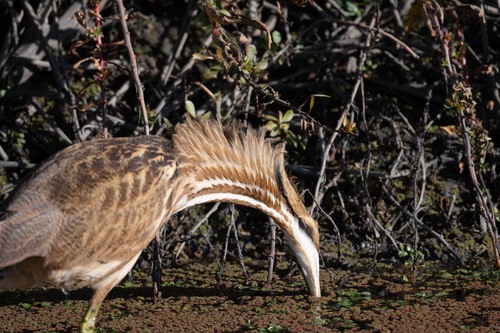
American Bittern (Botaurus lentiginosus) American Bittern
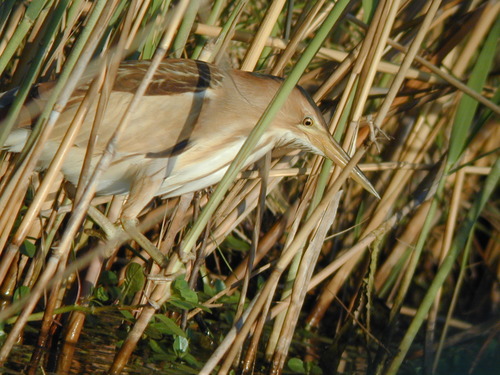
Little Bittern (Botaurus minutus) Little Bittern

Media

Loading…

In short

The most reliable field mark to separate American Bittern from Little Bittern is size: American Bittern is a large, chunky heron, while Little Bittern is much smaller and more delicate, with a dramatically shorter wingspan and body mass. In flight, Little Bittern of all ages shows a pale, oval-shaped forewing panel against otherwise dark wings, while American Bittern’s wings are more uniformly dark with buff or chestnut tips but lack a strong panel. Juvenile Little Bitterns are heavily streaked above and below, but still much smaller than even a young American Bittern. Structure also helps: American Bittern is robust with a thick neck and heavy bill, while Little Bittern is slim and short-necked. Both species are secretive marsh birds, but their size and wing patterns are the best field clues.

Identification tips

  1. Size is the first check: American Bittern is a large heron, much bigger and bulkier than the tiny, delicate Little Bittern. Even at a distance or in flight, this difference is striking.
  2. Wing panel in flight: All ages and sexes of Little Bittern show a pale, pinkish-buff oval panel on the forewing, contrasting with otherwise dark wings. American Bittern lacks this panel; its wings are dark with buff or chestnut tips but no strong contrast.
  3. Underwing color: Little Bittern has a whitish underwing, visible in flight. American Bittern’s underwing is darker and less contrasting.
  4. Plumage streaking: Juvenile and female Little Bitterns are heavily streaked above and below, but American Bittern’s underparts are more finely lined with black, giving a striped effect rather than bold streaks.
  5. Crown and back color: American Bittern has a chestnut brown crown and back with black centers to the feathers. Male Little Bitterns have a glossy black crown and back with a faint green sheen; females are browner and duller.
  6. Neck sides: American Bittern shows a bluish-black elongated patch on the side of the neck (especially in males), which is not present in Little Bittern.
  7. Bill structure: American Bittern has a long, robust, yellowish-green bill; Little Bittern’s bill is long and sharp but appears finer and more delicate relative to head size.
  8. Leg color: Both have yellowish-green legs, not diagnostic.
  9. Behavior when flushed: Little Bittern often makes short, low flights between reedbeds, flashing its pale wing panel. American Bittern is more likely to freeze with bill up or fly with slow, heavy wingbeats.
  10. Voice: A deep, booming call is diagnostic of American Bittern. Little Bittern’s calls are soft and unremarkable.
  11. Habitat and range: American Bittern is only in the Americas; Little Bittern is only in the Old World. If you are in North America, Little Bittern is extremely unlikely except as a rare vagrant.
  12. Sex and age pitfalls: Female and juvenile Little Bitterns are duller and more streaked, but still tiny and show the wing panel. Juvenile American Bitterns look like adults but with less olive on the neck sides.
  13. Jizz: American Bittern appears heavy, thick-necked, and slow-moving. Little Bittern is slim, short-necked, and quick in movement.
  14. Tail and primary projection: Not diagnostic with available notes.
  15. Supercilium and facial pattern: American Bittern shows a buff superciliary stripe and mustachial stripe; Little Bittern’s facial pattern is less marked, especially in males.

Size

American Bittern is much larger: 58–85 cm (23–33 in) in length, with a 92–115 cm (36–45 in) wingspan and a body mass of 370–1,072 g. Little Bittern is tiny by comparison: 33–38 cm (13–15 in) long, with a 52–58 cm (20–23 in) wingspan and a body mass of about 147 g [wikipedia][wikidata]. Even a juvenile American Bittern dwarfs an adult Little Bittern. In the field, this size difference is often obvious even at a distance or in flight.

Plumage

Juvenile and female Little Bitterns are heavily streaked above and below, but always show a pale, pinkish-buff oval forewing panel (formed by inner wing coverts) contrasting with otherwise dark wings; this panel is most obvious in adult males but present in all ages and sexes. The underwing of Little Bittern is whitish. American Bittern, in all plumages, lacks a pale wing panel: its primaries and secondaries are blackish-brown with buff or chestnut tips, and the upperparts are chestnut-brown, barred and speckled with black, giving a more mottled look. American Bittern’s underparts are buff and rust with fine black streaks, creating a striped effect, while Little Bittern males have clean pale buff underparts, and females/juveniles are streaked but paler below. The crown and back of American Bittern are chestnut brown with black centers, while male Little Bitterns have black with a faint green sheen. The sides of the neck in American Bittern show a bluish-black patch (larger in males), not seen in Little Bittern. Juvenile American Bitterns resemble adults but with less olive on the neck sides.

Behaviour

Both species are secretive and prefer to remain hidden in dense marsh vegetation. American Bittern is solitary and often stands motionless with its bill pointed upward, blending into reeds. Little Bittern also skulks in reeds but is more likely to be seen making short, low flights between cover, showing its pale wing panels. American Bittern is more likely to be active at dusk or night, while Little Bittern may be seen during the day, especially when flushed.

Habitat

American Bittern breeds in marshes across Canada and the northern/central United States, wintering in the southern US, Caribbean, and parts of Central America. Little Bittern breeds in European and western Palearctic wetlands, migrating to sub-Saharan Africa for winter. In their respective ranges, both are found in reedbeds and marshes, but American Bittern is strictly Nearctic, while Little Bittern is Old World. Habitat overlap is not expected outside of rare vagrancy.

Voice

American Bittern’s call is a loud, booming series of 'oong, kach, oonk' notes, reminiscent of a congested pump or distant bull. Little Bittern is much quieter, with soft barking or croaking calls, lacking the deep, resonant boom of American Bittern. In the field, hearing a booming call points strongly to American Bittern.

Submit a better description

Use the same sections as the comparison. Your text is published immediately.

The most reliable field mark to separate American Bittern from Little Bittern is size: American Bittern is a large, chunky heron, while Little Bittern is much smaller and more delicate, with a dramatically shorter wingspan and body mass. In flight, Little Bittern of all ages shows a pale, oval-shaped forewing panel against otherwise dark wings, while American Bittern’s wings are more uniformly dark with buff or chestnut tips but lack a strong panel. Juvenile Little Bitterns are heavily streaked above and below, but still much smaller than even a young American Bittern. Structure also helps: American Bittern is robust with a thick neck and heavy bill, while Little Bittern is slim and short-necked. Both species are secretive marsh birds, but their size and wing patterns are the best field clues.

  1. Size is the first check: American Bittern is a large heron, much bigger and bulkier than the tiny, delicate Little Bittern. Even at a distance or in flight, this difference is striking.
  2. Wing panel in flight: All ages and sexes of Little Bittern show a pale, pinkish-buff oval panel on the forewing, contrasting with otherwise dark wings. American Bittern lacks this panel; its wings are dark with buff or chestnut tips but no strong contrast.
  3. Underwing color: Little Bittern has a whitish underwing, visible in flight. American Bittern’s underwing is darker and less contrasting.
  4. Plumage streaking: Juvenile and female Little Bitterns are heavily streaked above and below, but American Bittern’s underparts are more finely lined with black, giving a striped effect rather than bold streaks.
  5. Crown and back color: American Bittern has a chestnut brown crown and back with black centers to the feathers. Male Little Bitterns have a glossy black crown and back with a faint green sheen; females are browner and duller.
  6. Neck sides: American Bittern shows a bluish-black elongated patch on the side of the neck (especially in males), which is not present in Little Bittern.
  7. Bill structure: American Bittern has a long, robust, yellowish-green bill; Little Bittern’s bill is long and sharp but appears finer and more delicate relative to head size.
  8. Leg color: Both have yellowish-green legs, not diagnostic.
  9. Behavior when flushed: Little Bittern often makes short, low flights between reedbeds, flashing its pale wing panel. American Bittern is more likely to freeze with bill up or fly with slow, heavy wingbeats.
  10. Voice: A deep, booming call is diagnostic of American Bittern. Little Bittern’s calls are soft and unremarkable.
  11. Habitat and range: American Bittern is only in the Americas; Little Bittern is only in the Old World. If you are in North America, Little Bittern is extremely unlikely except as a rare vagrant.
  12. Sex and age pitfalls: Female and juvenile Little Bitterns are duller and more streaked, but still tiny and show the wing panel. Juvenile American Bitterns look like adults but with less olive on the neck sides.
  13. Jizz: American Bittern appears heavy, thick-necked, and slow-moving. Little Bittern is slim, short-necked, and quick in movement.
  14. Tail and primary projection: Not diagnostic with available notes.
  15. Supercilium and facial pattern: American Bittern shows a buff superciliary stripe and mustachial stripe; Little Bittern’s facial pattern is less marked, especially in males.

American Bittern is much larger: 58–85 cm (23–33 in) in length, with a 92–115 cm (36–45 in) wingspan and a body mass of 370–1,072 g. Little Bittern is tiny by comparison: 33–38 cm (13–15 in) long, with a 52–58 cm (20–23 in) wingspan and a body mass of about 147 g [wikipedia][wikidata]. Even a juvenile American Bittern dwarfs an adult Little Bittern. In the field, this size difference is often obvious even at a distance or in flight.

Juvenile and female Little Bitterns are heavily streaked above and below, but always show a pale, pinkish-buff oval forewing panel (formed by inner wing coverts) contrasting with otherwise dark wings; this panel is most obvious in adult males but present in all ages and sexes. The underwing of Little Bittern is whitish. American Bittern, in all plumages, lacks a pale wing panel: its primaries and secondaries are blackish-brown with buff or chestnut tips, and the upperparts are chestnut-brown, barred and speckled with black, giving a more mottled look. American Bittern’s underparts are buff and rust with fine black streaks, creating a striped effect, while Little Bittern males have clean pale buff underparts, and females/juveniles are streaked but paler below. The crown and back of American Bittern are chestnut brown with black centers, while male Little Bitterns have black with a faint green sheen. The sides of the neck in American Bittern show a bluish-black patch (larger in males), not seen in Little Bittern. Juvenile American Bitterns resemble adults but with less olive on the neck sides.

Both species are secretive and prefer to remain hidden in dense marsh vegetation. American Bittern is solitary and often stands motionless with its bill pointed upward, blending into reeds. Little Bittern also skulks in reeds but is more likely to be seen making short, low flights between cover, showing its pale wing panels. American Bittern is more likely to be active at dusk or night, while Little Bittern may be seen during the day, especially when flushed.

American Bittern breeds in marshes across Canada and the northern/central United States, wintering in the southern US, Caribbean, and parts of Central America. Little Bittern breeds in European and western Palearctic wetlands, migrating to sub-Saharan Africa for winter. In their respective ranges, both are found in reedbeds and marshes, but American Bittern is strictly Nearctic, while Little Bittern is Old World. Habitat overlap is not expected outside of rare vagrancy.

American Bittern’s call is a loud, booming series of 'oong, kach, oonk' notes, reminiscent of a congested pump or distant bull. Little Bittern is much quieter, with soft barking or croaking calls, lacking the deep, resonant boom of American Bittern. In the field, hearing a booming call points strongly to American Bittern.

Discard your changes?

You have unsaved edits. If you leave now, those changes will be lost.

American Bittern · Little Bittern · My Tricky Birds