

Amazonian Antshrike vs Cliff Flycatcher
Thamnophilus amazonicus versus Hirundinea ferruginea
Play a quiz with Amazonian Antshrike and Cliff Flycatcher
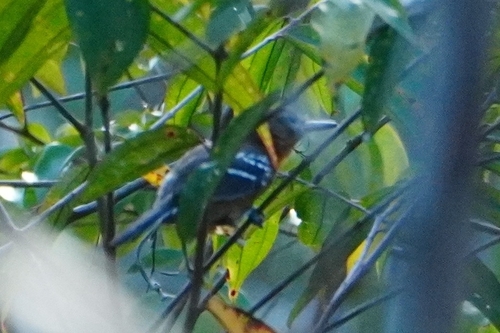 Amazonian Antshrike
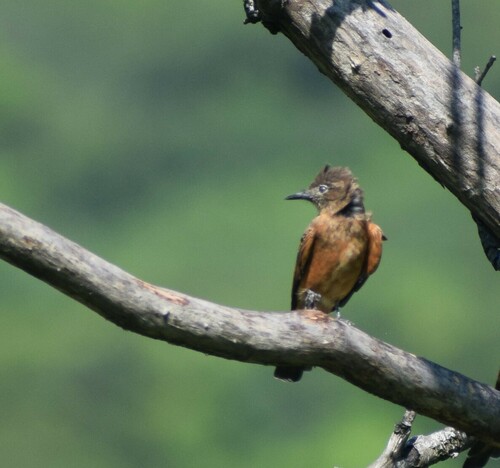 Cliff Flycatcher
In short
The most reliable field mark to separate Amazonian Antshrike from Cliff Flycatcher is the distinctive rufous and orange in the wings and underparts of the flycatcher, visible even in flight, versus the sexually dimorphic, barred and spotted black/gray or rufous/olive pattern of the antshrike. Juvenile Cliff Flycatchers resemble adults but are paler, while female Amazonian Antshrikes are bright rufous-crowned and olive-backed, and males are gray and black with white wing spots. Structurally, Cliff Flycatcher is larger, longer-tailed, and perches upright on exposed sites, while Amazonian Antshrike is more compact and skulking. Habitat and behavior also differ: antshrikes are thicket dwellers, while flycatchers favor open perches on cliffs or buildings.
Identification tips
- Orange wing panel (Cliff Flycatcher): In all ages and sexes, Cliff Flycatcher shows bright orange bases to the primaries and secondaries, visible as a bold orange flash in flight and as orange edges to folded wings when perched. Amazonian Antshrike never shows this mark; its wing spots are white, not orange.
- Underpart color: Cliff Flycatcher has rich cinnamon-rufous underparts (adults and juveniles), while Amazonian Antshrike males are gray below and females are yellowish red-brown to buff, never as uniformly rufous as the flycatcher.
- Sexual dimorphism (Antshrike): Amazonian Antshrike is strongly dimorphic: males are black and gray with white spots, females have a rufous crown and olive back. Cliff Flycatcher sexes are alike.
- Crown and head pattern: Female Amazonian Antshrike has a bright rufous crown, unlike the brown crown and whitish supercilium of Cliff Flycatcher. Male antshrikes have a black or gray crown, never a supercilium.
- Back and upperparts: Cliff Flycatcher is uniformly brown above, sometimes with orange-brown rump or tail base in some subspecies. Amazonian Antshrike males have black or gray backs with a gray rump and a hidden white scapular patch; females are deep olive above.
- Tail pattern: Antshrike has black tail with white tips and spots (both sexes, though less so in some subspecies/females), while Cliff Flycatcher has a plain brown to sooty black tail, sometimes with rufous inner webs but never with white spots or tips.
- Bill shape: Antshrike has a heavy, hooked bill (shrike-like), while Cliff Flycatcher has a broad-based, flat flycatcher bill, more suited to aerial insect hunting.
- Perching behavior: Cliff Flycatcher often perches upright and conspicuously on open sites (cliffs, wires, buildings), while antshrike stays low or mid-level, hidden in dense foliage.
- Foraging style: Cliff Flycatcher sallies out in long, gliding flights to catch insects in the air, returning to the same perch. Antshrike gleans insects from leaves and branches, rarely sallying far.
- Habitat context: Dense forest or tangled thickets point to antshrike; open rocky areas, cliffs, or urban structures point to flycatcher.
- Size and jizz: Cliff Flycatcher is larger, longer-tailed, and more elongated in posture; antshrike is smaller, more compact, and rounder.
- Group behavior: Cliff Flycatcher may be seen in pairs or family groups, sometimes in the open; antshrike is usually single or in pairs, often in mixed flocks, but always in cover.
- Juvenile confusion: Juvenile Cliff Flycatchers look like duller adults but retain the orange wing panel and rufous underparts. Juvenile antshrikes are not described in detail but would show the same sexual dimorphism and lack orange in the wings.
- Supercilium: Cliff Flycatcher has a whitish supercilium; antshrike lacks this feature in all plumages.
- Voice: Not diagnostic with current information.
Size
Cliff Flycatcher is distinctly larger, measuring 15.5–18.5 cm in length and weighing 21–42 g, compared to Amazonian Antshrike's 14–15 cm and 17–21 g. The flycatcher has a longer tail and a more robust, upright stance, while the antshrike is more compact with a shorter tail and a heavier, hooked bill. These differences are most apparent when both species are seen perched side by side, but even singly, the flycatcher's larger, more elongated silhouette and longer tail are notable.
Plumage
Juvenile and adult Cliff Flycatchers of both sexes show a consistent pattern: brown upperparts, a whitish supercilium, and, most distinctively, bright orange bases to the primaries and secondaries, creating a striking orange flash in the wing in flight. Their underparts are rich cinnamon-rufous. Juveniles are similar but paler and duller. In contrast, Amazonian Antshrike is sexually dimorphic: adult males are black and gray with white spots on the wings and tail, and gray underparts; females have a bright rufous crown, deep olive back, and yellowish red-brown underparts with a buff belly. Both sexes have white spots or tips on the wings and tail, but never the extensive orange or rufous of the flycatcher. Subspecies of antshrike vary in darkness and tone, but none approach the flycatcher's orange wing panel or uniform rufous underparts.
Behaviour
Cliff Flycatcher typically perches conspicuously on open ledges, wires, or buildings, often sallying out in long, swallow-like flights to catch insects and returning to the same perch. It is fearless and often found in pairs or small groups. Amazonian Antshrike, by contrast, is a skulker of dense thickets and vine tangles, foraging quietly in the midstory or understory, often as part of mixed-species flocks. It hops and lunges for prey, rarely perching in the open.
Habitat
Amazonian Antshrike is a bird of dense lowland forest, thickets, and vine tangles, typically found in the Amazon basin and adjacent regions, always in wooded or shrubby habitats. Cliff Flycatcher is associated with open, rocky habitats such as cliffs, road cuts, and urban buildings, often far from dense forest. Seeing a bird perched on a cliff face or urban structure strongly favors Cliff Flycatcher; seeing a bird deep in tangled vegetation strongly favors Amazonian Antshrike.