

Alpine Chough vs Common Raven
Pyrrhocorax graculus versus Corvus corax
Play a quiz with Alpine Chough and Common Raven
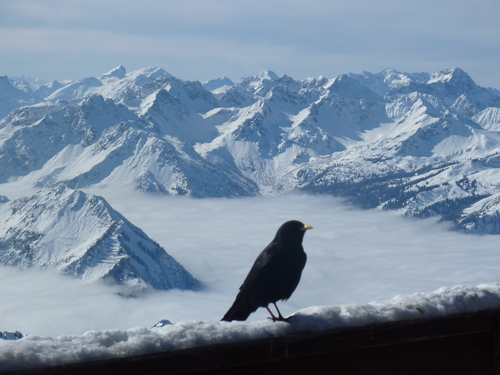 Alpine Chough
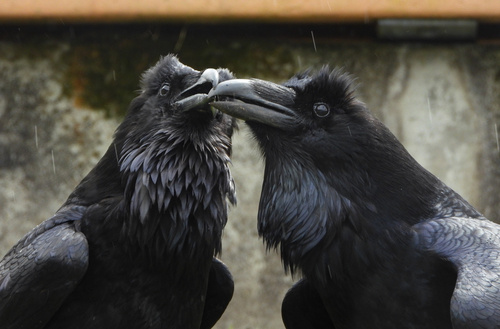 Common Raven
In short
The most reliable field mark separating Alpine Chough from Common Raven is the bill: Alpine Chough has a short, slender, bright yellow bill, while the raven’s is massive, heavy, and black. In flight, Alpine Choughs show a proportionally longer, more rounded tail and shorter wings, with a buoyant, acrobatic flight style, compared to the raven’s long, wedge-shaped tail and broad, stable wings. Both are glossy black, but ravens are much larger and have shaggy throat feathers. Juvenile Alpine Choughs are duller with a yellow bill, while juvenile ravens have a duller black and a blue-grey iris. Calls are also distinctive: Alpine Choughs give high, whistled notes, while ravens produce deep croaks.
Identification tips
- Bill color and shape: Alpine Chough’s bill is short, slender, and bright yellow in all ages (duller in juveniles); Common Raven’s is massive, heavy, and black. This is the single most reliable field mark at any distance.
- Tail shape in flight: Alpine Chough has a longer, more rounded or square-tipped tail; Common Raven’s tail is longer, strongly wedge-shaped, and more graduated. Watch for this especially in soaring or gliding birds.
- Wing shape and flight style: Alpine Chough’s wings are shorter and less rectangular, with a buoyant, acrobatic flight and frequent tail fanning; Raven’s wings are broad, with stable, powerful soaring and less frequent flapping.
- Size: Ravens are much larger and bulkier, with a wingspan nearly twice that of Alpine Chough. If seen together, the difference is unmistakable, but beware of lone birds at a distance.
- Leg color: Alpine Chough has red legs (brownish in juveniles), while the raven’s legs are black. Leg color can be hard to see unless perched or at close range.
- Throat feathers: Ravens have shaggy, pointed throat feathers (especially when calling or displaying), while Alpine Chough’s throat is smooth.
- Juvenile features: Juvenile Alpine Choughs are duller black with a dull yellow bill and brownish legs; juvenile ravens are duller with a blue-grey iris and pinkish gape. Bill color remains a key separator.
- Plumage gloss: Both are glossy black, but this is not a reliable separator in the field.
- Voice: Alpine Choughs give high-pitched, whistled calls; ravens produce deep croaks. If you hear a musical, rippling call, it is a chough; a deep croak is a raven.
- Habitat: Alpine Choughs are almost always in high mountain habitats above the treeline; ravens occur in a much broader range of habitats, including lowlands.
- Social behavior: Alpine Choughs are often seen in flocks, especially outside the breeding season; ravens are usually solitary or in pairs, except for subadult communal roosts.
- Perched posture: Ravens appear heavier, with a thick neck and large head; Alpine Choughs are slimmer and more delicate overall.
- Flight agility: Alpine Choughs are highly maneuverable, often performing aerial acrobatics; ravens are agile but tend to soar more steadily and for longer periods.
- Iris color (juveniles): Juvenile ravens have a blue-grey iris; Alpine Choughs have dark brown irises at all ages.
- Contextual clues: In Europe and Asia, if you see a glossy black corvid with a yellow bill above the treeline, it is an Alpine Chough. If the bill is black and the bird is huge, it is a raven.
Size
Common Raven is vastly larger: body length averages about 66 mm (likely a typo in the source; actual field guides list 54–71 cm), and mass is about 947 g, making it one of the heaviest passerines. Alpine Chough is much smaller, at 37–39 cm length and 188–252 g. The raven’s wingspan (116–153 cm) dwarfs the chough’s (75–85 cm). Even at a distance, the raven’s bulk, long wedge-shaped tail, and heavy bill stand out, while Alpine Chough is noticeably lighter and more agile in flight.
Plumage
- Juvenile/immature birds: Juvenile Alpine Choughs are duller black with a dull yellow bill and brownish legs; juvenile ravens are also duller than adults, with a blue-grey iris and a pinkish gape at first. No distinctive upperwing pattern is described for either species at any age, so focus on structure and bill color for young birds.
- Adults: Both are glossy black overall, but Alpine Chough has a short, slender yellow bill and red legs, while the raven has a massive black bill, shaggy throat feathers, and a wedge-shaped tail. Raven’s plumage may show pale bases to neck feathers (rarely visible in the field). Sexes are identical in both species.
- In flight: Alpine Chough has less rectangular wings and a longer, more rounded tail; the raven’s tail is longer and wedge-shaped, and the wings are broader and more stable in soaring.
Behaviour
Alpine Choughs are highly aerial, performing acrobatic, buoyant flights with loose, deep wingbeats, often seen soaring and maneuvering near cliffs. Ravens are also agile but tend to soar more stably with less flapping, using their bulk and broad wings for long glides. Alpine Choughs are more social, often in flocks, especially outside breeding season, while ravens are usually seen singly or in pairs, with subadults sometimes roosting communally but foraging alone.
Habitat
Alpine Choughs are strictly birds of high mountains, breeding and foraging above the treeline from Spain through Central Asia, and are rarely seen away from alpine or subalpine habitats. Common Ravens are habitat generalists, found from mountains to lowlands, forests, tundra, and even deserts across the Northern Hemisphere. If you are below the treeline or in lowland areas, a raven is far more likely.
Voice
Alpine Choughs give high-pitched, whistled calls ("preep" and "sweeeooo"), quite unlike any crow or raven, and also have rolling churrs and quiet warbles. Common Ravens produce deep, resonant croaks, much lower and more sonorous than any chough call. The difference is obvious with experience: choughs sound high and musical, ravens deep and guttural.