

African Desert Warbler vs Asian Desert Warbler
Curruca deserti versus Curruca nana
Play a quiz with African Desert Warbler and Asian Desert Warbler
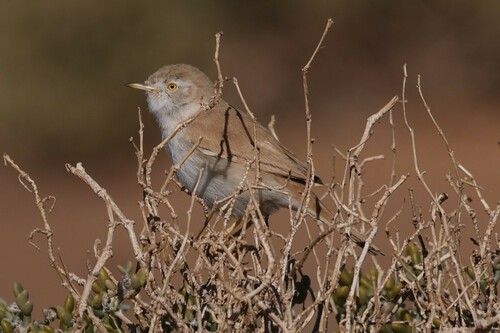 African Desert Warbler
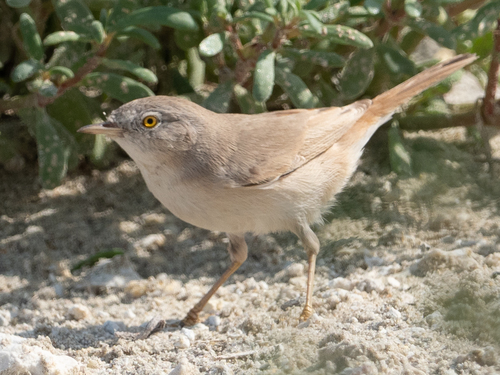 Asian Desert Warbler
In short
The most reliable field mark between African Desert Warbler and Asian Desert Warbler is overall coloration: African is distinctly more yellowish or sandy, while Asian is colder grey-brown above. Both are tiny, pale warblers with yellowish bills, legs, and irises, and are extremely similar in size and structure. No distinctive age-specific upperwing or flight pattern is documented for either species, so separation relies on subtle differences in plumage tone, especially on the upperparts and tail. Voice, structure, and habitat overlap considerably, so careful attention to color is essential.
Identification tips
- Overall upperpart color is the primary field mark: African Desert Warbler is noticeably more yellowish or sandy above, while Asian Desert Warbler is colder, pale grey-brown. This is consistent across all ages and sexes.
- Tail and wing color: Asian Desert Warbler shows browner wings and tail contrasting with greyer back, while African Desert Warbler is more evenly sandy-yellow throughout.
- Underparts: Both are whitish below, so this is not useful for separation.
- Bill, legs, and iris: Both species have yellowish bills and legs, and yellow irises. Do not use these features for separation.
- Size: African is slightly smaller, but this is not discernible in the field.
- Sex and age: Sexes are alike in both; no distinctive juvenile or immature upperwing patterns are reported for either, so age is not a separator.
- Flight and perched jizz: Both are small, active warblers with similar structure and behavior; neither shows distinctive flight patterns or wing markings.
- Habitat: Both use arid, bushy desert; do not rely on habitat unless you are far outside the known range of one species.
- Voice: Asian Desert Warbler's song is described as a jingly mix of clear and harsh notes, often given in flight. If you hear this, it may support Asian, but absence of song is not helpful.
- Pitfalls: In poor light or at distance, the subtle difference in upperpart tone can be masked by dust or sun angle. Try to view the bird in good light and compare to nearby sand or vegetation for context.
- Context: If you are in central or western Asia, Asian Desert Warbler is expected; in North African deserts, African Desert Warbler is the default. In northeast Africa (Red Sea coast), both may occur, so careful plumage assessment is needed.
- Feeding behavior: Both species feed on the ground and in low bushes; do not use this for separation.
- Confusion with other warblers: Both can resemble female Common Whitethroat, but that species is larger, with different structure and facial pattern.
- No reliable separation by molt or seasonal plumage: Both species retain their basic color differences year-round.
- Summary tip: Always prioritize overall upperpart tone—warm sandy-yellow for African, cold pale grey-brown for Asian—when separating these two in the field.
Size
African Desert Warbler is marginally the smallest in the genus at 11–12 cm and 7–10 g, while Asian Desert Warbler is just slightly larger at 11.5–12.5 cm. In the field, this difference is negligible and not a reliable separation point. Both appear as tiny, delicate warblers with similar proportions.
Plumage
No age-specific upperwing or flight pattern differences are documented for either species; juveniles and adults of both show similar wing and tail structure and lack bold panels or contrasting marks. The key plumage difference is in the overall tone of the upperparts: African Desert Warbler of all ages is pale sandy yellow-brown above and whitish below, giving a warm, yellowish impression. Asian Desert Warbler is pale grey-brown above with browner wings and tail, and also whitish below, resulting in a colder, greyer look. Both have yellowish bills, legs, and yellow irises. Sexes are alike in both species.
Behaviour
Both species are ground-feeding warblers, often seen foraging low in sparse desert vegetation. Asian Desert Warbler is noted as especially likely to feed on the ground, but this is not a strong separator as African Desert Warbler does so as well. Both are active and may perch on low shrubs.
Habitat
Habitat is not a reliable separator where ranges overlap or on migration: both species breed in arid, sparsely vegetated desert or semi-desert with some bushes for nesting. Asian Desert Warbler breeds in central and western Asia and winters into northeast Africa, while African Desert Warbler is resident in North African deserts. In areas of potential overlap (northeast Africa), habitat alone is not diagnostic.
Voice
Asian Desert Warbler has a distinctive jingly song with clear and harsh notes, often delivered in flight. No specific vocal differences are described for African Desert Warbler in the provided sources, so voice is not a reliable separator based on current information.
African Desert Warbler · Asian Desert Warbler · My Tricky Birds