

Abdim's Stork vs White Stork
Ciconia abdimii versus Ciconia ciconia
Play a quiz with Abdim's Stork and White Stork
 Abdim's Stork
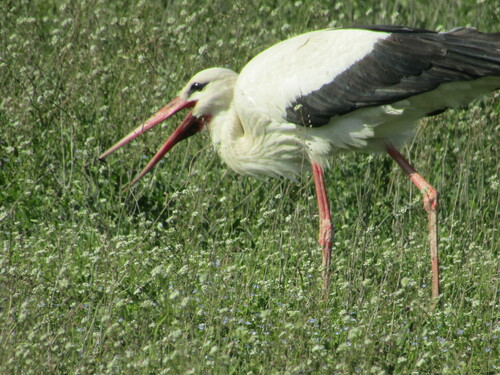 White Stork
In short
The most reliable field mark to separate Abdim's Stork from White Stork is overall coloration: Abdim's is a much smaller, mostly black stork with white belly and red facial skin, while White Stork is a much larger bird with almost entirely white plumage except for black wings. In flight or at rest, White Stork’s long red bill and legs stand out, contrasting with Abdim’s shorter grey bill and grey legs with red knees and feet. If you see a stork with extensive black on the body and a white belly, especially if it looks small and delicate, it is Abdim’s; a big, mostly white stork with black wings is White Stork. These differences hold true for all ages in the field, as neither species has confusing immature wing patterns. Size and structure are also key: White Stork is nearly half again as long and much heavier than Abdim’s.
Identification tips
- Overall coloration: Abdim's Stork is mostly black with a white belly and underparts; White Stork is almost entirely white except for black wings. This is the fastest way to distinguish them at any distance.
- Bill color and shape: Abdim’s has a grey bill that is shorter and less pointed; White Stork has a long, pointed, bright red bill. Bill color is especially obvious at close range or in good light.
- Leg color: Abdim’s has grey legs with red knees and feet; White Stork has long, bright red legs. Leg color is visible both in flight and when perched.
- Facial skin: In breeding season, Abdim’s shows red facial skin in front of the eye and blue near the bill, a feature never shown by White Stork.
- Size: White Stork is much larger and heavier, with a longer neck and legs. If you see a stork that looks small and delicate, it is almost certainly Abdim’s.
- Flight profile: White Stork flies with long neck and legs extended, appearing large and stately. Abdim’s, being smaller, looks more compact and less elongated in flight.
- Plumage in flight: White Stork shows white body and underwings with black only on the flight feathers; Abdim’s shows a mostly dark body with white belly, making the bird look much darker overall.
- Perched appearance: White Stork is tall, upright, and mostly white; Abdim’s is shorter, darker, and often shows a clear white belly patch against black.
- Habitat context: In Sub-Saharan Africa, Abdim’s is more likely in open grasslands; White Stork is more likely in cultivated fields or near settlements.
- Seasonal marks: Only Abdim’s develops blue and red facial skin in breeding season. White Stork’s bare parts remain red year-round.
- No confusing juvenile wing patterns: Both species lack distinctive immature upperwing marks that could cause confusion; the main adult field marks apply to all ages.
- Group behavior: Abdim’s is more likely to be seen in flocks, especially when foraging for insects; White Stork can also be gregarious, but is often seen singly or in pairs, especially near nests.
- Jizz: White Stork’s size and upright stance are distinctive; Abdim’s looks smaller, with a less imposing posture.
- Bill and leg length in flight: White Stork’s bill and legs project well beyond the body, giving a stretched appearance; Abdim’s proportions are shorter overall.
- When in doubt: If you see a stork that appears mostly black with a white belly, it is Abdim’s; if it is mostly white with black wings, it is White Stork. Use size and bare part color as secondary checks.
Size
Abdim's Stork is the smallest stork species, measuring about 73 cm (29 in) and weighing just over 1 kg (2.2 lb) [wikipedia]. In contrast, White Stork is much larger, averaging 100–115 cm (39–45 in) in length with a wingspan of 155–215 cm (61–85 in) [wikipedia]. White Stork is also considerably heavier. In the field, White Stork will look tall, long-necked, and robust, while Abdim’s appears more slender and compact. Size alone is often diagnostic if both species are seen together.
Plumage
Both species have contrasting black and white plumage, but the distribution is very different and consistent across ages. Abdim's Stork is mostly black with a white belly and underparts, and in breeding season shows red facial skin and blue near the bill. Its legs are grey with red knees and feet, and the bill is grey. White Stork, by contrast, is almost entirely white except for the black on the wings. Its legs and long, pointed bill are bright red. There are no confusing juvenile or immature wing patterns reported for either species; the main differences are present in all plumages visible in the field.
Behaviour
Both species are typical storks in their movements and feeding, but White Stork is more likely to be seen in open fields, on rooftops, or soaring high on thermals. Abdim’s Stork is often seen in open habitats, foraging for insects, and may be found in flocks. In flight, White Stork appears larger, with slower, more powerful wingbeats and a longer, more extended neck and legs. Abdim’s Stork, being smaller, may appear more agile and less imposing in the air.
Habitat
Abdim’s Stork is found widely in open habitats in Sub-Saharan Africa and Yemen, preferring grasslands and savannas [wikipedia]. White Stork is more widespread across Europe, parts of Asia, and Africa, and is often found in open fields, wetlands, and even urban areas. In areas of overlap (mainly Africa), White Stork is more likely in agricultural or human-modified landscapes, while Abdim’s is more strictly associated with open, natural grasslands.