Motmot

Bird course · Lesson 2 · 10 minutes

At the pond

Five birds of every park pond and canal

Today we walk to the pond in the park. Britain is full of water, and the five birds in this lesson live on almost all of it: from the canal in town to the lake in the country park.

Water birds are the perfect place to train your eye. They are big, they sit still, and they let you look closely. We start with the most familiar duck in the country and end with a bird that can stand still for half an hour.

At the end there's a quiz of eight questions, with two birds from last week mixed in.

Today: 5 birds

Bird 1 of 5

Mallard

Anas platyrhynchos

How to recognise it

  • Shiny green head
  • Thin white neck ring
  • Yellow bill, and a little black curl on the tail
bill The beak.

Where and when

Every pond, canal and ditch, all year.

Call The famous "quack" is the female; the male gives a soft, nasal "rhaeb". Recording: Xavier Riera · xeno-canto

Ducks with odd white patches in parks are usually farmyard Mallards. Leave them for later. The brown female comes in week 5.

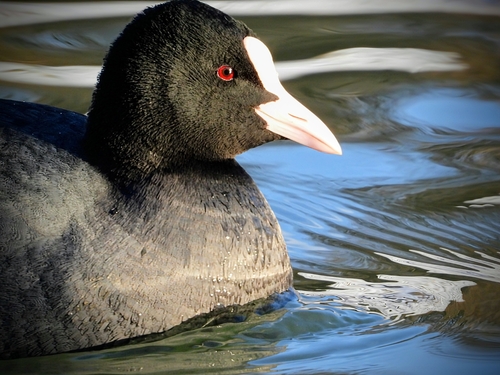
Coot, adult adult
Photo: Paweł Sułkowicz · CC BY-NC

Bird 2 of 5

Coot

Fulica atra

How to recognise it

  • All black, round body
  • White bill and white frontal shield
  • Dives and pops back up like a cork
bill The beak.
frontal shield A bare, coloured plate above the bill.

Where and when

Open water, often in groups in winter. Quarrels loudly in spring.

Call A short, sharp "kowp!", like a cork leaving a bottle. Recording: Agris Celmins · xeno-canto
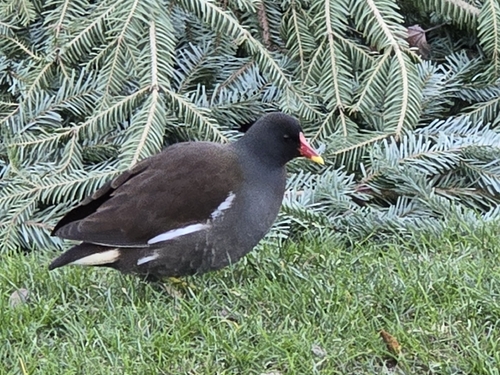
Moorhen, adult adult
Photo: Angi K. · CC BY-NC

Bird 3 of 5

Moorhen

Gallinula chloropus

How to recognise it

  • Red frontal shield and bill with a yellow tip
  • White line along the flank
  • Flicks its white undertail as it walks
frontal shield A bare, coloured plate above the bill.
flank The side of the body, below the wing.
undertail The feathers under the tail.

Where and when

Edges of ditches and ponds, often on the grass. Nods its head while swimming.

Call A sudden, gurgling "kurruk" from the reeds. Recording: Dominique Guillerme · xeno-canto

Coot or Moorhen?

CootCoot
MoorhenMoorhen

Look at the face. White shield: Coot. Red shield with a yellow tip: Moorhen. The Moorhen also has that white line along its side and walks on the grass much more.

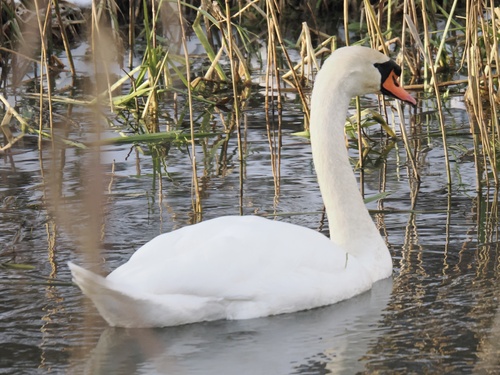
Mute Swan, adult adult
Photo: engelbertwaldmann · CC BY-NC

Bird 4 of 5

Mute Swan

Cygnus olor

How to recognise it

  • Big and all white
  • Orange bill with a black knob at the base
  • Swims with the neck in an elegant S-curve
bill The beak.

Where and when

Rivers, canals, lakes and flooded fields, all year.

Sound Not a voice: listen to the throbbing "wing-wing-wing" of its wings in flight. Recording: Stanislas Wroza · xeno-canto

Grey-brown swans are this year's young: week 5.

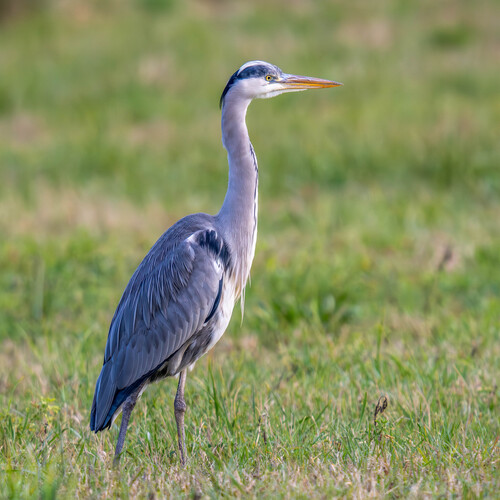
Grey Heron, adult adult
Photo: Lluís Amat · CC BY-NC

Bird 5 of 5

Grey Heron

Ardea cinerea

How to recognise it

  • Tall and grey, with a long neck and legs
  • Black stripe from the eye ending in a thin plume
  • Flies with the neck pulled in, legs sticking out behind

Where and when

Stands motionless at the water's edge, in fields, and beside garden fish ponds.

Call A loud, hoarse "fraank" in flight. Recording: Joost van Bruggen · xeno-canto

Quiz

8 questions, with a few birds from earlier lessons mixed in. Your answers stay in this browser.

Out and about this week

Walk past a pond or canal. Coots or Moorhens: which do you see more? Find a heron and time how long it stands still.