Motmot

Bird course · Lesson 1 · 10 minutes

Your first five

Garden birds you can see from your window

We're taking a look in the back garden. Make a coffee, sit by the window and look outside. There's a good chance that within ten minutes you'll see at least three of the five birds in this lesson. They live all over Britain, all year round, and nearly all of them visit gardens.

In this lesson you learn to recognise five birds. For each bird you get three things to look for. Words in bold are parts of a bird; you'll find what they mean right there on the card. For the Blackbird and the House Sparrow we only look at the male; the females look very different and get their own lesson in week 5.

At the end of the lesson there's a short quiz of eight questions.

Today: 5 birds

Blackbird, adult male adult male
Photo: codrin_bucur · CC BY

Bird 1 of 5

Blackbird

Turdus merula

How to recognise it

  • All black
  • Orange-yellow bill
  • Yellow eye-ring
eye-ring A ring of bare skin or feathers around the eye.

Where and when

Lawns and borders everywhere. Hops, stops, tilts its head and listens for worms.

Song Slow, relaxed, fluting phrases from a rooftop or treetop, at dawn and dusk from February to July. Recording: Marc Anderson · xeno-canto

Only the male is black. A brown "blackbird" is a female: week 5.

Don’t confuse with: Starling (week 4): shorter tail, speckled, walks instead of hopping.

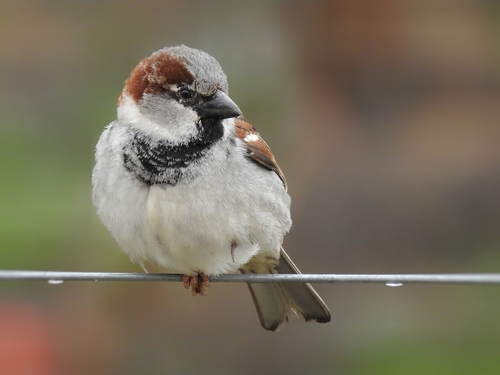
House Sparrow, adult male adult male
Photo: quilicotriste · CC BY

Bird 2 of 5

House Sparrow

Passer domesticus

How to recognise it

  • Grey crown
  • Black bib
  • Chestnut-brown sides of the head
crown The top of the head.
bib A dark patch on the throat.

Where and when

Always near houses, in noisy groups. Chirps from hedges and gutters, and bathes in dust.

Call Endless "chilp, chilp" chirping from a hedge full of sparrows. Recording: Esperanza Poveda · xeno-canto

There are far fewer than there were 40 years ago, but you can still find them in most towns and villages.

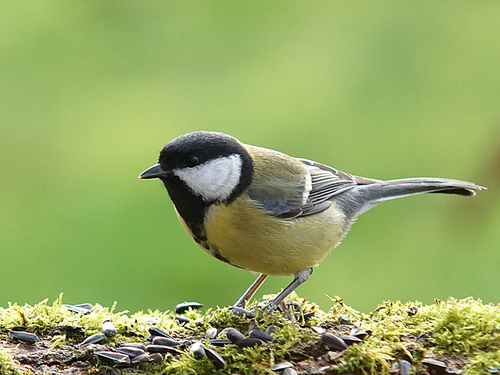
Great Tit, adult adult
Photo: sylvainm_53 · CC BY

Bird 3 of 5

Great Tit

Parus major

How to recognise it

  • Black head with white cheeks
  • Yellow breast with a black stripe down the middle, like a tie
  • Bigger than a Blue Tit
cheek The side of the face, below the eye.
breast The front, between throat and belly.

Where and when

Gardens, parks and woods. One of the most regular visitors to a peanut feeder.

Song A loud, see-sawing "tea-cher, tea-cher", already from January. Recording: Joost van Bruggen · xeno-canto

Tip: a broad tie running down between the legs is a male; a thin one that stops halfway is a female.

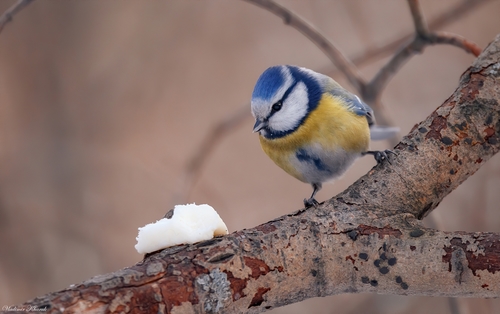
Blue Tit, adult adult
Photo: vladimirkharuk · CC BY

Bird 4 of 5

Blue Tit

Cyanistes caeruleus

How to recognise it

  • Blue crown
  • White face with a dark line through the eye
  • Small, yellow underneath, blue wings
crown The top of the head.

Where and when

Gardens and woods, hanging upside down on thin twigs and feeders.

Song A high "tsee-tsee-tsirrrr": two thin notes and a trill. Recording: Paul Kelly · xeno-canto

Great Tit or Blue Tit?

Great TitGreat Tit
Blue TitBlue Tit

Look at the head first. Black cap: Great Tit. Blue cap: Blue Tit. The Great Tit is also clearly bigger and has the black tie.

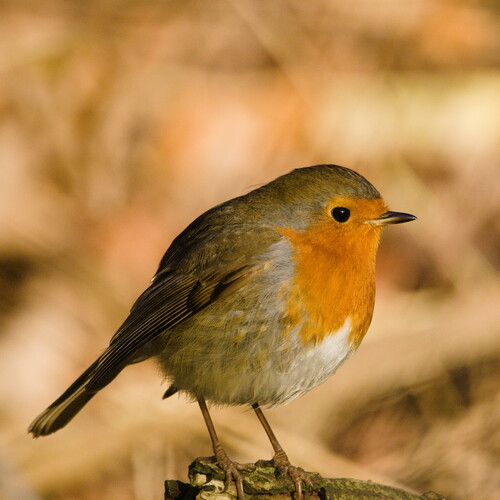
Robin, adult adult
Photo: larib-bonvier · CC BY-NC

Bird 5 of 5

Robin

Erithacus rubecula

How to recognise it

  • Orange face and breast
  • Grey border around the orange
  • Round, with a plain brown back
breast The front, between throat and belly.

Where and when

Alone, never in groups. Follows gardeners for worms, and sings in autumn and winter too.

Young Robins in summer are brown with pale spots and no orange at all: week 5.

Quiz

8 questions. Your answers stay in this browser.

Out and about this week

Spend ten minutes at a window this week. Which of the five do you see? Write them down. Bonus: look at every Blackbird. Is one of them brown? Then you have already found a female.